Google Ads Campaigns can spend money very quickly. That is useful when they generate profitable enquiries, but painful when clicks arrive without real business.
The difficult part is identifying why money is being wasted.
Not every expensive click is bad. Not every low CPL is good. And not every poor lead is click fraud.
Most waste in Google Ads Campaigns falls into three areas:
- Invalid traffic: Automated, accidental or manipulative interactions.
- Poor intent: Real people clicking who are unlikely to become customers.
- Broken tracking: Good or bad activity being measured incorrectly.
Each problem needs a different solution.
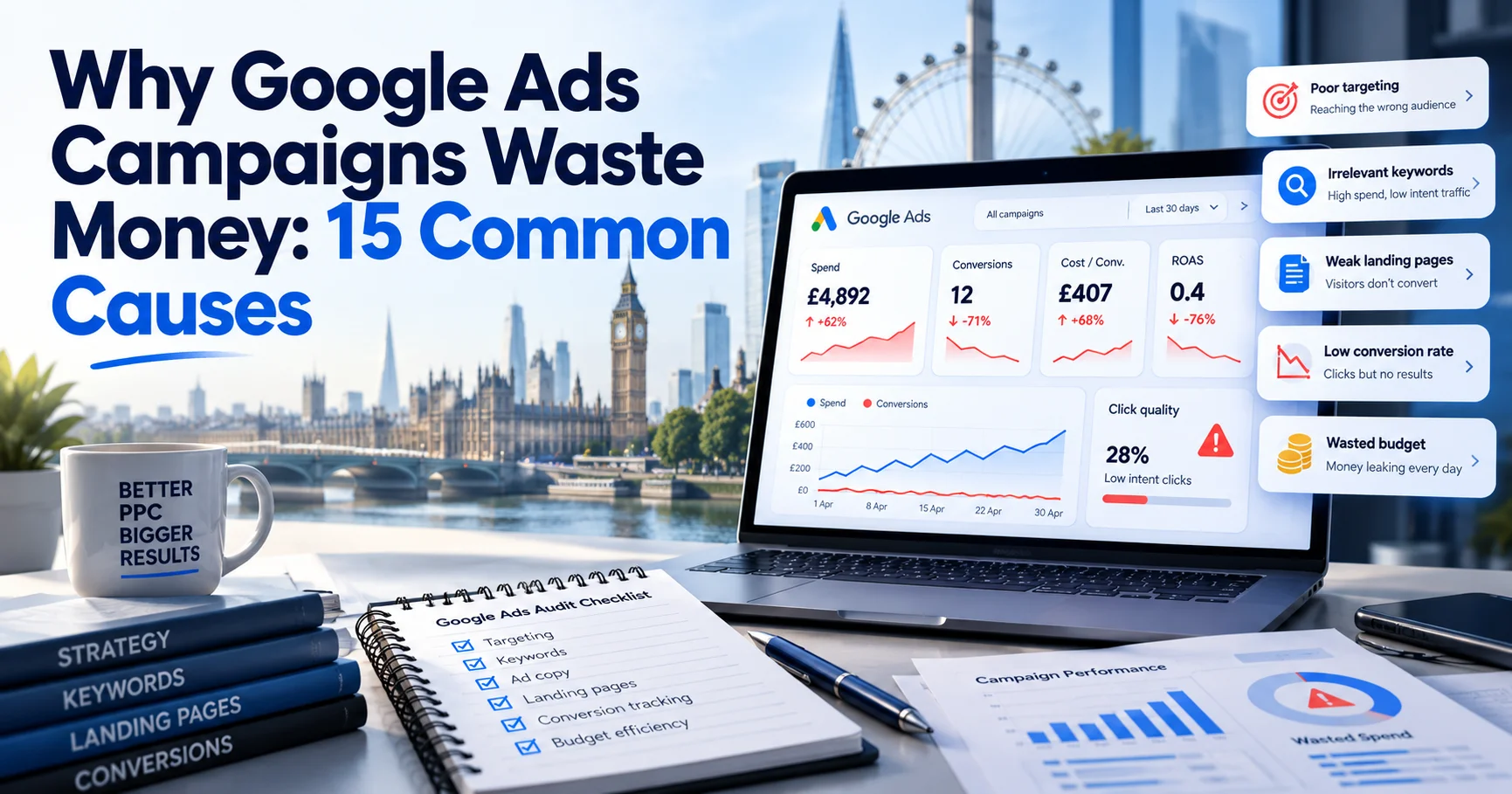
This guide covers 15 common reasons Google Ads Campaigns waste money and what to check before simply reducing your budget.

First, Diagnose Why Your Google Ads Campaigns Are Wasting Money
Before changing bids or keywords, identify the type of problem.
| What You See | Check First |
| Strange bursts of clicks | Invalid traffic |
| Real visitors but poor enquiries | Search intent |
| Leads happen but are not recorded | Conversion tracking |
| Many reported conversions but weak sales | Conversion quality |
| Spend comes from unsuitable areas | Location targeting |
| Clicks arrive but few enquiries follow | Landing page |
| Strong campaigns lack budget | Budget allocation |
Google explains that invalid traffic may include automated, accidental or manipulative interactions. Detected invalid interactions are generally filtered from advertiser charges.
A genuine person searching for the wrong thing is different.
That is usually a targeting problem.
1. Google Ads Campaigns Are Targeting the Wrong Search Terms
One of the biggest sources of wasted spend is poor search intent.
Imagine a London locksmith targeting:
locksmith London
The campaign may also appear for:
- locksmith jobs;
- locksmith training;
- DIY lock repair;
- key-cutting products;
- locksmith tools.
These are genuine searches, but they do not match the company’s commercial goal.
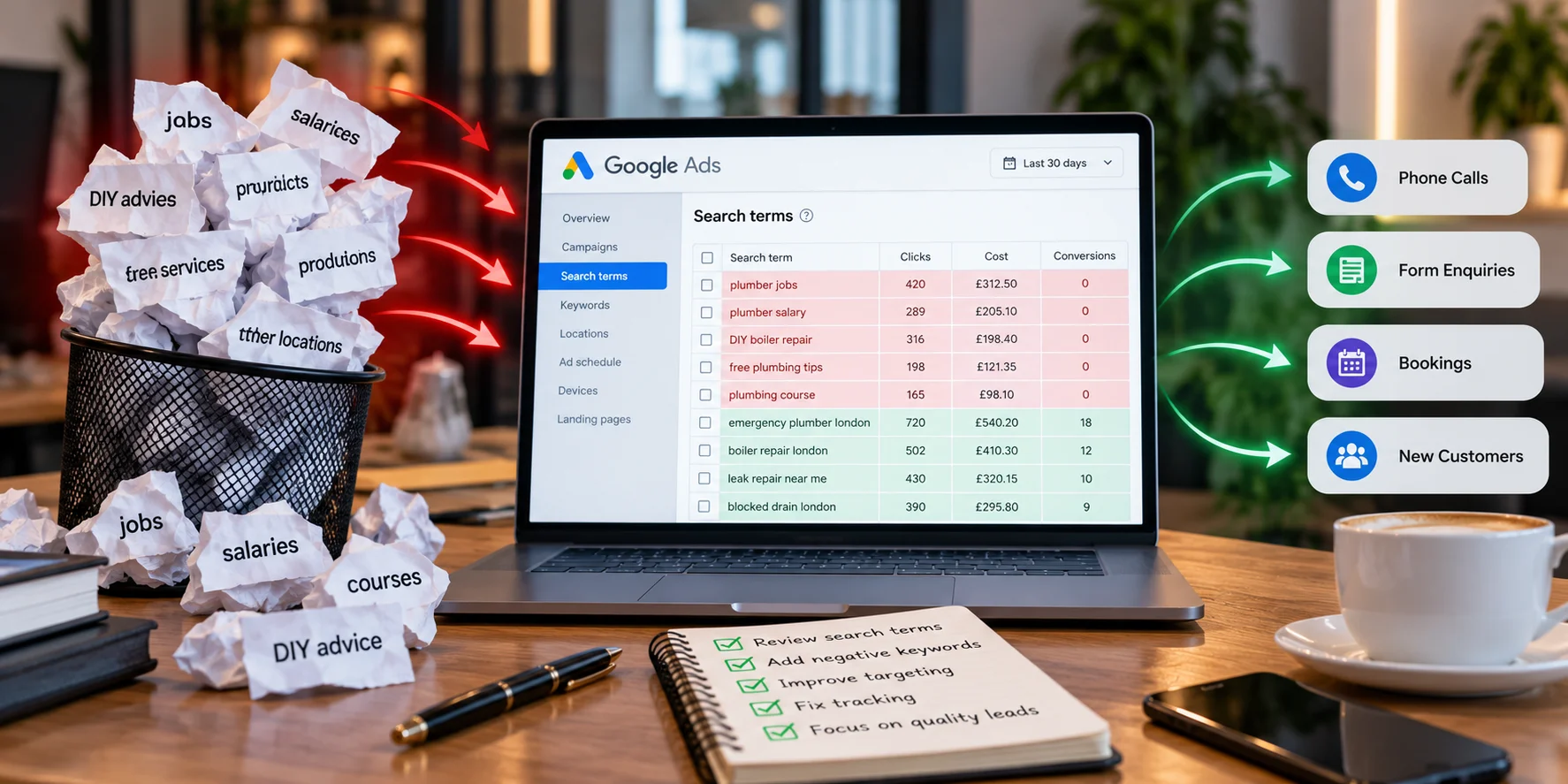
Google’s Search terms report shows the actual searches that triggered your ads. Use it to identify irrelevant queries, discover useful keyword opportunities and find searches that may need adding as negative keywords.
Do not review keywords alone.
Review the real search queries behind your Google Ads Campaigns.
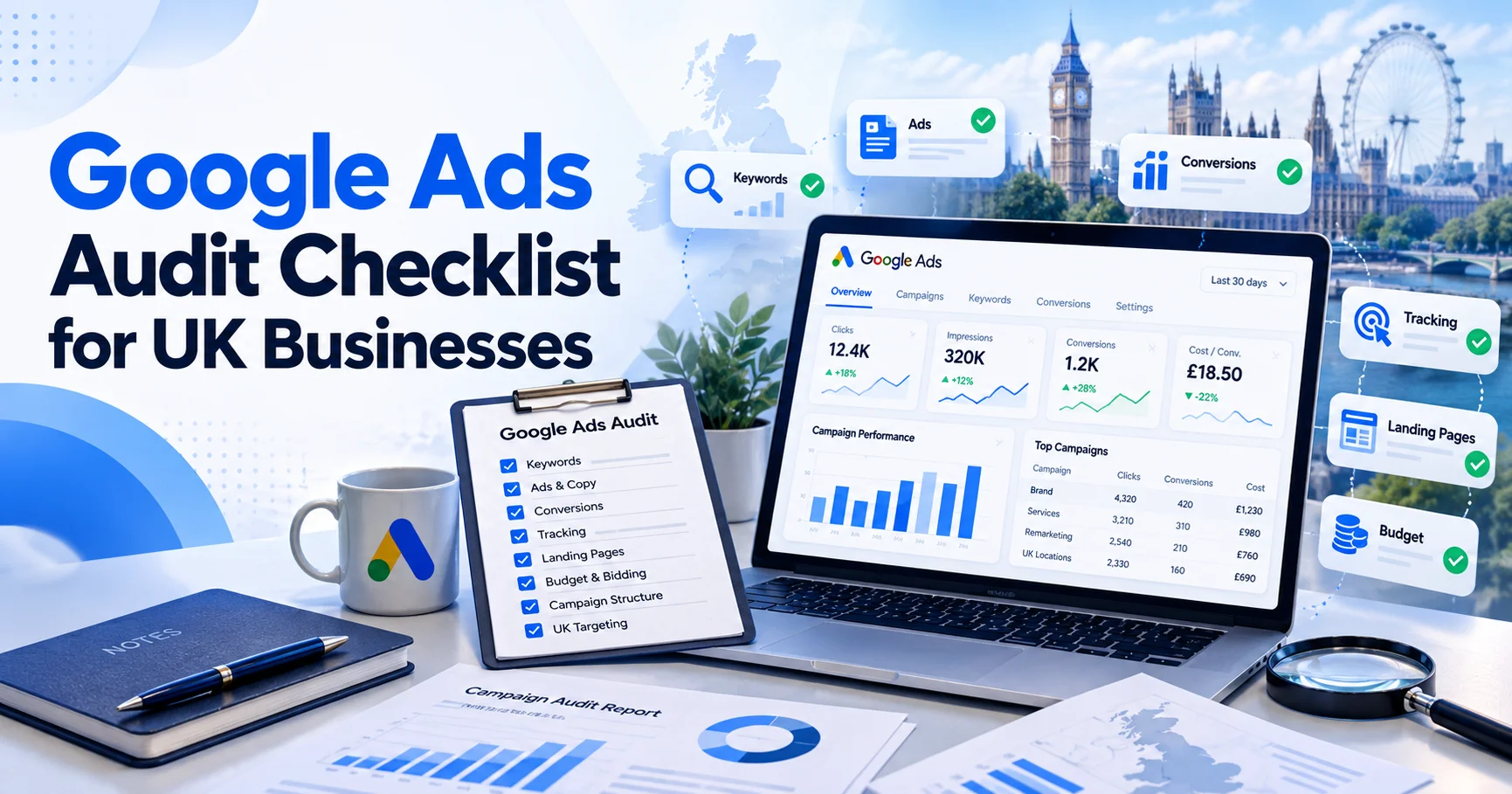
Our Google Ads Audit Checklist for UK Businesses explains how to review search terms, tracking, locations and wasted spend in a structured order.
2. Your Negative Keyword List Is Too Weak
Poor search terms often continue because negative keywords are missing.
Negative keywords can stop adverts appearing for searches involving:
- jobs;
- courses;
- free information;
- DIY queries;
- irrelevant products.
However, adding hundreds of negatives is not automatically better.
A poorly chosen negative keyword can block valuable searches.
Review the complete search query before excluding it.
The goal is simple: remove obvious poor intent without blocking potential customers.
3. Match Types Are Bringing Low-Intent Traffic
Broad, phrase and exact match can all work.
The problem starts when businesses judge match types by their labels rather than results.
Suppose an accountant targets:
small business accountant London
A broad setup may discover valuable variations. It may also trigger educational or job-related searches.
Review:
- triggered searches;
- CPC;
- conversions;
- lead quality;
- sales.
A broad-match keyword producing profitable customers can be useful.
An exact-match keyword producing poor enquiries can still waste money.
Judge outcomes, not labels.
4. Google Ads Campaigns Target Too Wide an Area
Good keywords can still waste money when location targeting is poor.
Imagine a boiler company serving Greater London and Surrey. If its ads reach people hundreds of miles away, those clicks may have little commercial value.
Google’s location targeting guidance explains how advertisers can target countries, areas within a country, radius-based locations and other geographic groups. Review geographic performance regularly so budget is not being spent in areas the business cannot serve profitably.
Review both your selected locations and real performance by area.
For example:
- London: £2,200 spend and 28 qualified enquiries
- Surrey: £750 spend and 7 enquiries
- Hertfordshire: £850 spend and 1 poor enquiry
Hertfordshire clearly deserves investigation.
The important question is not whether an area feels expensive.
It is whether it produces useful business.
5. You Treat Every Device the Same
Mobile and desktop visitors can behave differently.
An emergency locksmith may generate its best calls from mobile searches. A B2B company may receive stronger leads from desktop users during working hours.
Do not compare devices using CPC alone.
Follow the complete path:
Click → Lead → Qualified Lead → Sale → Revenue
A device with higher CPC may still produce better customers.
If one device consumes significant spend without creating business value, investigate why.
6. Your Google Ads Campaigns Run at the Wrong Times
Some businesses need adverts around the clock.
Others do not.
Emergency services may perform well overnight. A B2B consultancy may receive most qualified enquiries Monday to Friday.
Review performance by:
- hour;
- day;
- lead quality;
- sales.
Do not make major changes based on a few conversions.
Look for patterns that repeat.
Once the evidence is strong enough, align the schedule with how customers actually buy.
7. Too Many Services Are Mixed Together
Poor campaign structure makes budget control harder.
Imagine one construction campaign containing:
- roofing;
- extensions;
- loft conversions;
- bathroom work;
- commercial construction.
These services can have different CPCs, margins, landing pages and customer values.
A £150 lead could be poor for a small repair but excellent for a £20,000 project.
Separate Google Ads Campaigns where meaningful commercial differences exist.
You do not need dozens of tiny campaigns.
You need enough structure to control budget, targeting and performance properly.
8. Ads and Keywords Do Not Match
Someone searching for a specific service expects a relevant advert.
Suppose they search:
emergency boiler repair London
Then they see:
Trusted Home Services | Great Prices
The advert is vague.
A stronger ad should clearly reflect:
- the service;
- location;
- problem;
- offer;
- next action.
Clear wording usually beats clever wording.
Review important commercial keywords against the ads that serve them.
9. You Ignore Quality Score Completely
Quality Score should not become your main target.
But ignoring it can hide useful clues.
Google describes Quality Score as a diagnostic measure involving:
- expected CTR;
- ad relevance;
- landing-page experience.
If ad relevance is weak, inspect whether the advert matches the keyword.
If landing-page experience is poor, inspect the destination.
Do not chase 10/10 scores for their own sake.
Your real goal is profitable customers.
Our Google Ads Quality Score guide explains the metric in more detail.
10. Landing Pages Do Not Match Your Google Ads Campaigns
A strong keyword and advert can still fail after the click.
Imagine an advert promises:
Emergency Plumber in Chelsea
The visitor then reaches a general homepage covering heating, bathrooms, commercial maintenance and nationwide plumbing.
The user now has to search for the service they expected.
That creates friction.
A landing page should clearly match:
- service;
- location;
- problem;
- offer;
- call to action.
Landing Page Example
Suppose 500 clicks cost £2,500.
At a 1% conversion rate, those clicks produce around five leads.
At 4%, the same traffic produces around 20 leads.
The media spend has not changed.
The landing-page performance has.
This is why increasing traffic is not always the answer.
11. Conversion Tracking Is Broken
Broken tracking can make good Google Ads Campaigns look bad and poor campaigns look successful.
Service businesses may need to track:
- enquiry forms;
- phone calls;
- bookings;
- quote requests.
Ecommerce businesses may need purchases and revenue.
Google’s conversion tracking guidance explains how conversion actions can be used to measure website actions, phone calls, app activity and offline outcomes. Accurate tracking is essential before deciding whether a campaign is profitable or wasting money.
Do not assume tracking works because a conversion action exists.
Test it.
Complete a form. Make a test call where relevant. Check what Google Ads records.
Suppose 20 genuine enquiries arrive but Google records only eight.
The campaign may look far more expensive than it really is.
The opposite problem can also happen.
One real lead may trigger three conversions.
Before cutting or increasing spend, make sure your numbers are trustworthy.
12. You Count the Wrong Actions as Conversions
Not every useful website action is a lead.
Someone may:
- view a contact page;
- click a button;
- scroll;
- watch a video;
- open a form.
These actions may help with analysis.
They should not automatically carry the same weight as genuine enquiries.
Imagine Google Ads reports 100 conversions, but only 18 are actual leads.
You do not have 100 leads.
You have 18.
This affects CPL, bidding and budget decisions.
13. Google Ads Campaigns Optimise for Cheap Leads Instead of Good Leads
A low CPL can still hide poor business performance.
Imagine Campaign A produces:
20 leads at £40 each
Only two become customers.
Campaign B produces:
10 leads at £70 each
Five become customers.
Campaign A looks better when comparing CPL alone.
Campaign B may be far more profitable.
Ask what happened after each call or form submission.
Was the person serious?
Were they in the right location?
Did they want the correct service?
Did they become a customer?
Our construction Google Ads case study shows why real enquiry quality matters when making campaign decisions.
14. Budget Goes to the Wrong Google Ads Campaigns
Businesses often ask:
How much should I spend on Google Ads?
Another question matters just as much:
Where should the money go?
One campaign may produce profitable customers but regularly hit its budget limit.
Another may spend freely while producing weak leads.
Giving both equal budget makes little sense.
Compare:
- CPL;
- customer acquisition cost;
- lead quality;
- customer value;
- search demand;
- profit margin.
A campaign with higher CPC can deserve more money when it produces better customers.
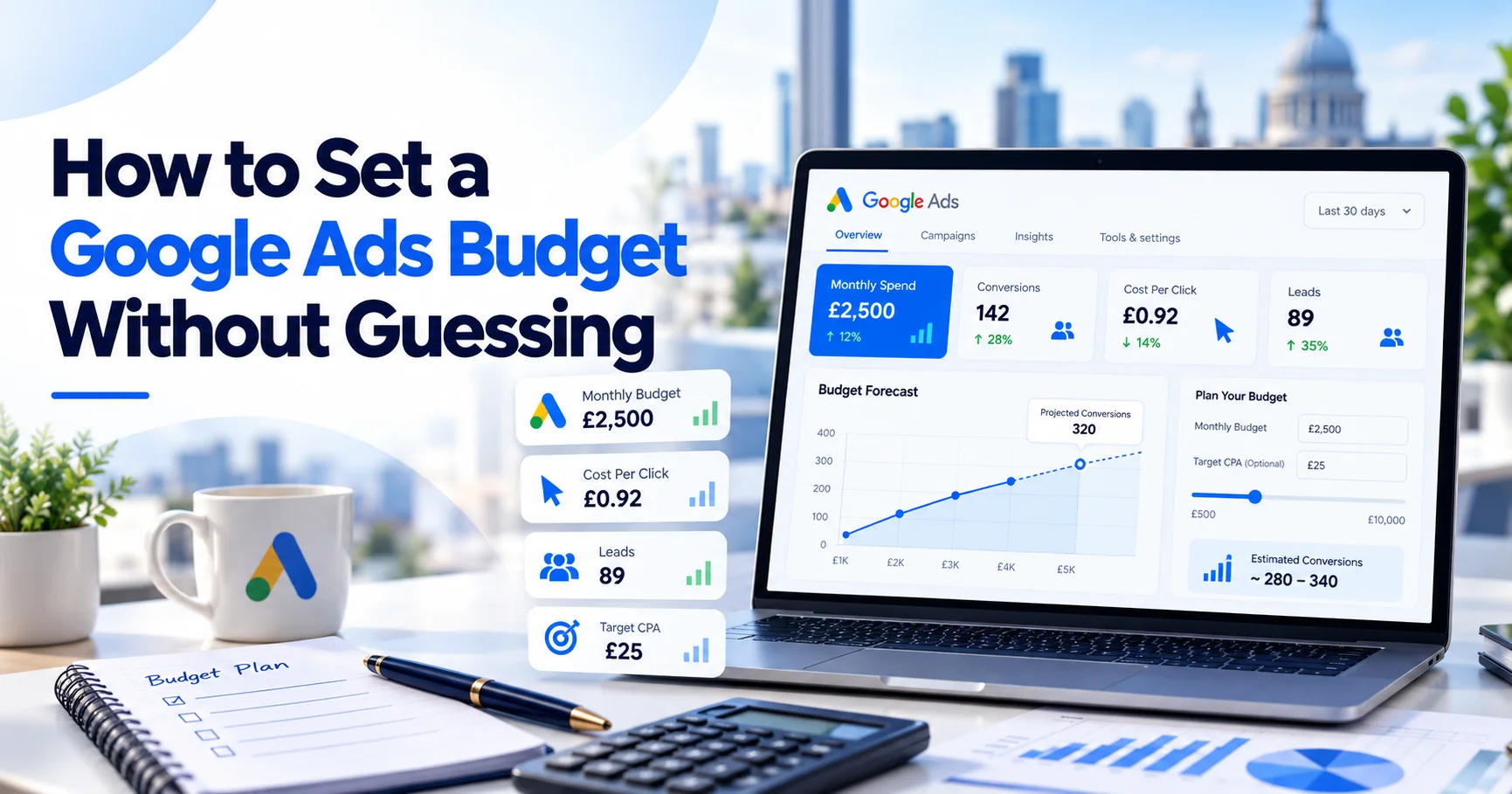
Our guide on how to set a Google Ads budget without guessing explains how CPC, conversion rates and customer goals affect budget planning.
15. Automated Bidding Is Learning From Bad Data
Automation depends on the signals you provide.
Suppose your account tells Google that:
- contact-page views;
- button clicks;
- spam submissions;
- real enquiries
are all equally valuable.
Automated bidding may then optimise towards actions that do not produce real business.
Before blaming automation, ask:
- What is the campaign optimising towards?
- Can the conversion data be trusted?
- Are the goals commercially useful?
- Is there enough data to judge performance?
Automation can help.
But it cannot repair poor tracking by itself.
Invalid Traffic Is Different From Poor Intent
This distinction matters when reviewing Google Ads Campaigns.
Invalid traffic may involve automated, accidental or manipulative interactions.
Poor intent involves real people who simply are not suitable customers.
For example, someone may search for:
- jobs;
- courses;
- free advice;
- areas you do not cover;
- products you do not sell.
That is not automatically click fraud.
It may simply mean your targeting needs improvement.
Do not blame invalid traffic for every bad enquiry.
Check search terms, location targeting, networks and lead quality first.
Google Ads Campaigns Waste Example: Search Terms
Imagine a London chauffeur company spends £3,000 on search ads.
A search-term review shows £620 went towards:
- chauffeur jobs London;
- chauffeur licence course;
- driver salary London;
- cheap taxi London.
Those are real searches.
They simply do not match the service being sold.
The solution is better targeting and negative keywords, not abandoning Google Ads entirely.
Google Ads Campaigns Waste Example: Location Targeting
Imagine a London service business accidentally targets most of England.
It spends:
£4,500 in London and useful surrounding areas
and:
£1,300 in locations it rarely serves
Those distant clicks may be genuine.
The problem is that the company cannot use the demand effectively.
Tighter geographic targeting can protect more of the existing budget.
Google Ads Campaigns Waste Example: Broken Tracking
Suppose Campaign A generates 30 real enquiries but reports only 12 conversions.
Campaign B generates 10 enquiries but reports 28 conversions because several actions fire for each lead.
If budget decisions rely only on Google’s conversion column, money may move towards the weaker campaign.
That is why conversion tracking should be checked before major budget changes.
Google Ads Waste Diagnostic Matrix
| Symptom | Likely Problem | First Check |
| Strange automated-looking clicks | Invalid traffic | Traffic source |
| Many clicks, few useful enquiries | Poor intent | Search terms |
| Leads come from wrong areas | Location targeting | Geographic report |
| Too many reported conversions | Tracking | Duplicate actions |
| Too few reported conversions | Tracking | Forms and calls |
| Cheap leads rarely become customers | Lead quality | Sales feedback |
| Strong campaign runs out of budget | Budget allocation | Profitability |
| High CPC with good customers | Possibly healthy | CPA and revenue |
| Low CPC with poor leads | Poor intent | Search terms |
Diagnose before changing the account.
What Should You Fix First?
When several problems appear together, fix them in a sensible order.
1. Repair Tracking
If you cannot trust the conversion data, fix it first.
Otherwise, every later decision may rely on bad information.
2. Stop Obvious Wasted Spend
Remove clearly irrelevant search terms, unusable locations and heavily spending campaigns that produce little value.
3. Improve Search Intent
Review keywords, negatives, advertisements and landing pages.
4. Reallocate Budget
Move money towards Google Ads Campaigns producing stronger commercial outcomes.
5. Look for Growth
Once the foundations are healthy, explore new services, locations and audiences.

Do Not Change Everything at Once
When an account wastes money, rebuilding everything immediately can be tempting.
But changing bidding, budgets, keywords, ads, landing pages, locations and tracking together makes results harder to understand.
Fix urgent problems first.
Then introduce less critical improvements gradually.
Keep a simple change log covering:
- what changed;
- when;
- why;
- what happened afterwards.
This makes future decisions much easier.
How Much Wasted Spend Is Too Much?
There is no universal percentage.
Instead of asking:
What percentage of every Google Ads account is wasted?
Ask:
Which spend failed to support a useful business outcome, and why?
Review whether:
- the click was relevant;
- the location was useful;
- the landing page matched;
- tracking worked;
- the lead was qualified;
- the lead became revenue.
That gives you something practical to improve.
How Wixdek Reviews Google Ads Campaigns
At Wixdek, we do not treat every expensive click or poor lead as the same problem.
We first identify what is happening.
Is traffic irrelevant?
Is location targeting too wide?
Is tracking unreliable?
Is the landing page losing good visitors?
Are leads failing to become customers?
That diagnosis matters because every problem needs a different fix.
The goal is not simply to reduce spending.
It is to reduce unproductive spend while protecting Google Ads Campaigns that generate useful business.
When Should You Increase Your Budget Again?
Do not increase spending because you fixed one keyword.
Look for a healthier overall pattern.
Tracking should be reliable.
Search intent should be relevant.
Lead quality should make commercial sense.
The business should also have capacity for more enquiries.
Once those conditions are in place, stronger Google Ads Campaigns may deserve more budget.
Scaling a broken campaign usually makes its problems more expensive.
Need Help Fixing Google Ads Campaigns That Waste Money?
If you are spending on Google Ads but cannot explain which clicks create real enquiries, the problem may not be your total budget.
It may be how your Google Ads Campaigns use that budget.
Wixdek can review search terms, conversion tracking, targeting, campaign structure, budgets, landing pages and lead quality.
Our PPC agency in London service focuses on tighter budget control and campaign decisions linked with measurable business outcomes.
The first goal is not to spend more.
It is to understand what your existing spend is actually producing.
Frequently Asked Questions
Why do Google Ads Campaigns waste money?
Google Ads Campaigns commonly waste money because of irrelevant search terms, weak negative keywords, poor location targeting, broken conversion tracking, weak landing pages, low-quality leads and poor budget allocation.
How can I find wasted spend in Google Ads Campaigns?
Start with conversion tracking.
Then review search terms, locations, campaign spending and lead quality. These areas often reveal whether the main problem is tracking, targeting or budget allocation.
Can broad match make Google Ads Campaigns waste money?
Yes, when broad match produces poor-intent searches and nobody reviews them.
However, broad match can still perform well when conversion tracking, bidding and search-term management are strong.
Do negative keywords reduce wasted spend?
They can.
Negative keywords help prevent ads from appearing for clearly irrelevant searches. Avoid overly aggressive negatives that may block valuable traffic.
Can poor location targeting waste my Google Ads budget?
Yes.
Businesses can pay for clicks outside their practical service areas when location targeting is too broad or geographic performance is not reviewed regularly.
Does a high CPC mean Google Ads Campaigns are performing badly?
Not necessarily.
Higher CPC traffic can still be profitable when it converts into valuable customers. Compare CPC with conversion rate, customer acquisition cost and customer value.
Can bad conversion tracking waste money?
Yes.
Incorrect tracking can make weak campaigns appear strong and successful campaigns appear poor. It can also send bad signals into automated bidding.
Does a low cost per lead mean a campaign is successful?
Not always.
Cheap leads may still be poor-quality leads. Compare CPL with customer acquisition cost, close rate and revenue.
Should I reduce my Google Ads budget when performance is weak?
Not automatically.
First identify whether the issue comes from tracking, targeting, search intent, landing pages, lead quality or budget allocation.
Reducing spend without fixing the underlying problem may only hide it.
How often should Google Ads Campaigns be reviewed?
Review Google Ads Campaigns often enough to catch search-term, tracking and budget issues before they become expensive.
A deeper audit is useful after major changes, sharp performance drops or when results no longer match the spend.