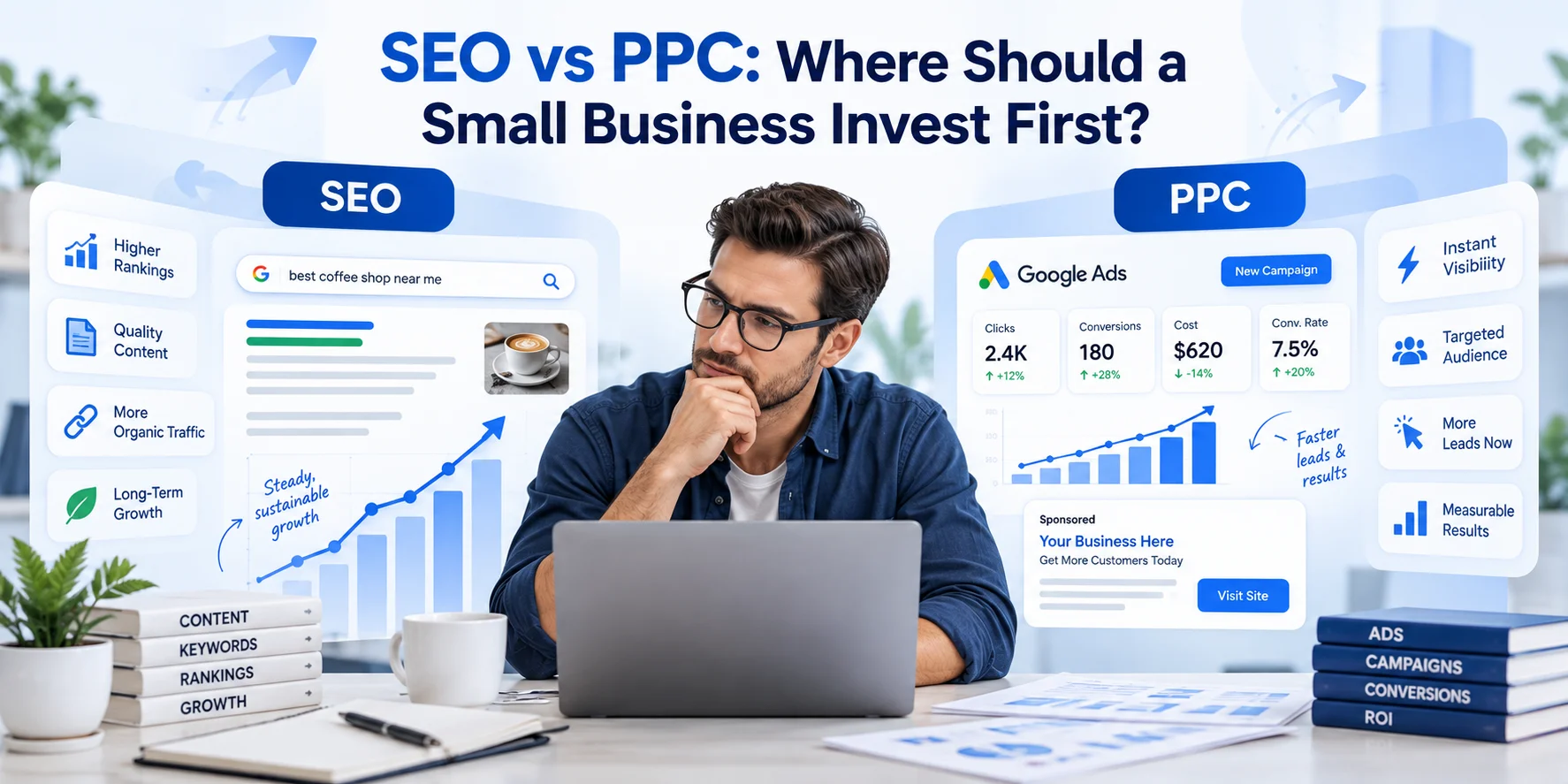
Should a small business invest in SEO or PPC first? It depends on what you need right now.
If you need enquiries quickly, PPC can bring targeted traffic soon after campaigns launch. If you want long-term search visibility without paying for every click, SEO should usually start early.
The SEO vs PPC decision is rarely about choosing one forever. It is about deciding where your budget should go first. Your cash flow, sales targets, competition, search demand and budget should guide that choice.
This guide compares SEO and PPC by speed, cost, control and long-term value. It also includes practical budget scenarios and a 12-month plan.
SEO vs PPC at a Glance
| Factor | SEO | PPC |
| Traffic source | Organic search results | Paid advertisements |
| Payment per click | No | Usually yes |
| Speed | Builds over time | Can start quickly |
| Control | Less direct | High |
| Long-term value | Can continue over time | Usually stops when spending stops |
| Testing | Slower | Faster |
| Budget flexibility | Usually planned monthly | Easy to adjust |
| Best use | Long-term visibility | Immediate demand |
| Main risk | Takes time | Poor targeting wastes budget |
Google explains that SEO and PPC support different goals. Paid search can help businesses reach customers quickly, while SEO focuses on organic visibility over time. See Google’s guide to SEO and PPC.
There is no universal winner. The right choice depends on your business.
What Is SEO?
SEO stands for search engine optimisation. It helps your website become more visible in organic search results.
SEO can include technical fixes, service pages, useful content, internal links, local optimisation and authority building. You do not pay Google each time someone clicks an organic listing.
SEO is not free, though. You may still pay for strategy, content, development or professional support.
Google’s SEO Starter Guide explains how useful content, crawlable pages and clear site structure can help search engines understand a website.
SEO usually suits businesses that want to build visibility over time.
What Is PPC?
PPC stands for pay-per-click advertising. Google Ads is one common example.
You create campaigns around keywords, searches, locations, audiences or products. You then pay for advertising interactions based on the campaign and bidding model.
PPC gives you more direct control over budgets, locations, keywords, schedules and landing pages. You can also pause or change campaigns quickly.
When comparing SEO vs PPC, this control is one of PPC’s biggest advantages.
When Should a Small Business Invest in PPC First?
PPC may deserve the larger first investment when your business needs leads quickly.
Imagine a new plumbing company in South London. Its website has little organic visibility, but the business needs enquiries now. Waiting months for stronger rankings may not suit its cash flow.
A focused paid search campaign can place the business in front of people already searching for its services.
That does not guarantee profitable leads. The targeting, offer, landing page and tracking still need to work.
You Need Leads Quickly
PPC is useful when waiting is not practical.
This can apply to:
- new businesses;
- new locations;
- new services;
- seasonal campaigns;
- businesses with immediate sales targets.
Paid campaigns can start generating visits soon after launch. SEO normally needs more time.
You Want to Test an Offer
PPC can also test demand and messaging quickly.
For example, you might want to compare:
- Emergency boiler repair
- Same-day boiler repair
Paid campaigns can show which message attracts more useful enquiries before you invest heavily in organic content.
You Need More Budget Control
Paid campaigns give you direct control over spending.
Google Ads uses average daily campaign budgets. Google’s Google Ads budget guidance explains how these budgets and spending limits work.
You can increase spend when capacity is available and reduce it when your pipeline is full.
You Know Your Numbers
PPC works best when you understand customer value.
You should know:
- what an average customer is worth;
- how many leads become customers;
- what you can afford to pay for a lead;
- what acquisition cost remains profitable.
Without those numbers, it is harder to judge campaign performance.
If you are planning your paid budget, our guide to PPC management costs in London explains management fees, advertising spend and total costs.
When Should a Small Business Invest in SEO First?
SEO may deserve more budget when immediate lead volume is less urgent.
In the SEO vs PPC comparison, SEO becomes more attractive when long-term visibility matters more than quick traffic.
You Have Time to Build Visibility
A business with a healthy sales pipeline can invest more patiently.
Instead of paying for each visit, you can improve commercial pages and build useful supporting content. Over time, those pages may continue attracting organic traffic.
Search Demand Is Clear
SEO works best when people already search for what you sell.
An accountant may target bookkeeping, tax and accounting searches. A roofing company may target roof repairs, replacements and emergency services.
When demand already exists, organic visibility can become a strong long-term channel.
For local businesses, organic SEO and local SEO also require different tactics. Our guide on how SEO and local SEO work differently explains the difference.
Your Website Needs Stronger Foundations
SEO work often uncovers wider website problems.
You may have slow pages, weak service content, poor internal links or missing commercial pages.
Fixing those problems can support rankings and improve the customer journey.
If organic visibility is a major growth goal, see our SEO services in London approach.
SEO vs PPC: Which Is Faster?
PPC is usually faster.
Once a campaign is approved and active, you can begin reaching relevant searchers quickly.
SEO takes longer because search engines need to discover, understand and evaluate your pages.
Competition also matters. A small local niche may move faster than a competitive national market.
For SEO vs PPC speed, PPC usually wins in the short term. SEO is better treated as an ongoing growth channel.
SEO vs PPC: Which Costs Less?
There is no simple answer.
SEO does not charge you for every organic click. However, strategy, content, development and optimisation still cost money.
PPC uses direct advertising spend and may also include management fees.
The real comparison is:
Long-term organic investment vs ongoing paid media spend.
A useful SEO vs PPC cost comparison should focus on qualified leads, customers and revenue, not just monthly fees.
Both channels can waste money when managed badly.
SEO vs PPC: Which Gives You More Control?
PPC gives you more direct control.
You can change:
- budgets;
- locations;
- keywords;
- advertisements;
- schedules;
- landing pages.
You can also pause campaigns immediately.
SEO does not work that way. You can improve your website and follow good search practices, but you cannot manually choose your organic ranking.
In the SEO vs PPC control comparison, PPC has the clear advantage.
SEO vs PPC for Keyword Research
PPC can provide useful commercial search data.
A business can test keywords and see which searches generate clicks, leads and sales.
Google’s Keyword Planner documentation explains how advertisers can find keyword ideas and review search estimates.
Suppose one paid keyword consistently brings strong leads. That may suggest the same topic deserves more SEO attention.
However, paid and organic behaviour will not always match.
Use PPC data as evidence, not as a guarantee.
SEO vs PPC Decision Matrix
Use this table as a starting point.
| Business Situation | SEO Priority | PPC Priority | Suggested Direction |
| New business needing leads | Medium | High | Use PPC while building SEO |
| Business with steady referrals | High | Medium | Build SEO and test PPC |
| Seasonal business | Medium | High | Increase PPC during peaks |
| Local service business | High | High | Combine local SEO and PPC |
| New product or service | Medium | High | Test demand with PPC |
| Small monthly budget | High | Low to medium | Focus on core SEO and small tests |
| Weak website | High | Medium | Fix the site before scaling ads |
| Strong site, low visibility | Medium | High | Use PPC while SEO grows |
| Strong organic rankings | High | Medium | Use PPC to fill gaps |
| New service area | High | High | Build SEO and test paid demand |
Your final decision should also consider margin, sales capacity and customer value.
If your website itself may be holding results back, use our SEO audit checklist for UK service businesses before increasing spend.
SEO vs PPC Small Business Decision Flow
Ask these questions in order.
Do you need qualified leads now?
If yes, give PPC more weight while starting basic SEO work.
Is there clear search demand?
If yes, build strong service pages. If you are unsure, use a controlled PPC test to measure demand.
Is your website difficult to use or convert on?
Fix it before scaling either channel.
Are paid campaigns producing profitable customers?
Keep funding what works. If not, review targeting, landing pages and tracking.
Are organic enquiries growing?
If yes, adjust the budget using real lead and sales data.
The goal is not to become SEO-only or PPC-only. Move budget towards what produces useful business results.
Scenario 1: A New Local Service Business
Imagine a new locksmith covering several London boroughs.
The website has few rankings, but the business needs phone calls quickly. In this SEO vs PPC situation, PPC may need the larger early share.
A possible starting split could be:
- 60% to 70% PPC
- 30% to 40% SEO
PPC can capture immediate demand while SEO builds service pages and local visibility.
Scenario 2: An Established Business
Now imagine an accountancy firm already receives regular referrals.
It does not need emergency leads but wants more search visibility. In this SEO vs PPC scenario, SEO may deserve more budget.
A possible split could be:
- 60% to 70% SEO
- 30% to 40% PPC
Paid search can test valuable terms while SEO builds broader visibility.
Scenario 3: A Seasonal Business
Seasonal businesses may need a changing SEO vs PPC mix.
PPC can increase during busy periods because budgets are flexible. SEO should continue throughout the year because organic visibility cannot be switched on instantly.
Scenario 4: A Small Budget
A small budget needs focus.
Suppose a company has £1,500 per month for search marketing.
A possible split could be:
- £1,000 for targeted paid campaigns
- £500 for core SEO work
That is only an example. The right split depends on competition, click costs, customer value and website quality.
Do Not Send Paid Traffic to a Weak Website
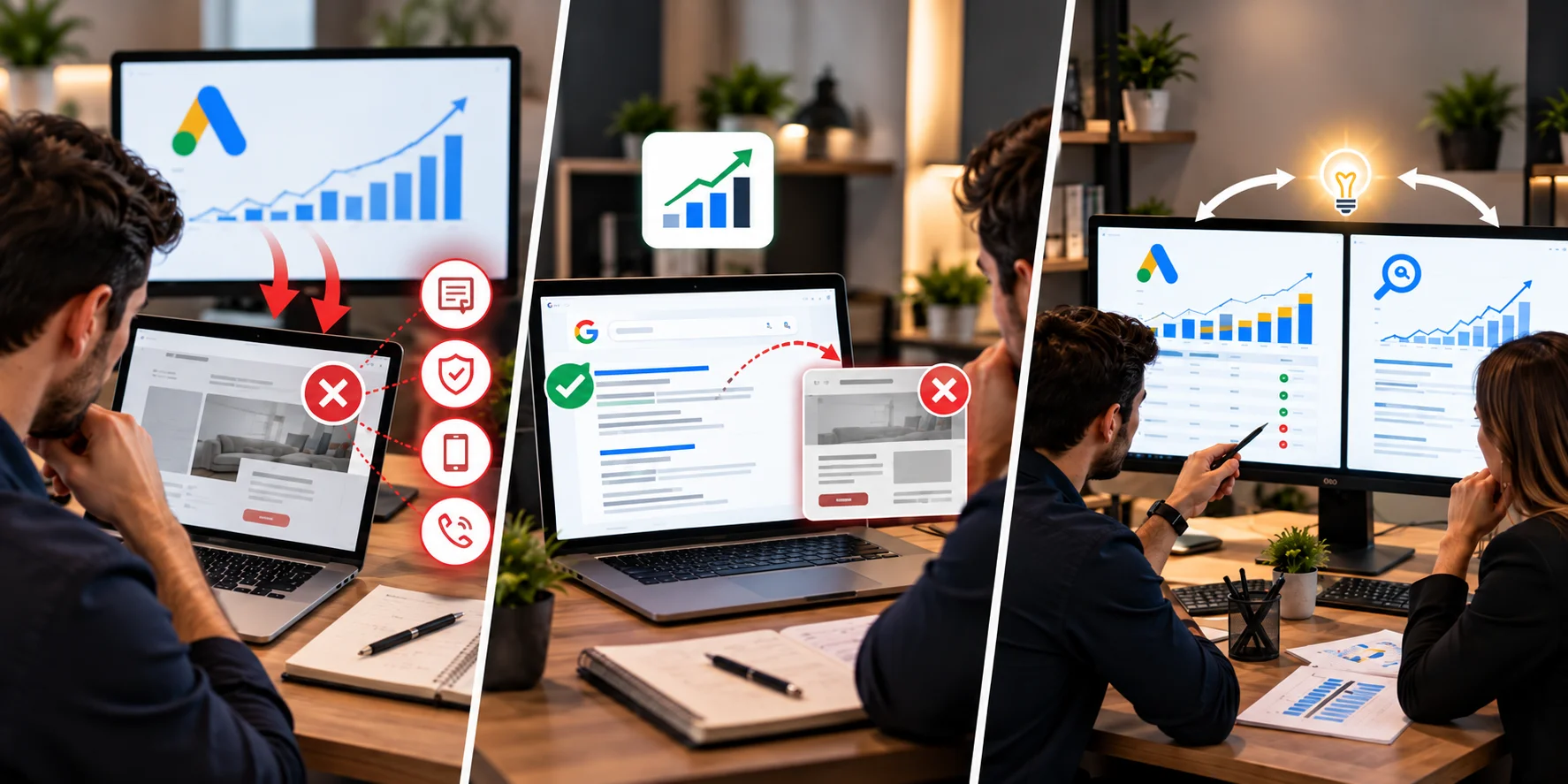
Good PPC cannot rescue a poor landing page.
Before increasing spend, check that visitors can quickly understand:
- what you offer;
- why they should trust you;
- how to contact you;
- what action they should take next.
Your site should also work well on mobile, and calls and forms should be tracked correctly.
SEO Cannot Fix a Weak Offer Either
Higher rankings do not automatically create customers.
A page can rank well and still fail if the offer is unclear, generic or difficult to trust.
SEO creates visibility. Your website still needs to convert that visibility into business.
Should PPC Data Guide SEO?
Yes, when the data is useful.
Paid campaigns can reveal which searches produce strong or weak leads.
If one term generates many poor enquiries, you may decide not to build a large SEO campaign around it.
If another term brings fewer but better customers, it may deserve stronger organic coverage.
This is why SEO and PPC teams should share data.
Should SEO Data Guide PPC?
Yes.
SEO data can show which pages already perform well and where organic visibility is weak.
If you rank strongly for one service, you may not need to place most of your paid budget there.
PPC can instead target new services, locations or competitive searches where organic visibility is weaker.
PPC Agency or In-House Management?
Once you choose paid search, you also need to decide who manages it.
A smaller account may work with an agency or freelancer. A larger business may have enough work for an in-house specialist.
Cost matters, but so do skills, workload and campaign complexity.
Our PPC agency vs in-house management guide explains that choice in more detail.
How Should You Set a Google Ads Budget?
Do not choose a number just because it feels affordable.
Start with your business targets.
Work out:
- how many customers you need;
- how many leads normally create one customer;
- what a customer is worth;
- what acquisition cost you can afford.
Then build your budget backwards from those numbers.
For more detail, see how to set a Google Ads budget without guessing.
A 12-Month SEO vs PPC Plan
Small businesses do not need one permanent SEO vs PPC split.
Your budget should change as more data becomes available.
Months 1 to 3: Fix the Foundation
Set up tracking first.
Make sure calls, forms and other important actions are measured. Fix obvious website issues and improve key commercial pages.
If you need leads quickly, launch a focused PPC test.
SEO should concentrate on technical basics, main services and useful local pages.
Months 4 to 6: Use Real Data
Review which paid searches create useful leads.
Use that information to improve SEO priorities.
Remove wasted paid searches and put more budget into stronger opportunities.
Months 7 to 9: Expand Organic Visibility
Build useful content around proven services, locations and customer questions.
Avoid publishing pages simply because a keyword tool shows volume.
Keep PPC running where organic visibility remains weak.
Months 10 to 12: Rebalance
Compare qualified leads, sales and acquisition costs.
Increase investment where commercial performance is strongest.
Do not cut PPC simply because SEO traffic has grown. Do not keep spending on PPC simply because it has always been part of the plan.
Example 12-Month Budget Shift
| Stage | SEO Share | PPC Share | Main Goal |
| Months 1 to 3 | 35% | 65% | Early leads and foundations |
| Months 4 to 6 | 45% | 55% | Use paid data to guide growth |
| Months 7 to 9 | 55% | 45% | Expand organic visibility |
| Months 10 to 12 | 60% | 40% | Rebalance using results |
This is not a fixed formula.
A business needing immediate leads may keep more budget in PPC. A company with more time may invest in SEO earlier.
The important part is having a commercial reason for every budget change.
When SEO and PPC Work Best Together
The SEO vs PPC debate often makes the channels sound like competitors.
They can work better together.
PPC provides speed, testing and control. SEO builds long-term organic visibility.
For example, a London company entering a new borough could test demand with paid search while building organic location pages.
If the paid campaign performs well, that data can help guide future SEO investment.
How Wixdek Approaches SEO and PPC
At Wixdek, we treat SEO vs PPC as a business decision.
Some companies need leads quickly. Others already have short-term demand but need stronger organic visibility.
SEO should support long-term calls, forms and sales. PPC should capture immediate demand and fill important visibility gaps.
The goal is not to spend money across every channel. It is to invest where the next useful return is most likely.

SEO vs PPC: Which Should You Choose First?
Choose PPC first when speed matters most.
It can make sense when you:
- have a new business;
- need enquiries quickly;
- want to test demand;
- need tighter budget control.
Choose SEO first when you have more time and want stronger long-term organic visibility.
For many small businesses, the best answer is a blend.
Start SEO early. Use PPC where speed matters. Then move your budget using real lead and sales data.
Do not judge the decision on traffic alone.
Look at qualified enquiries, sales, customer value and profit.
Not Sure Where Your Next £1,000 Should Go?
If you are facing an SEO vs PPC budget decision, start with the numbers.
Wixdek can review your current search visibility, PPC opportunities, conversion tracking and lead journey before you increase spend.
If paid search looks like the stronger immediate opportunity, our PPC agency in London service explains our approach to campaign structure, tracking, lead quality and budget control.
The goal is to identify which channel has the stronger job to do first.
Frequently Asked Questions
Is SEO better than PPC for a small business?
Neither is always better. PPC suits businesses that need faster visibility, while SEO supports longer-term organic growth.
Should a new business start with SEO or PPC?
A new business needing customers quickly may start PPC while building SEO at the same time.
Is SEO cheaper than PPC?
Not automatically. SEO has strategy and optimisation costs, while PPC requires advertising spend and may include management fees.
Does PPC help SEO rankings?
No. Paying for Google Ads does not improve organic rankings. However, PPC data can help identify useful keywords and offers.
How long should a small business run PPC?
There is no fixed period. Keep running PPC while it produces commercially useful results.
Should I stop PPC when SEO starts working?
Not automatically. PPC may still cover searches where organic visibility is weak.
Can a small business use SEO and PPC together?
Yes. PPC can capture immediate demand while SEO builds long-term visibility.
How much should a small business spend on PPC?
Start with customer value, conversion rates and your acceptable acquisition cost. Work backwards from those numbers.
Which is better for local businesses, SEO or PPC?
Both can work. Local SEO builds longer-term visibility, while PPC can capture immediate local demand.
What should I measure when comparing SEO and PPC?
Measure qualified leads, sales, bookings, acquisition cost and revenue. Traffic and rankings are useful signals, but they are not the final business goal.
By Wixdek