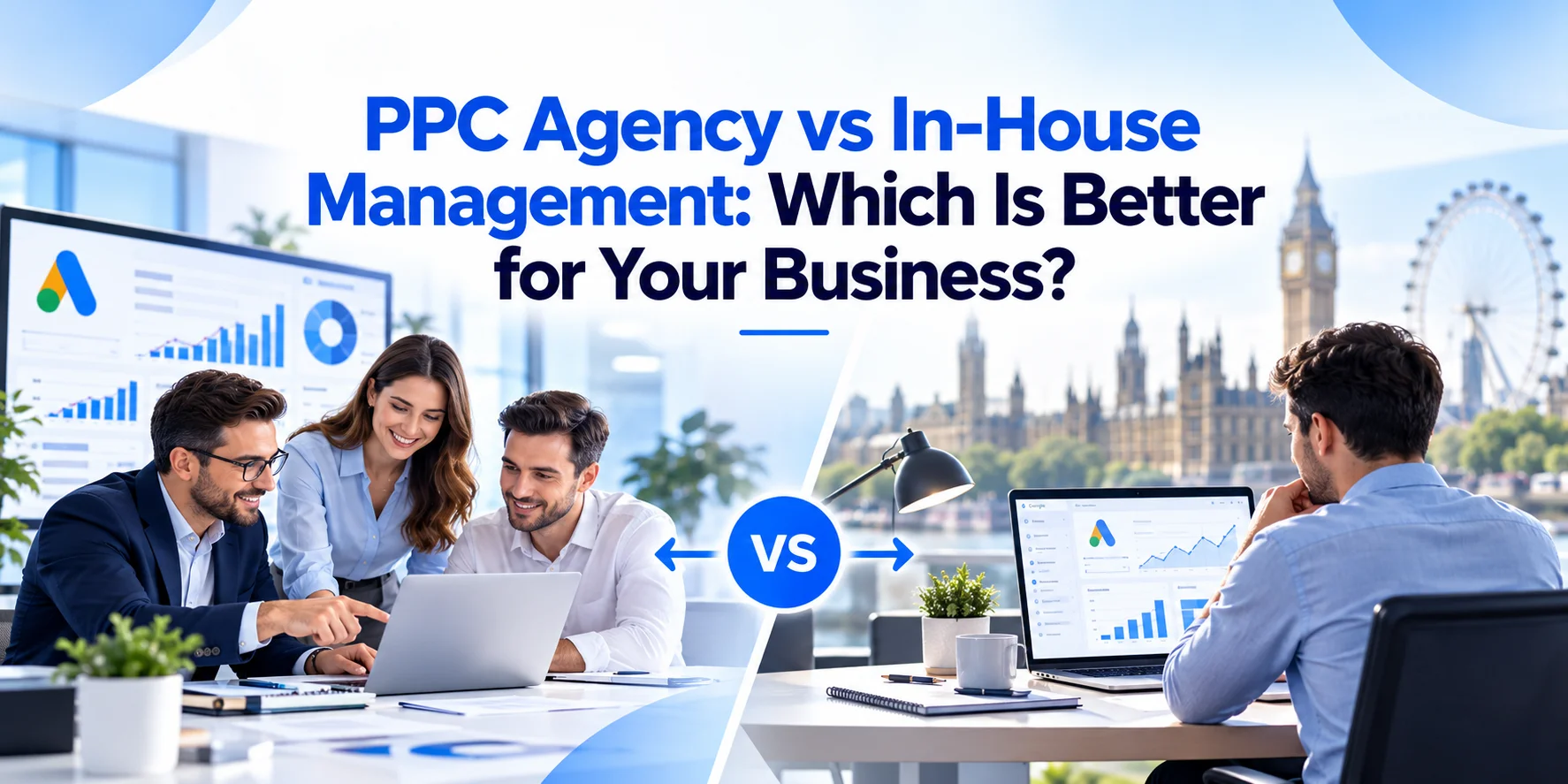
Should you hire a PPC agency or manage paid advertising in-house?
There is no universal answer.
A PPC agency gives you access to several specialists without hiring them individually. An in-house PPC manager works inside your business and usually develops deeper knowledge of your customers, products and internal systems.
The right PPC Agency vs In-House Management choice depends on:
- advertising spend;
- account complexity;
- internal marketing maturity;
- required specialist skills;
- speed of campaign changes;
- workload;
- need for direct control.
For smaller and growing businesses, an agency can often provide broader expertise without the fixed cost of a full internal team. For larger businesses with steady paid-media demand and strong internal systems, in-house management can make more sense.
This guide compares cost, capability, control, scalability, business knowledge and risk so you can choose the model that fits your business.
PPC Agency vs In-House Management at a Glance
| Factor | PPC Agency | In-House PPC |
| Main cost | Monthly management fee | Salary + employment costs |
| Specialist depth | Access to several skills | Usually one main specialist |
| Brand knowledge | Must be learned | Usually deeper |
| Daily availability | Shared across clients | Dedicated internally |
| Scaling | Easier to add resource | May require hiring |
| Recruitment | Usually unnecessary | Required |
| Staff absence risk | Lower with team cover | Higher with one employee |
| Tools | Often already available | May need separate purchase |
| Control | Strong but external | Very high |
| Best fit | Growing or complex accounts | Large, steady PPC workload |
There is no automatic winner. The right model depends on what your account actually needs.
What Is a PPC Agency?
A PPC agency is an external company that manages paid advertising for clients.
Depending on the agency, services may include:
- Google Ads;
- Microsoft Ads;
- Shopping;
- Performance Max;
- paid social;
- conversion tracking;
- feed management;
- landing-page advice;
- reporting.
The main advantage is access to a wider team. Your account may have one main manager, but that person can often involve specialists in tracking, analytics, landing pages, feeds, creative or development when needed.
What Does In-House PPC Management Mean?
In-house PPC means an employee inside your company manages paid advertising.
That person may be a:
- PPC Manager;
- Paid Media Manager;
- Performance Marketing Manager;
- Digital Marketing Manager.
They can work directly with sales, finance, product, customer service and management. That gives them stronger day-to-day business context.
The trade-off is that the company carries the employment cost and depends heavily on the skills of the person hired.
PPC Agency vs In-House Management: Cost
Cost is one of the biggest comparison points, but businesses often compare the wrong numbers.
They compare:
Agency monthly fee
with:
Employee salary
That is incomplete.
A fairer comparison is:
Agency management fee vs total employment cost
An in-house hire may also involve:
- employer National Insurance;
- pension contributions;
- recruitment;
- training;
- equipment;
- software;
- paid leave;
- extra design or development support.
Your research cites an average London PPC Manager base salary of about £41,663 per year, before these additional costs.

Example Agency Cost
Suppose agency management costs:
£1,200 per month
Annual management fee:
£1,200 × 12 = £14,400
Advertising spend normally sits separately.
Example In-House Cost
Suppose you hire a PPC Manager at:
£42,000 per year
The real cost may also include employer contributions, software, equipment, training, recruitment and other specialist support.
This does not mean an agency is always cheaper. If PPC creates enough full-time work, an internal employee can offer excellent value.
The real question is whether the workload justifies the fixed cost.
PPC Agency vs In-House Management: Which Gives Better Expertise?
PPC can involve:
- search intent;
- bidding;
- keywords;
- Shopping feeds;
- tracking;
- analytics;
- CRM data;
- landing pages;
- creative;
- reporting.
One strong employee may understand many of these areas, but few people are experts at all of them.
That is where the PPC Agency vs In-House Management comparison becomes less about salary and more about capability.
PPC Agency vs In-House Management: Where an Agency Is Stronger
An agency can spread work across specialists.
For example:
- a paid-search specialist manages campaigns;
- an analytics specialist reviews tracking;
- a developer fixes landing-page issues;
- a designer supports creative;
- a feed specialist works on Shopping.
This wider skill pool can help when an account uses several platforms or campaign types.
PPC Agency vs In-House Management: Where In-House Is Stronger
An internal employee has something an external team needs time to learn:
business context
They may know:
- which products make the best margin;
- which leads sales rejects;
- which stock is running low;
- which locations perform best;
- which services management wants to grow.
That information can improve campaign decisions quickly.

PPC Agency vs In-House Management: Which Gives Better Control?
In-house PPC usually provides faster direct control.
Imagine a property company needs to stop one campaign this morning and move budget to another development. An internal manager can normally make that change straight away.
With an agency, the same change may involve an email, an account-management process or agreed communication times.
Good agencies can still respond quickly, but businesses making frequent daily changes may value internal control more heavily.
PPC Agency vs In-House Management: Which Scales Better?
Agencies often have an advantage when workload changes quickly.
Imagine an ecommerce retailer doubles advertising activity before Christmas. The account suddenly needs more campaign work, creative, feed changes, reporting and testing.
An agency may be able to add team resource. One internal employee cannot instantly become three.
The company may need freelancers, contractors or another hire.
PPC Agency vs In-House Management: How Much Attention Will You Get?
An agency manages more than one client. A poor agency may spread staff too thinly.
Before hiring one, ask:
- Who manages the account?
- How many accounts do they handle?
- How often is optimisation performed?
- Who covers holidays?
- Who handles technical issues?
- How quickly are urgent changes made?
But full-time attention does not automatically mean better PPC.
The stronger question is:
What useful work is being done?
PPC Agency vs In-House Management: Account Complexity Matters
A large company can have a simple PPC account. A small business can have a complicated one.
For example, a professional-services company may spend £15,000 per month on a few Search campaigns.
An ecommerce company may spend £8,000 while managing:
- thousands of products;
- Shopping feeds;
- Performance Max;
- seasonal promotions;
- remarketing;
- conversion data.
The lower-spend account may require more technical work.
That is why PPC Agency vs In-House Management should be decided partly by complexity, not just ad spend.
PPC Account Complexity Scorecard
Give your account 0, 1 or 2 points for each area.
| Area | 0 | 1 | 2 |
| Platforms | One | Two | Three+ |
| Campaign types | Simple Search | Several | Search, Shopping, PMax, social |
| Locations | One | Several | National / multi-market |
| Products/services | Small range | Several | Large/changing |
| Tracking | Basic | Several conversions | CRM/offline/ecommerce |
| Landing pages | Few | Several | Constant testing |
| Reporting | Basic | Channel-level | Revenue/CRM/attribution |
| Creative | Low | Regular | High |
What the Score Means
0–4: Relatively simple account.
5–10: Moderate complexity requiring reliable PPC expertise.
11–16: Complex account where team depth becomes more important.
This score does not automatically mean “hire an agency”. You also need to assess how ready your internal team is.
Internal Team Maturity Scorecard
Give each answer 0 for No, 1 for Partly and 2 for Yes.
| Question | No | Partly | Yes |
| Clear sales targets? | 0 | 1 | 2 |
| Know lead-to-sale rate? | 0 | 1 | 2 |
| Know customer value/margin? | 0 | 1 | 2 |
| Sales provides lead feedback? | 0 | 1 | 2 |
| Reliable tracking? | 0 | 1 | 2 |
| Design/development support? | 0 | 1 | 2 |
| Senior person can manage PPC hire? | 0 | 1 | 2 |
| Enough PPC work for a full-time role? | 0 | 1 | 2 |
What the Score Means
0–5: Internal marketing support is still developing.
6–11: Either model may work.
12–16: The business is more ready to support an internal PPC specialist.
Use Both Scores Together
| Account Complexity | Team Maturity | Model to Consider |
| Low | Low | Freelancer or agency |
| Low | High | In-house if workload supports it |
| High | Low | Agency |
| High | High | Agency, in-house team or hybrid |
The scorecard is not a strict rule. It helps identify what the business is actually missing.
Single-Person Risk
An in-house PPC operation built around one employee creates a potential single point of failure.
That person may take leave, become ill, resign or hold account knowledge nobody else fully understands.
An agency usually has more team cover, although agencies also need good handover processes.
No account should depend entirely on one person’s memory.
Recruitment Is Part of the Cost
Hiring a strong PPC specialist takes time.
You need to:
- advertise;
- interview;
- assess technical skills;
- onboard;
- train.
Technical assessment can be difficult when nobody inside the company already understands PPC.
An agency removes much of that recruitment burden, but choosing an agency also requires due diligence. Ask who will actually manage the account rather than judging only the sales presentation.
Tools and Technology
PPC management may involve:
- analytics;
- call tracking;
- feed software;
- reporting systems;
- CRM integrations;
- research platforms;
- conversion tracking.
Agencies often already use several of these systems. An internal team may need to buy and manage them separately.
The bigger issue is not always software cost. It is whether someone understands how the systems connect.
PPC Agency vs In-House Management: Business Knowledge
In-house teams usually have the advantage here.
Suppose a chauffeur company receives many airport-transfer leads but learns that corporate accounts have much higher lifetime value.
An internal PPC manager may hear this directly from sales and quickly adjust budgets, campaigns, landing pages and messaging.
An agency can make the same changes when it receives strong commercial feedback. If sales data never reaches the agency, optimisation may stay focused on form submissions rather than valuable customers.
Communication matters in both models.
PPC Agency vs In-House Management: External Perspective
Agencies have a different advantage: exposure to multiple PPC environments.
That can help them spot patterns across:
- campaign structures;
- tracking problems;
- landing-page issues;
- bidding strategies;
- industries.
Internal teams understand the business deeply. Agencies often bring broader external experience.
Neither type of knowledge is automatically better. They solve different problems.
Reporting Quality Depends on the Team
Either model can produce good or bad reporting.
Strong PPC reporting should explain:
- spend;
- conversions;
- lead quality;
- sales;
- revenue;
- important changes;
- next actions.
A dashboard full of clicks and impressions is not enough when the real target is qualified customers.
Account Ownership Matters
Your company should retain appropriate access to:
- Google Ads;
- analytics;
- conversion tracking;
- CRM data;
- Merchant Center where relevant.
This matters with both agencies and employees.
Do not allow years of campaign history to sit inside an account the company cannot control.
PPC Agency vs In-House Management for Small Businesses
A smaller business may need campaign management, call tracking, reporting and occasional landing-page support, but not enough work for a full-time PPC specialist.
In that situation, the PPC Agency vs In-House Management decision often favours external support because the workload does not justify a full-time salary.
PPC Agency vs In-House Management for Growing Businesses
Growing companies often sit between the two models.
They may need:
- deeper internal business knowledge;
- more campaign support;
- new channels;
- better tracking;
- additional creative.
For these companies, PPC Agency vs In-House Management may not need to be an either-or decision. A hybrid approach can combine internal ownership with specialist external support.
PPC Agency vs In-House Management for Large Businesses
A large business may have enough advertising work to justify internal PPC managers, designers, developers and analysts.
That makes in-house management more practical.
However, larger companies still use agencies for:
- specialist channels;
- international campaigns;
- audits;
- tracking projects;
- temporary support;
- independent reviews.
The PPC Agency vs In-House Management decision can therefore change by channel, market or project.
The Hybrid PPC Model
A hybrid model combines internal ownership with external expertise.
For example, an internal Marketing Manager may control:
- targets;
- budget;
- commercial priorities;
- sales feedback.
The agency may handle:
- campaigns;
- optimisation;
- technical tracking;
- specialist channels.
Another business may have an internal PPC Manager but use an agency for paid social, Shopping feeds, international expansion or audits.
The important thing is clear ownership.
When a PPC Agency Makes More Sense
A PPC agency may be the stronger choice when:
- you need several specialist skills;
- workload changes frequently;
- several platforms are used;
- tracking needs improvement;
- campaigns are complex;
- one employee would still need outside support;
- you want expert help before scaling.
For businesses considering this route, Wixdek provides a PPC agency in London service covering campaign management, tracking and optimisation.
When In-House PPC Makes More Sense
In-house management may be stronger when:
- paid media creates a large, steady workload;
- campaigns change frequently;
- business context is important;
- direct control matters;
- internal reporting is mature;
- tracking is reliable;
- technical and creative support already exists.
Hiring one PPC Manager without these systems can leave that person trying to solve problems outside their role.
PPC Agency vs In-House Management: Questions to Ask
Before deciding, ask:
- Is there enough PPC work for a full-time employee?
- How many advertising platforms do we use?
- Does the account need specialist tracking?
- Is lead and sales data reliable?
- Can someone internally manage the employee?
- How quickly do campaigns need to change?
- Do we need creative or development support?
- What happens if one PPC person leaves?
- Are we comparing an agency fee with total employment cost?
- Which model gives us the skills we actually need?
Do not choose only from the cheapest headline number. Poor PPC decisions can cost far more than management fees.
Budget Matters Too
A £1,500-per-month Google Ads account is very different from a £100,000-per-month paid-media programme.
Start with the commercial target.
Work out:
- required leads or sales;
- customer value;
- acceptable acquisition cost;
- advertising budget.
Then decide how much management resource the account justifies.
Our guide on setting a Google Ads budget without guessing explains that process.
How Wixdek Approaches PPC Management
At Wixdek, we treat PPC as a business-growth channel rather than a traffic contest.
That means looking at:
- campaign structure;
- search intent;
- conversion tracking;
- calls;
- forms;
- sales;
- landing pages;
- budget;
- customer acquisition cost.
We also do not assume every business needs an agency forever.
A company may start with agency support and later build internal capability. Another may have an internal marketing team but need outside help with specialist PPC work.
The right model depends on the account and the business behind it.
PPC Agency vs In-House Management: Final Decision
There is no universal winner.
Choose a PPC agency when the account requires several specialist skills but does not justify a complete internal paid-media team.
Choose in-house management when PPC creates enough steady work and the business has strong internal systems to support the role.
Choose a hybrid model when you need both internal commercial knowledge and external specialist expertise.
The best PPC Agency vs In-House Management decision should consider:
- total cost;
- workload;
- account complexity;
- specialist skills;
- internal maturity;
- control;
- business knowledge;
- staff-cover risk.
That gives you a better answer than simply asking which option is cheaper.
Frequently Asked Questions
Is a PPC agency cheaper than hiring in-house?
It can be, especially when the business does not have enough PPC work for a full-time specialist.
Compare the agency fee with total employment cost rather than salary alone.
What are the main benefits of a PPC agency?
A PPC agency can provide broader specialist skills, easier scaling, team cover and less recruitment burden.
What are the benefits of in-house PPC?
An internal manager can develop deeper knowledge of the business, customers, products and sales process while working exclusively on the company’s campaigns.
What is the biggest drawback of a PPC agency?
The agency works across several clients and may not have the same daily business knowledge as an internal employee.
Good communication can reduce this gap.
What is the biggest risk of in-house PPC?
One employee can become a single point of failure if that person leaves or becomes unavailable.
When should PPC be brought in-house?
It becomes more practical when paid media creates enough consistent work and the company has mature internal marketing systems.
Can a PPC agency and in-house manager work together?
Yes. A hybrid model can combine internal commercial knowledge with external specialist support.
Should a small business hire a full-time PPC Manager?
Not automatically. If the account is small, there may not be enough specialist work to justify a full-time employee.
How do I choose PPC Agency vs In-House Management?
Compare total cost, required skills, workload, account complexity, internal team maturity, speed, control and business knowledge.
The best PPC Agency vs In-House Management choice is the one that gives your account the skills and support it actually needs.
Is PPC Agency vs In-House Management only about cost?
No. Capability, control, workload, business knowledge, risk and account complexity can be more important than the headline management cost.
Is a hybrid PPC model worth considering?
Yes. It can work especially well for growing businesses that need internal ownership but also require specialist PPC expertise.
By Wixdek