
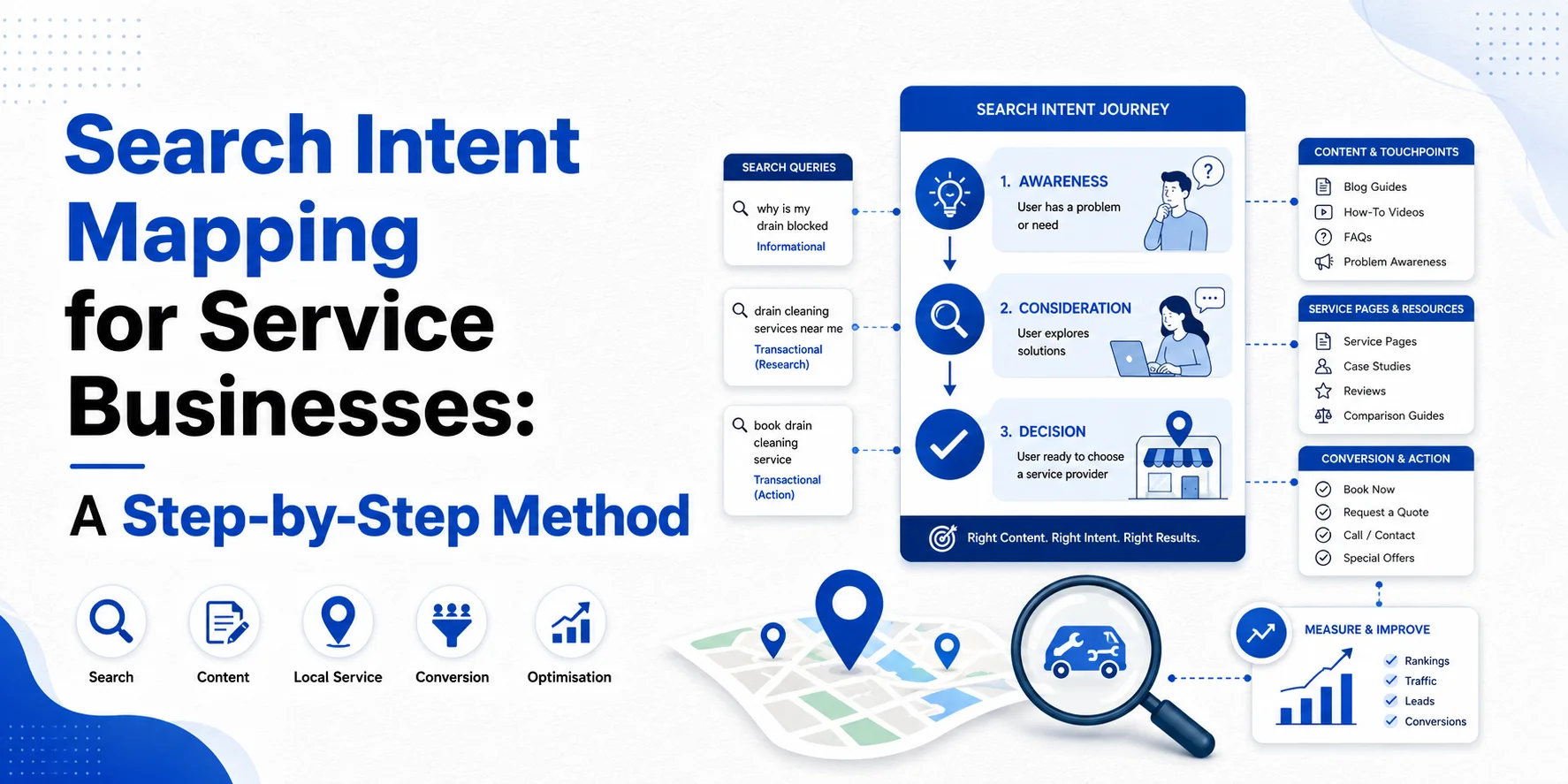
Getting more keywords isn’t always the answer. A service business can have hundreds of useful keywords and still struggle if those searches are sent to the wrong pages. Someone searching for “emergency electrician London” probably doesn’t want a long educational blog. They want an electrician. Someone searching for “why does my fuse box keep tripping?” has a different need. A useful guide may be the better page.
This is where search intent mapping comes in. Search intent mapping is the process of understanding what somebody wants to achieve with a search and assigning that search to the most suitable page on your website. At Wixdek, we normally give one URL one clear main purpose. That does not mean one keyword per page.
A page can target several closely related searches, but those searches should normally share the same main intent. This guide explains how to build a practical keyword-to-page mapping system for service businesses without creating dozens of pages that compete with each other.
What Is Search Intent in SEO?
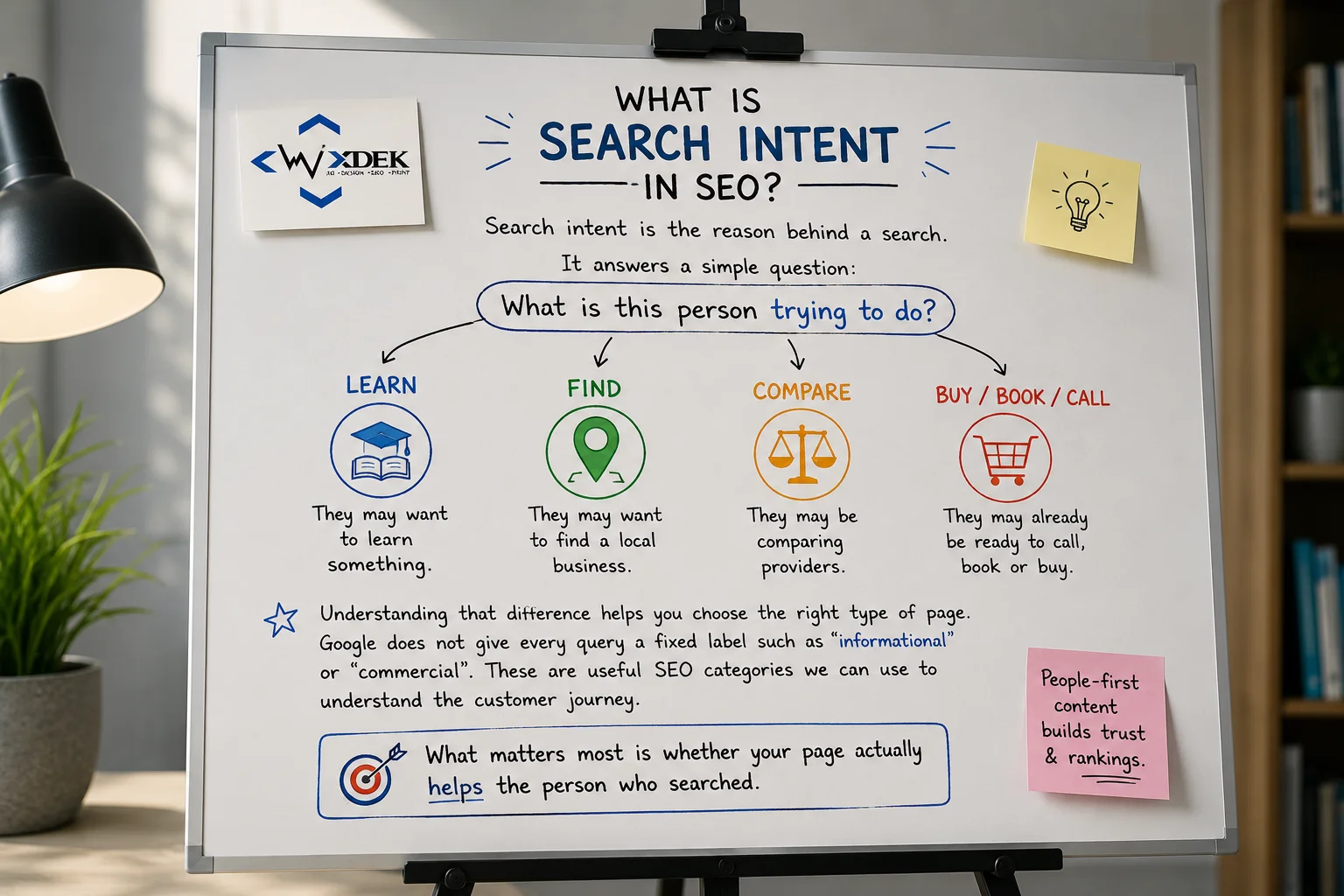
Search intent is the reason behind a search.
It answers a simple question:
- What is this person trying to do?
- They may want to learn something.
- They may want to find a local business.
- They may be comparing providers.
Or they may already be ready to call, book or buy. Understanding that difference helps you choose the right type of page. Google does not give every query a fixed label such as “informational” or “commercial”. These are useful SEO categories we can use to understand the customer journey. What matters most is whether your page actually helps the person who searched.
Google’s people-first content guidance asks site owners to create content that helps their intended audience achieve their goal rather than content made mainly to attract search traffic. Read Google’s people-first content guidance.
The Main Search Intent Types
For service-business SEO, most searches can be understood through a few broad intent types.
Informational Search Intent
The person wants an answer.
Examples include:
- “why is my boiler losing pressure?”
- “how often should an office be cleaned?”
- “what causes rats in a house?”
These searches often work well as blog posts, guides or FAQ-style resources. The reader may not be ready to book yet. But useful informational content can introduce the business and guide the person towards a related service when that makes sense.
Commercial Search Intent
The person is considering a service or provider.
Examples might include:
- “best commercial cleaning company London”
- “SEO agency vs SEO consultant”
- “emergency plumber near me”
- They are further down the customer journey.
Depending on the query, a service page, local page, pricing guide or comparison page may be more suitable than a general blog.
Transactional Search Intent
The person appears ready to take action.
A search such as:
- “book boiler repair London”
- or:
- “emergency electrician London”
shows a much stronger need than a broad educational search. The page should make the service clear and make contacting the business easy. For many local service companies, this is where strong service pages matter most.
Local Search Intent
Local intent appears when somebody is looking for a business in a specific area or near their current location.
Examples might include:
- “electrician Camden”
- “office cleaning Westminster”
- “locksmith near me”
Local results can appear across Google Search and Maps. Google says local results are mainly affected by relevance, distance and prominence. See Google’s local ranking guidance. A local query does not automatically mean you need to create a new location page. You still need to check whether the business genuinely serves that area and whether a separate page would provide useful information.
Navigational Search Intent
This happens when somebody is already looking for a specific company, page or brand.
For example:
- “Wixdek SEO”
- or:
- “Wixdek SEO consultant”
The homepage or relevant branded service page will often satisfy this type of search. You usually do not need to create new content just to capture every branded variation.
Search Intent Mapping Is Not One Keyword Per Page
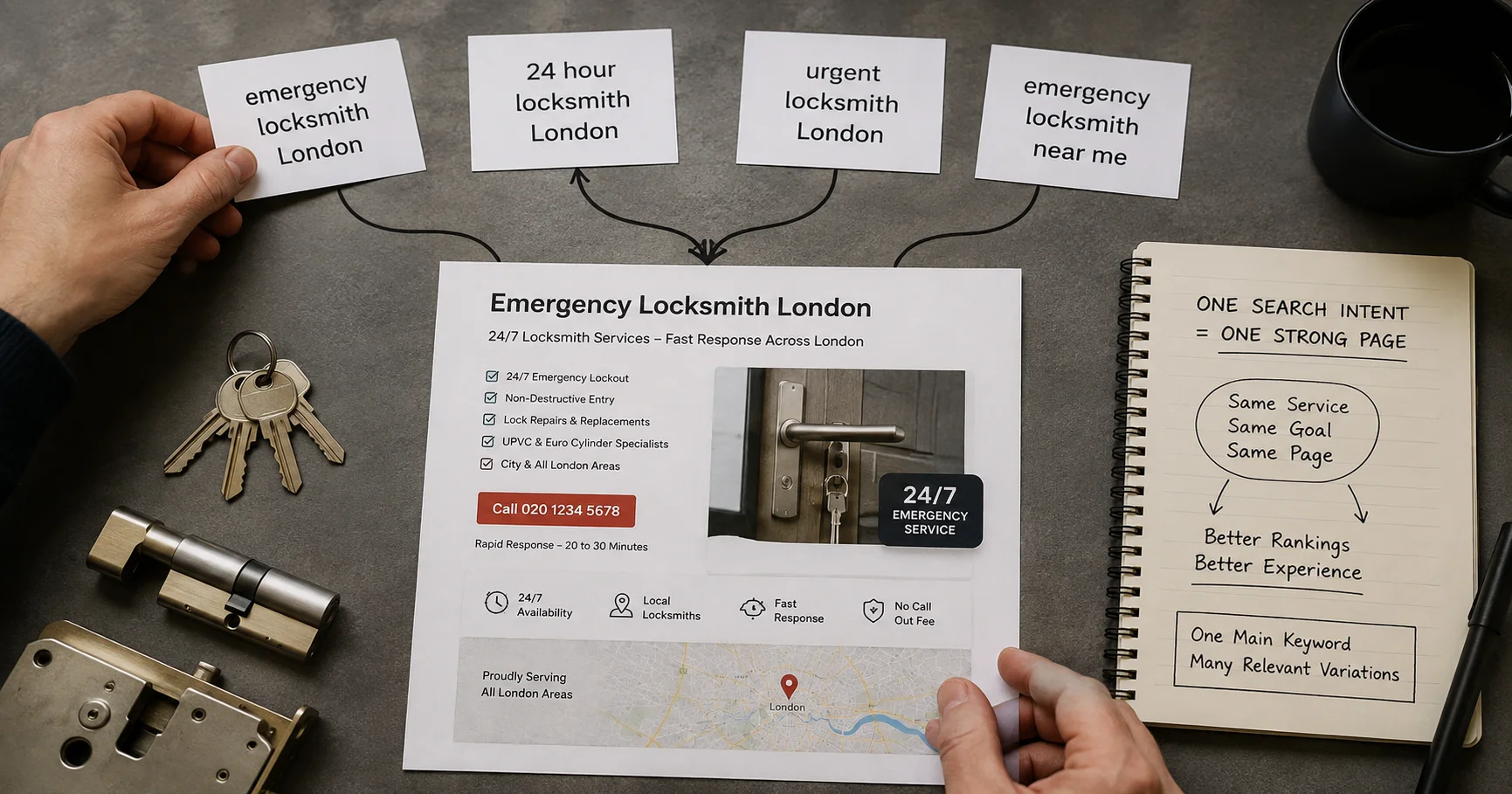
This is one of the most important parts of keyword intent mapping. A page does not need to target only one exact keyword. Imagine a locksmith service page.
These searches may all have very similar intent:
- emergency locksmith London
- 24 hour locksmith London
- urgent locksmith London
- emergency locksmith near me
Creating four almost identical pages could make the site harder to manage and create unnecessary overlap. A better approach may be one strong emergency locksmith page that naturally covers closely related searches. The rule is therefore better written as:
One main search intent per URL, not one exact keyword per URL.
That keeps the website clearer.
Why Search Intent Mapping Matters for Service Businesses
Poor keyword mapping usually creates one of two problems. The first is that the wrong page ranks. For example, a blog about emergency plumbing may appear when you actually want the emergency plumbing service page to attract ready-to-call customers. The second problem is page overlap. You may have four URLs trying to answer the same search.
Google then has several similar pages to understand, while users may not know which page contains the best answer. Good SEO keyword mapping gives each important search theme a clear home.
The Wixdek Search Intent Mapping Method
Our method follows a simple flow:
Query → Intent → Page Type → URL → Internal Links → Performance Review
Let’s go through it step by step.
Step 1: Start With the Business, Not the Keyword Tool
Before collecting thousands of keywords, understand what the business actually sells. Write down the main services. Then look at service areas, high-value work, customer questions and common buying decisions. For a London electrician, that might include emergency electrical work, residential electrical services and commercial work. Wixdek’s published London electrician case study shows this type of service setup, with emergency, residential and commercial electrical work. The campaign focused on ready-to-call searches, local relevance and service-specific intent. See the Wixdek London electrician case study.
Starting with the business stops keyword research becoming a huge list of searches with no commercial direction.
Step 2: Collect Relevant Search Queries
Now collect the search terms people use around those services. You can use keyword research tools, customer questions, existing website data and Google Search Console. Search Console is particularly useful because it shows queries that have already caused your website to appear in Google Search. Google’s Performance report lets you review queries, pages, clicks, impressions and CTR. You can also choose a query and see which pages Google has shown for it. See Google Search Console Performance guidance.
Don’t worry about assigning pages yet. First collect the useful search patterns.
Step 3: Group Queries by Meaning
Now stop looking at keywords as individual rows. Group searches that mean roughly the same thing.
For example:
- emergency electrician London
- urgent electrician London
- 24 hour electrician London
These may belong in one group because the person appears to need urgent electrical help.
Another group might contain:
- why does my fuse box keep tripping
- why does my electricity keep tripping
- what causes a fuse box to trip
- These searches have a different purpose.
The wording changes, but the informational search intent stays similar. This grouping is the heart of a good keyword mapping strategy.
Step 4: Check the Search Results
Before deciding which page type to create, look at the current search results. Search intent is not something you should decide only from the wording of the keyword. Look at what Google currently shows. Are most results service pages? Are they guides? Comparison pages? Directories? Local results? Product pages? Pricing guides? This gives you another clue about what people searching that phrase may find useful.
Do not blindly copy the page type used by the top result. Use the search results as evidence, then combine that evidence with your own customer knowledge.
What Does a Map Pack Tell You?
If Google shows a strong local result or Maps section, that is a useful clue that location matters for that search. Google explains that local results consider relevance, distance and prominence. That may support a local SEO strategy. It does not mean you should automatically create 50 town pages. Each location page still needs a real business purpose.
Step 5: Decide Which Page Type Fits the Intent
This is where the keyword-to-page mapping happens. For most service businesses, there are five page types that solve a large part of the problem.
When Does a Query Need a Service Page?
Use a service page when somebody is mainly looking for the service itself.
Examples include:
- commercial cleaning services London
- emergency electrician London
- rat control London
The page should explain what the service is, who it is for, where it is available and what the customer should do next. The purpose is not to teach the whole subject. It is to help somebody evaluate and contact the service provider.
Service Page Keyword Mapping
Closely related service queries can often share one page. For example:
| Query | Intent | Best page |
| emergency electrician London | Transactional | Emergency electrician service page |
| 24 hour electrician London | Transactional | Same emergency service page |
| urgent electrician London | Transactional | Same emergency service page |
You do not necessarily need a separate URL for every wording variation.
When Does a Query Need a Location Page?
A location page makes sense when location is a major part of the search and the business genuinely serves that area. For example:
electrician Camden
may justify a Camden-focused page if the business actually serves Camden and there is enough useful local information to make that page worthwhile. A strong location page should do more than swap one borough name for another. It should explain the relevant services, coverage, customer needs and real local context. Creating hundreds of nearly identical city or borough pages just to capture keyword variations is not a useful keyword mapping strategy.
When Does a Query Need a Blog?
Use a blog when the person mainly wants information. For example:
why does my fuse box keep tripping?
They are asking a question. A useful article can explain likely causes, what the person can safely check and when professional help may be needed. The blog can then link naturally to the relevant electrical service page. This allows the blog to support the commercial page instead of trying to replace it.
When Does a Query Need a Pricing Page?
Some searches are mainly about cost.
For example:
- electrician cost London
- commercial cleaning prices London
- how much does SEO cost in London
A dedicated pricing guide may work better than forcing a large pricing section into a service page or creating a broad informational article. Pricing pages can help people who are already considering the service but need to understand budget, pricing factors or what is included. The page should answer the cost question honestly. Do not create a pricing page if you cannot provide anything useful about price, cost drivers or budgeting.
When Does a Query Need a Comparison Page?
Comparison pages suit searches where somebody is choosing between options.
For example:
- SEO agency vs SEO consultant
- or:
- in-house cleaning vs commercial cleaning company
- The visitor is not asking what the service is.
- They are trying to make a decision.
A comparison page should explain the differences, strengths, limitations and which option suits which situation. That gives it a different purpose from the main service page.
A Simple Page-Type Decision Table
| Search behaviour | Likely intent | Page type |
| Wants the service | Commercial/Transactional | Service page |
| Wants the service in a specific area | Local/Commercial | Location page |
| Wants an answer | Informational | Blog or guide |
| Wants to understand cost | Commercial investigation | Pricing page |
| Wants to choose between options | Commercial investigation | Comparison page |
| Wants a specific brand | Navigational | Homepage or relevant branded page |
Use this as a starting point. The actual search results and business context should still guide the final choice.
Step 6: Assign One Main Intent to One URL
Once you know the page type, give the query group a home. Your SEO keyword mapping spreadsheet may look like this:
| Keyword group | Main intent | Page type | Target URL |
| Emergency electrician terms | Transactional | Service | /emergency-electrician-london/ |
| Camden electrician terms | Local commercial | Location | /electrician-camden/ |
| Fuse box problem questions | Informational | Blog | /why-does-fuse-box-keep-tripping/ |
| Electrician cost terms | Commercial investigation | Pricing | /electrician-cost-london/ |
| Electrician option comparisons | Commercial investigation | Comparison | Relevant comparison URL |
The goal is not to stuff every keyword into the page. The goal is to know which URL should satisfy each search need.
Step 7: Map Secondary Keywords to the Same Intent
Once the main page is chosen, add closely related terms. Imagine the main service page targets emergency electrician searches.
Secondary phrases may include:
- 24 hour electrician
- urgent electrical call-out
- emergency electrical repair
These can support the page if they match the same customer need. Do not create another URL simply because one phrase has slightly different wording. This is where good SEO keyword mapping saves a lot of unnecessary content.
Step 8: Check Existing Pages Before Creating New Ones
Before publishing anything, check what is already on the website. You may already have a suitable page. If so, improve it rather than creating another URL. This is where your SEO content audit framework becomes useful. Review the existing page and decide whether to:
- Keep it
- Improve it
- Merge it
- or:
- Remove it
Creating a new page should not be the default answer every time a keyword appears in research.
Step 9: Look for Intent Overlap
Now check whether two or more pages have been assigned the same main search intent.
Imagine the website already has:
- /emergency-electrician-london/
- and:
- /24-hour-electrician-london/
If both pages offer almost the same service to the same person at the same stage of the journey, you should ask whether both URLs genuinely need to exist. This is where keyword cannibalisation can start to become a concern. But do not call every shared keyword cannibalisation. Two pages may mention the same phrase while serving very different intents.
For example:
- Emergency Electrician London
- and:
- How Much Does an Emergency Electrician Cost?
- may overlap in wording but serve different customer questions.
Our guide on how to fix keyword cannibalisation without losing rankings covers that problem in more detail.
Step 10: Make Blogs Support Service Pages
This is where many service-business content strategies go off track. A company creates lots of blog articles, but those articles are not connected to the pages that make money.
Imagine a commercial cleaning company has a service page targeting:
- commercial cleaning London
- A useful supporting blog could target:
- how often should an office be professionally cleaned?
- The blog answers the informational question.
Then, where it makes sense, it links to the commercial cleaning service page. The service page remains the main destination for commercial intent. The blog helps somebody earlier in the customer journey and gives them a natural path towards the service.
That relationship should look like this:
- Informational query → Helpful blog → Relevant service page → Enquiry
- Not:
- Informational query → Blog trying to sell everything
- and not:
- Commercial query → Three blogs competing with the service page
Why Internal Linking Matters to Intent Mapping
Keyword mapping tells you which page should own the search intent. Internal linking helps reinforce the relationship between those pages. A service page may link to a useful pricing guide. A pricing guide may link back to the service. A blog may point to a commercial service when the reader needs professional help. Google recommends using links that are crawlable and useful to people, with anchor text that helps explain the destination. Search Console can then help you monitor which pages are appearing for important searches.
Our internal linking strategy for service websites will go deeper into how pillar pages, supporting content and commercial pages should connect.
Step 11: Use Search Console to Test the Mapping
Keyword intent mapping does not end when the spreadsheet is finished. After pages are live, check what Google is actually showing. In Search Console, choose an important query and then open the Pages view. Google’s documentation confirms that this lets you see which URLs from your site were shown for that query. If the intended page is appearing, that is useful evidence.
If a different page keeps appearing, investigate why. Maybe the wrong page is better optimised. Maybe the internal linking is unclear. Maybe two URLs overlap. Or perhaps your original understanding of the intent was wrong. The map should be updated when real performance data gives you a better answer.
Step 12: Review Clicks and Impressions, Not Rankings Alone
Average position can help, but it should not be the only measure used to judge whether the mapping works. Google recommends focusing more on trends in clicks and impressions than position alone. Look at whether the correct page is gaining impressions for the correct type of query. Then check clicks. For commercial pages, go one step further.
Check whether that traffic produces calls, forms, bookings or other useful actions. A perfectly mapped keyword that produces no business value may not deserve the priority you first gave it.
Worked Example: London Electrician Search Intent Map
Wixdek’s public London electrician case involved a business offering emergency, residential and commercial electrical services. The campaign focused on ready-to-call, local and service-specific intent, and eight priority service pages were optimised. The exact confidential keyword export is not public, so the map below is a worked example based on that verified service and intent setup, rather than invented Search Console data.
| Example query | Search intent | Best page type | Why |
| emergency electrician London | Transactional | Service page | The customer appears ready to contact an electrician |
| commercial electrician London | Commercial/Transactional | Service page | The search is for a specific electrical service |
| electrician Camden | Local commercial | Location page | Location is central to the search |
| why does my fuse box keep tripping | Informational | Blog | The person wants an explanation |
| electrician cost London | Commercial investigation | Pricing guide | Cost is the main question |
| emergency electrician vs regular electrician | Commercial investigation | Comparison page | The person is comparing service types |
The important part is not the keyword itself. It is the job each URL has.
Service Page
The emergency electrician page should focus on somebody who needs help. It should make the emergency service, availability, coverage and contact route clear.
Location Page
A Camden electrician page should only exist if the company genuinely serves Camden and can provide useful information for customers there. It should not be a copied London page with “Camden” pasted into the headings.
Informational Blog
The fuse-box article should answer the customer’s question. It can then guide people towards professional electrical help where appropriate.
Pricing Page
The cost guide should explain what affects electrician pricing, what customers may need to budget for and what information is needed for a quote.
Comparison Page
The comparison should help somebody decide which service or option fits their situation. Each page therefore plays a different role. That is search intent SEO in practice.
Another Example: Commercial Cleaning
The same keyword mapping strategy works in other service sectors. Imagine a London cleaning company. You might map:
| Search theme | Intended page |
| commercial cleaning London | Main commercial cleaning service page |
| office cleaning Westminster | Westminster location/service page |
| how often should an office be cleaned | Informational blog |
| commercial cleaning cost London | Pricing guide |
| in-house cleaner vs cleaning company | Comparison guide |
The informational blog should not be rewritten to target commercial cleaning London more heavily than the service page. Its job is different. This separation is what helps content clusters support commercial pages rather than compete with them.
What Should Go in a Keyword Mapping Spreadsheet?
You do not need an overcomplicated document. A practical Wixdek-style search intent map can contain:
| Field | What to record |
| Query or keyword group | Closely related searches |
| Main intent | Informational, commercial, transactional, local or navigational |
| Customer stage | Early research, comparing, ready to act |
| Page type | Service, location, blog, pricing or comparison |
| Target URL | The page that owns the intent |
| Secondary queries | Close variations |
| Existing page? | Yes or no |
| Overlapping URL | Possible competing page |
| Internal link target | Commercial or supporting page |
| CTA | What the reader should do next |
| Search Console check | Which URL Google actually shows |
This is enough to turn keyword research into a website plan.
Common Search Intent Mapping Mistakes
One common mistake is creating a new URL for every keyword variation. That usually creates unnecessary content. Another is putting informational and commercial intent into the same article because the keywords look similar. For example, “SEO audit checklist” and “technical SEO services London” may be related topics, but the user needs are different. A third mistake is making every blog target commercial service keywords.
Blogs should often support service pages, not replace them. The final mistake is never reviewing the map again. Search behaviour changes. Websites change. Your services change. Competitors change. A keyword map should be useful enough to update.
Don’t Copy the Search Results Blindly
Looking at Google results is useful. Copying them is not. If every top-ranking article contains ten sections, that does not mean you need the same ten sections. Google’s people-first guidance warns against mainly summarising what other pages already say without adding much value. Use the search results to understand likely intent. Then add your own experience, business information, examples and expertise.
For Wixdek content, that may include real campaign lessons, original diagrams, Search Console evidence, client scenarios or practical mapping examples.
Search Intent Mapping and the Customer Journey
A good website supports more than the final sale. Think of the journey like this:
Problem → Research → Compare → Decide → Contact
Different pages can support different moments. Someone asking why their office has a pest problem may start with a blog. Later, they may read a pest-control service page. Then they might check costs or reviews. Finally, they contact the business. You do not need to force the first page to do every job. A clearer journey usually makes the whole website easier to understand.
How Wixdek Maps Search Intent
At Wixdek, keyword mapping starts with the business. We look at the services, locations, customer needs and commercial priorities before deciding which searches deserve pages. Closely related keywords are grouped by meaning. Each group gets one main intent. Then we choose the page type that best fits that need. The final question is:
Which URL should be the clearest answer for this search?
If the answer is already an existing page, we improve that page where needed. If the query deserves a genuinely different page, we map a new URL. If several existing pages serve the same intent, we review the overlap before adding anything else. This keeps the website focused and helps prevent content from growing without a clear purpose.
Search Intent Mapping Graphic
Use this flow for the original Wixdek visual: Search Query → Identify User Need → Group Similar Queries → Choose Page Type → Assign One Main URL → Add Supporting Internal Links → Review in Search Console Under the Choose Page Type stage, show:
Service | Location | Blog | Pricing | Comparison
Suggested alt text: Search intent mapping process for service businesses showing how keywords are assigned to service, location, blog, pricing and comparison pages.
What Should You Do With an Existing Messy Website?
You do not need to rebuild everything. Start by exporting your existing pages. Then give each important page a main purpose. Compare that purpose with the searches it currently appears for. If the page already matches the right intent, keep or improve it. If several pages overlap, investigate whether they should be refocused or consolidated.
Use the SEO content audit framework to decide whether existing content should be kept, improved, merged or removed. Then use fix keyword cannibalisation without losing rankings when two URLs appear to be competing for the same purpose. Finally, use the internal linking strategy for service websites to connect informational pages with the commercial pages they support.
Build Pages Around People, Not Keyword Lists
Search intent mapping should make a website simpler. It should stop you from creating five pages where one good page would do the job. It should also stop you from forcing every valuable keyword into one huge page. Start with what the searcher needs. Then decide which type of page can answer that need best.
Map closely related searches to one clear URL. Use blogs to educate. Use service pages to explain services. Use location pages when location genuinely matters. Use pricing pages for cost questions. Use comparison pages when somebody needs help choosing. That gives both users and your SEO team a clearer website to work with.
Get Help With Search Intent and Keyword Mapping
If your website has lots of pages but you’re not sure which ones should target which searches, Wixdek can help you build a clearer keyword-to-page strategy. Our SEO services in London cover keyword research, search intent, content strategy, on-page SEO and implementation for businesses that want search visibility to lead to real enquiries. Wixdek’s current service approach focuses on high-intent searches and measurable leads rather than traffic alone.
If you already have an internal marketing or content team and need strategic guidance, you can also speak with an SEO consultant in London.
Request a Search Intent Review
Frequently Asked Questions
What Is Search Intent in SEO?
Search intent is the reason behind a search. It helps you understand whether somebody wants information, a service, a local provider, pricing information or help comparing options.
What Is Search Intent Mapping?
Search intent mapping groups related queries by what the user wants and assigns each group to the page best suited to answer that need.
How Do I Map Keywords to Pages?
Group similar keywords by meaning, identify their main intent, check the search results and then assign the group to a suitable service, location, blog, pricing or comparison page.
Should One Keyword Have One Page?
Not necessarily. Several closely related keywords can share one page when they have the same main intent. The better rule is usually one main intent per URL.
What Is Commercial Search Intent?
Commercial search intent appears when somebody is researching a service, provider, price or option before making a decision.
What Is Informational Search Intent?
Informational intent means the person mainly wants an answer or explanation. Blogs and guides often fit these searches well.
When Should I Create a Service Page?
Create or use a service page when the query shows that the person mainly wants the service itself and needs information that helps them contact or choose a provider.
When Should I Create a Location Page?
A location page can make sense when a business genuinely serves that area and the location is an important part of the customer’s search. The page should contain useful local information rather than copied text.
Should Blogs Target Service Keywords?
Blogs can mention and support service topics, but they should not normally compete directly with the main commercial service page. Give the blog its own informational purpose and link naturally to the service.
How Does Search Console Help With Keyword Mapping?
Search Console shows which queries make your website appear in Search and which pages Google shows for those queries. This can help you check whether the intended URL is appearing.
What Should I Do If Two Pages Target the Same Intent?
Review their queries, content purpose, links and performance. You may need to differentiate the pages, improve internal linking or consolidate them if they genuinely serve the same need.
How Often Should I Review a Keyword Map?
Review it when services, locations, website structure or search performance change. Search Console data can also reveal when Google starts showing a different page for an important query.