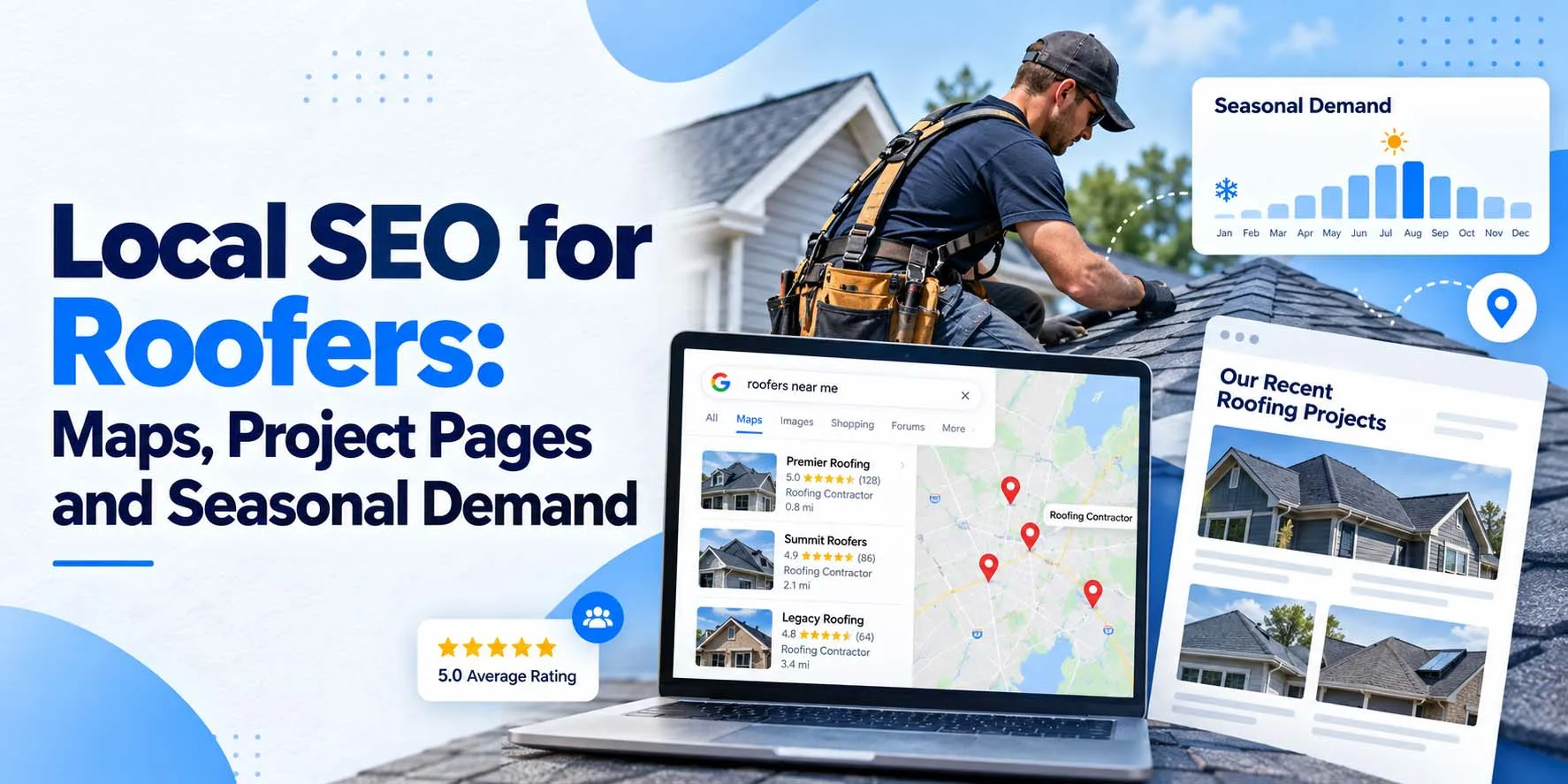
If you’re a roofer, being visible when someone needs roofing work matters.
A homeowner with a leaking roof doesn’t usually want to spend hours searching. They want a roofer who works nearby, has good reviews and looks trustworthy.
That’s where local SEO for roofers comes in.
Local SEO helps your roofing business appear when people search for roofing services in your area. It covers your Google Business Profile, website, service pages, location pages, reviews and other local signals.
But there’s another part that matters just as much.
Your website needs to show people that you actually do good work.
Photos of completed roofs, genuine project stories and local customer feedback can turn a basic roofing website into something much more convincing.
Seasonality matters too.
Roofing searches can change with the weather, storms and time of year. A good roofing SEO strategy plans for those changes instead of waiting until demand has already arrived.
This guide explains how local SEO for roofers works, how Google Maps can support local leads, how to use completed projects as useful website assets and how to plan around seasonal roofing demand.
What Is Local SEO for Roofers?
Local SEO for roofers means improving your online presence so nearby homeowners can find your business through Google Search and Google Maps when they need roofing work.
A customer might search for:
“roofer near me”
“roof repair London”
“roof leak repair Croydon”
“flat roofing contractor Ealing”
“roof replacement Wimbledon”
These searches can have very different levels of intent.
Someone searching “how to find a roof leak” may still be researching.
Someone searching “emergency roof repair near me” is much closer to making contact.
Your roofing website should therefore answer different customer needs while making the important services easy to find.
Google says local search results are mainly influenced by relevance, distance and prominence. It also recommends keeping Business Profile information complete and accurate. You can read Google’s official guidance on local ranking.
So roofing SEO isn’t simply about adding “roofer” to every page.
It’s about showing what you do, where you work and why customers can trust you.
Why Local SEO Matters for Roofing Companies
Roofing is often a problem-led service.
A homeowner may notice a water stain on the ceiling.
They may see broken tiles after a storm.
They may need a new roof before selling their property.
Or they may simply want an inspection before winter.
In each case, the customer needs to find a suitable roofer.
They may compare:
- Reviews
- Location
- Roofing services
- Previous work
- Photos
- Contact details
- Experience
- Accreditations
- Response information
If your business isn’t visible during that search, another roofer may get the enquiry.
That’s the bit many roofing companies overlook.
Being good at roofing doesn’t automatically make you visible online.
Your local presence needs to communicate that expertise.
How the Roofing Customer Search Journey Works
A strong roofing SEO strategy should cover different types of customer searches.
Emergency Roofing Searches
Emergency roofing searches often have strong buying intent.
Examples include:
“emergency roof repair near me”
“roof leaking after storm”
“emergency roofer London”
“storm damage roof repair Croydon”
The customer usually wants clear information quickly.
An emergency roofing page should make the service, coverage area and contact method obvious.
Don’t bury your phone number beneath five paragraphs of company history.
If someone’s ceiling is getting wet, they want to know what happens next.
Urgent local intent appears in other emergency services too. Our guide to local SEO for locksmiths explains how businesses can target high-intent searches where customers need help quickly.
Planned Roofing Searches
Other customers have more time to research.
They might be considering:
Roof replacement
Flat roof replacement
Roof repairs
Slate roofing
Tile roofing
Leadwork
Chimney repairs
Roof inspections
Gutter repairs
These services can have their own pages when they have different customer needs and enough useful information.
A roof replacement page should explain a different process from an emergency repair page.
That gives customers clearer answers and creates stronger topical coverage.
Google Business Profile for Roofers
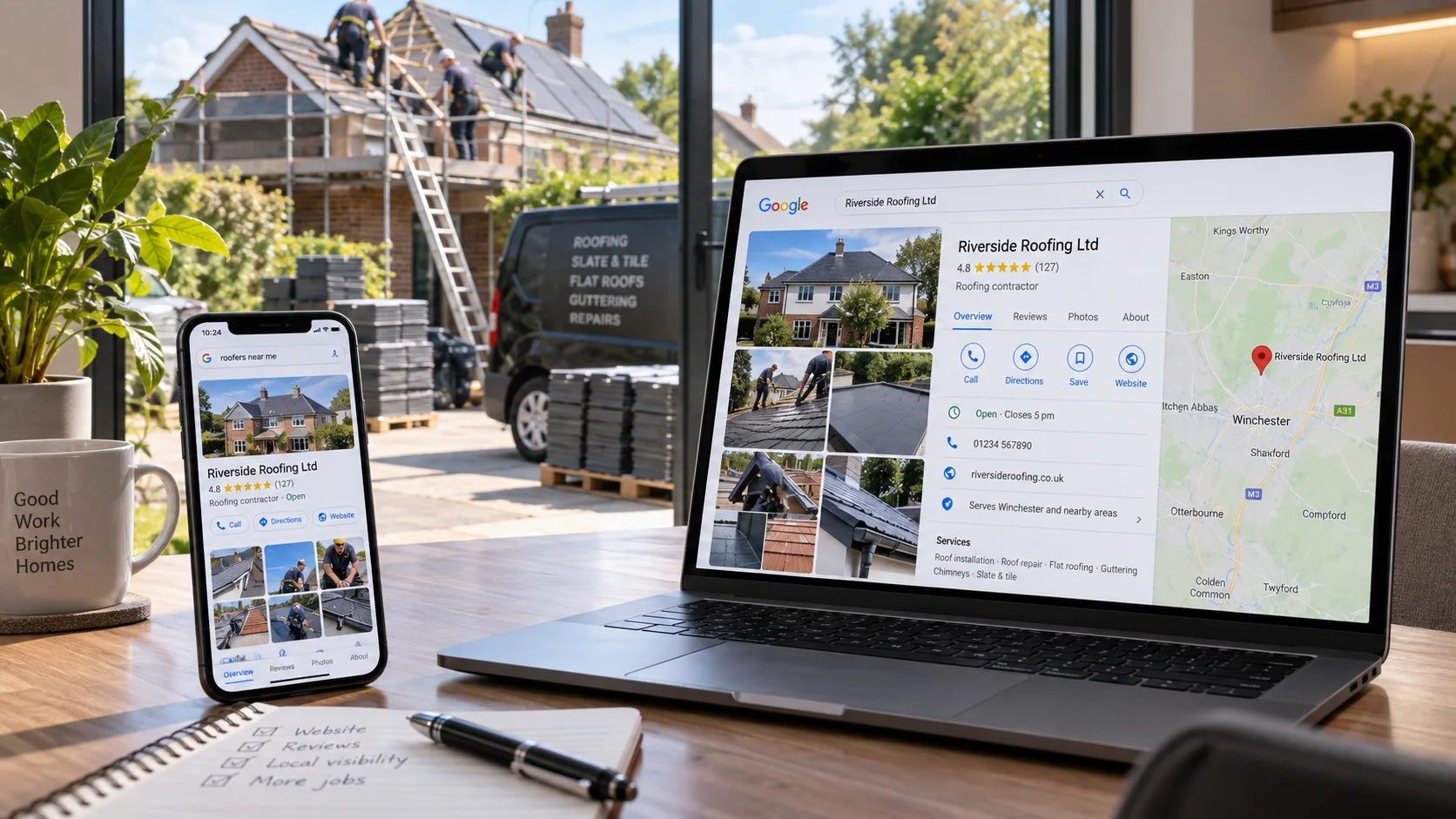
Your Google Business Profile is one of the key parts of local search.
It can help customers find your business through Google Search and Maps.
Start with the basics.
Make sure the profile contains accurate information about the real business.
This includes the business name, relevant category, contact details, opening hours and other information customers need.
Google also recommends adding photos and keeping your information up to date.
Choose the Right Business Category
Your primary category should accurately describe the main business.
Don’t choose categories because you think they might generate more searches.
Use the category that best represents what the roofing business actually does.
You can add relevant secondary categories where they genuinely apply.
For example, a roofer may offer several related services, but those services shouldn’t be used to create an inaccurate profile.
Add Real Roofing Photos
Photos can help customers understand the business before contacting you.
For a roofer, useful images could include:
- Completed roof projects
- Roofing teams at work
- Before and after images
- Different roofing materials
- Flat roof installations
- Slate or tile work
- Gutters and leadwork
- Company vehicles
Avoid filling the profile with generic stock photographs.
Real project photography gives customers something they can actually judge.
Google specifically provides businesses with the ability to add photos and videos to their Business Profiles.
Google Maps SEO for Roofers
Google Maps can be important for local roofing searches.
A customer may search for a roofer on their phone and compare several businesses before calling.
Your position can change depending on where the searcher is located and what they search for.
There is no permanent number-one Maps position.
Google states that businesses cannot request or pay for better local rankings. Instead, local results are mainly influenced by relevance, distance and prominence.
That means the strategy should focus on useful signals rather than shortcuts.
Keep the profile accurate.
Build genuine reviews.
Make the website useful.
Show real roofing experience.
Keep business information consistent.
Build relevant local authority.
Then measure the enquiries generated.
Roofing Service Pages
A roofing website should make its main services easy to understand.
A basic structure might include:
Roof Repairs
Roof Replacement
Flat Roofing
Slate and Tile Roofing
Emergency Roofing
Chimney Repairs
Leadwork
Gutter Repairs
Not every roofer needs all these pages.
Only create pages for services the business genuinely provides.
Each page should answer the questions customers have about that service.
For example, a roof repair page could explain common problems, what an inspection involves and when a repair may be appropriate.
A roof replacement page can explain the assessment, preparation, removal, installation and finishing process.
The content should help customers make a sensible decision.
Roofing Keyword Research
Good roofing keyword research starts with real services and customer problems.
Don’t begin by collecting hundreds of similar phrases.
Start with the searches that could realistically generate work.
| Search type | Example | Likely intent |
| Emergency | emergency roofer London | Very high commercial |
| Repair | roof repair Croydon | High commercial |
| Service | flat roof repair Ealing | High commercial |
| Replacement | roof replacement Wimbledon | Commercial |
| Location | roofer Richmond | Commercial |
| Problem | leaking roof repair | High commercial |
| Information | signs of roof damage | Informational |
| Cost | roof replacement cost UK | Commercial investigation |
This helps you decide which pages deserve attention.
A page should match the search intent behind the query.
There’s no need to force the exact keyword into every sentence.
Natural language works better for people and keeps the content readable.
Roofer Location Pages
Roofing businesses often serve several towns, boroughs or nearby areas.
For example, a London roofer may genuinely work across:
- Ealing
- Acton
- Chiswick
- Hammersmith
- Richmond
- Wimbledon
- Croydon
This can create useful opportunities for location pages.
But don’t create a page simply because a town has search volume.
The page needs to help someone looking for roofing services in that location.
Explain the areas you actually cover.
Mention relevant services.
Show genuine local projects where possible.
Include real customer feedback when permission has been given.
Make the contact process clear.
That creates a useful local resource rather than another keyword page.
Avoid Thin Location Pages
This is an important part of roofing SEO.
You shouldn’t create 100 pages that all say:
“We are a trusted roofer serving [location].”
Then change the location name and publish them.
That doesn’t give customers much value.
Google’s spam policies address doorway pages and other content created mainly to manipulate search results.
You can review Google’s Search spam policies before creating a large local page structure.
The better approach is simple.
Create fewer pages with more useful information.
Turn Completed Roofing Projects Into Local SEO Assets
This is one of the strongest opportunities for roofing companies.
A completed project isn’t just something to post on Facebook.
It can become useful website content.
Imagine your roofing company replaces a tiled roof on a Victorian terrace in Ealing.
You could create a project case study explaining the work.
For example:
Project: Roof replacement in Ealing
Property type: Victorian terrace
Problem: Damaged and worn roof covering
Work: Roof replacement and associated repairs
Materials: Relevant tiles, underlay and other project materials
Location: Ealing
Outcome: Completed roofing work
Add genuine photographs where the customer has given permission.
Now the project demonstrates experience.
It also gives potential customers a better idea of the work you actually carry out.
Why Roofing Project Pages Build Trust
Customers often want proof before choosing a roofer.
A service page tells them what you claim to do.
A project page can show what you’ve actually done.
That’s a big difference.
A useful project page might explain why the work was needed, what the inspection found, what work was completed and what the finished roof looked like.
Don’t exaggerate the result.
Don’t invent savings.
Don’t publish a customer quote that was never given.
Real project information is much stronger than made-up marketing language.
What to Include in a Roofing Project Page
A good project case study doesn’t need to be complicated.
Include enough information to tell the story.
You could show:
The property
Explain the type of building and general location.
The problem
Explain what needed attention.
The inspection
Describe what was found without making claims that weren’t actually established.
The work
Explain what your team completed.
The materials
Mention the relevant materials where useful.
The finished result
Show clear photographs and explain what was completed.
This creates genuine first-hand evidence.
It also gives you unique content that isn’t copied from another roofing website.
Use Local Project Proof Carefully
Local project information can make location pages stronger.
For example, an Ealing page could mention a genuine roof replacement completed in the area.
A Croydon page might feature a real repair project.
A Wimbledon page could show another completed job.
Don’t publish a customer’s exact address without permission.
You can usually describe the general area and property type instead.
Privacy matters more than an extra location keyword.
Roofing Reviews
Reviews are important because roofing work can involve significant spending.
Customers want to know whether a roofer is reliable.
Google says reviews and positive ratings can contribute to local prominence.
Build reviews naturally.
Ask genuine customers after completed work.
Make the process simple.
Respond professionally.
Don’t buy reviews.
Don’t write fake reviews.
Don’t ask customers to make false claims.
A genuine review about a roof repair is much more useful than a generic five-star sentence.
Trust Signals for Roofing Websites
Roofing customers are often choosing someone to work on an important part of their home.
Trust signals can therefore make a real difference.
Depending on the business, useful information can include:
- Genuine qualifications
- Relevant trade memberships
- Insurance details
- Guarantees where genuinely offered
- Customer reviews
- Real project photographs
- Clear business details
- Years of relevant experience
- Professional accreditations
Only show credentials that the business actually holds.
Don’t add a badge because it looks good on the page.
Customers should be able to understand what each trust signal means.
Trust and expertise matter in other high-consideration industries too. Our guide to local SEO for law firms looks at how reviews, expertise and location trust can support local visibility.
TrustMark and Roofing Businesses
TrustMark is a useful example of a recognised UK quality scheme for home improvement work.
TrustMark describes itself as the UK Government Endorsed Quality Scheme for work carried out in and around the home.
It says registered businesses are vetted against required standards and commit to good customer service.
If a roofing business is genuinely registered with TrustMark, that status can be shown accurately on the website.
You can direct customers to TrustMark’s homeowner guidance when explaining how to choose a tradesperson.
If the business isn’t registered, don’t suggest otherwise.
The same rule applies to every trade organisation and accreditation.
Roofing Safety and Expert Information
Roofing work involves working at height, so safety information needs to be handled carefully.
Don’t encourage homeowners to climb onto their own roofs to investigate damage.
Roof surfaces can be fragile, slippery or unsafe.
CITB warns that falls through fragile roofs and roof lights can cause serious injury or death. It also highlights roof repairs, inspections and gutter work among activities where these risks can occur.
For professional roofing businesses, CITB also provides training standards covering areas such as roof surveys, planning, safe working practices and working with different roofing systems.
This type of authoritative information can strengthen the trustworthiness of roofing content.
Technical SEO for Roofers
Good local SEO still needs a technically sound website.
A roofing website should be easy for both people and search engines to use.
Important pages should be crawlable and indexable.
The site should work properly on mobile.
Images should be compressed without losing useful quality.
Internal links should connect related services and locations.
Page titles should describe the actual page.
Broken links and unnecessary duplicate pages should be fixed.
This matters because roofing searches often happen on mobile devices.
A homeowner standing in the kitchen with a leaking ceiling doesn’t want to wrestle with a difficult website.
Click-to-Call for Roofing Leads
Make the phone number easy to find.
This is especially important on emergency roofing pages.
A mobile visitor should be able to tap the number and call.
Don’t make customers copy a number manually.
You can also track phone clicks and other enquiries as part of your measurement setup.
That helps you understand whether local search visibility is creating real business opportunities.
Local Business Structured Data
Structured data can help search engines understand suitable business information.
Google provides guidance on LocalBusiness structured data.
Depending on the page, this can describe information such as the business name, address and opening hours.
But structured data must match the information shown to visitors.
Don’t add fake reviews, locations or services to the markup.
Don’t use structured data as a way to make claims the page doesn’t support.
Accuracy matters.
Local Citations for Roofers
A citation is a mention of the business’s core details on another website.
These details may include the business name, address and phone number.
For a roofer, relevant citations could come from suitable trade directories, local business directories or other legitimate sources.
Don’t submit the business to hundreds of random websites just to create more listings.
Focus on useful and trustworthy places.
Check older listings too.
A roofer who moved from one address to another may still have old information sitting on several directories.
Keeping important business details accurate helps customers avoid confusion.
Seasonal Roofing Demand
Roofing demand isn’t always steady throughout the year.
Weather can affect both roofing problems and customer behaviour.
That’s why seasonal planning should be part of roofing SEO.
Spring and Summer Roofing Searches
Spring and summer can be useful periods for planned roofing work.
Homeowners may start looking at:
Roof replacement
Roof repairs
Roof inspections
Tile repairs
Flat roof work
Gutter repairs
Drier weather can also make planned exterior work easier to arrange.
This doesn’t mean every roofer will see the same pattern.
Use your own Search Console, lead and sales data to understand what happens in your market.
Autumn Roofing Searches
Autumn is a useful time to prepare homeowners for wetter and colder weather.
Relevant topics may include:
Roof inspections
Gutter cleaning
Roof leak checks
Storm preparation
Winter roof maintenance
A helpful article could explain what homeowners should check before the weather becomes harsher.
The aim isn’t to frighten people into booking work.
It’s to give them useful information before problems become more serious.
Winter and Storm-Related Searches
Winter can bring urgent roofing problems.
Heavy rain and strong winds may expose existing weaknesses.
Customers may search for:
“emergency roof repair”
“storm damage roofer”
“roof leaking after heavy rain”
“emergency roofer near me”
Emergency service pages should be ready before demand rises.
Don’t wait for the first major storm to start creating content.
Publish Seasonal Content Early
SEO content needs time to be crawled, indexed and evaluated.
That means seasonal content shouldn’t be published when the season is already in full swing.
A sensible planning window is around four to six weeks before a period when you expect demand to increase.
For example, winter roof preparation content could be refreshed before the wetter months arrive.
However, don’t treat four to six weeks as a ranking guarantee.
Search performance varies.
Use your own historical data to plan future updates.
Build a Roofing Content Calendar
A simple roofing content calendar can follow customer needs throughout the year.
For example:
| Period | Content focus |
| Early spring | Roof inspections and repairs |
| Late spring | Roof replacement and planned work |
| Summer | Roofing projects and maintenance |
| Early autumn | Gutters and winter preparation |
| Late autumn | Roof inspections and leak prevention |
| Winter | Emergency repairs and storm damage |
The exact timing should be adjusted based on your location and real customer demand.
A roofer in London may see different patterns from a roofer serving a rural area.
Your own data should guide the final plan.
Internal Linking for Roofing SEO
Internal links help connect related pages.
Imagine your main roofing page links to:
- Roof Repairs
- Roof Replacement
- Flat Roofing
- Emergency Roofing
- Areas We Serve
Then an Ealing location page could link to the roofing services actually offered there.
A project page could also link to the related service.
For example:
Ealing roof replacement project → Roof Replacement service
Or:
Croydon storm damage project → Emergency Roof Repair
These links make sense because they help the reader continue their journey.
For wider local SEO guidance, see Wixdek’s Local SEO service.
Build a Logical Roofing Website Structure
A simple website structure could look like this:
Roofing
│
├── Roof Repairs
├── Roof Replacement
├── Flat Roofing
├── Emergency Roofing
├── Roof Inspections
│
├── Projects
│ ├── Ealing Roof Replacement
│ ├── Croydon Roof Repair
│ └── Wimbledon Flat Roof
│
└── Areas We Serve
├── Ealing
├── Croydon
├── Wimbledon
└── Richmond
The exact structure will depend on the roofing company’s services and coverage.
You don’t need hundreds of pages.
You need useful pages that connect naturally.
Local Link Building for Roofers
Links from relevant websites can help build authority.
But don’t chase links simply because someone promises a large number.
A roofer could potentially earn mentions from:
- Local publications
- Property websites
- Community organisations
- Trade organisations
- Local business groups
- Construction resources
- Suppliers
- Genuine project partners
A completed project could also create an opportunity for a local story.
For example, a community building project involving roof repairs may be worth discussing with a local publication.
The important part is that the connection is genuine.
Turn Offline Roofing Work Into Online Authority
This is where offline work can become a real SEO asset.
Your team may complete dozens of roofing jobs each year.
Those jobs create experience.
With customer permission, some of that experience can become useful online evidence.
A project page can show the type of property, the problem, the work completed and the finished result.
A local publication may mention the project.
A customer may leave a review.
The website can link the project to a relevant service.
Now one completed job supports several parts of the online presence.
That’s much more useful than simply saying:
“We are experienced roofers.”
Show the experience instead.
How to Use Before and After Roofing Photos
Before and after images can be particularly useful for roofing businesses.
They help customers see the difference between the original problem and completed work.
For example, you might show:
Damaged tiles → repaired roof
Worn flat roof → completed replacement
Blocked guttering → cleared system
Damaged flashing → repaired flashing
Make sure the images are genuine.
Use captions where helpful.
Avoid editing images in ways that misrepresent the work.
And always consider customer privacy and permission before publishing property photographs.
Roofing Content Should Answer Real Questions
Your blog shouldn’t exist simply to create more URLs.
It should solve customer problems.
Useful topics could include:
- How do I know if my roof needs repair?
- How often should a roof be inspected?
- What causes roof leaks?
- How much does roof replacement cost?
- What should I do after storm damage?
- Should I repair or replace my roof?
- How long does a roof replacement take?
These questions can attract customers before they are ready to request a quote.
The article can then guide them towards the relevant service when professional help is needed.

Don’t Judge Roofing SEO by Rankings Alone
Ranking well is useful.
But rankings aren’t the final goal.
A roofing page can rank highly and still produce very few enquiries.
Maybe the service isn’t clear.
Maybe the page doesn’t show enough proof.
Maybe customers can’t find the phone number.
Maybe the business doesn’t explain its service area.
That’s why roofing SEO should be measured against meaningful outcomes.
Look at:
Search visibility → website visits → enquiries → quotes → booked work
That gives you a better picture of whether SEO is helping the business.
Common Local SEO Mistakes Roofers Make
Creating Hundreds of Town Pages
More pages don’t automatically mean more leads. Build location pages when they provide genuine local value.
Using the Same Project Story Everywhere
A project should be unique. Don’t copy one case study and change the town name.
Using Stock Roofing Photos
Stock images don’t show your actual work. Use real project photographs whenever possible.
Buying Fake Reviews
Fake reviews damage trust. Build genuine customer feedback instead.
Buying Random Links
A large number of unrelated links doesn’t equal strong local authority. Focus on relevant relationships and useful mentions.
Keyword Stuffing
You don’t need to write “roofer London” in every paragraph. Use natural language and explain the service properly.
Ignoring Seasonal Demand
Don’t wait until the first winter storm to publish emergency roofing content. Plan ahead.
Making Unsupported Claims
Don’t claim to be the best roofer in your city without evidence. Don’t promise response times you can’t consistently deliver. Don’t claim accreditations the business doesn’t hold.
Trust is worth more than a flashy claim.
A Practical Local SEO Framework for Roofers
A useful roofing SEO strategy can be built around six areas.
1. Optimise Your Google Business Profile
Keep the profile accurate, complete and relevant to the real business.
2. Build Strong Service Pages
Give important roofing services their own useful pages where the search intent is different.
3. Create Useful Location Pages
Cover areas the business genuinely serves and provide information that helps local customers.
4. Publish Real Project Evidence
Turn completed roofing work into genuine case studies, photos and local proof.
5. Plan Around Seasonal Demand
Create and refresh useful content before demand rises.
6. Measure Leads
Track calls, enquiries, quote requests and booked work rather than relying only on rankings.
This keeps the strategy focused on customers.
A Simple Roofing SEO Example
Imagine a roofing company serving West London.
It provides roof repairs, roof replacements, flat roofing and emergency callouts.
The website has four strong service pages.
The company also has useful location pages for Ealing, Acton and Chiswick.
Each page explains the services genuinely available in that area.
The company has completed several real roofing projects nearby.
With permission, those projects become case studies with photographs and explanations.
The Business Profile contains accurate information.
Genuine customers leave reviews.
The website makes it easy to call from a mobile phone.
Seasonal content is updated before winter and storm periods.
Now the website is doing more than targeting keywords.
It’s showing customers what the roofer actually does.
Similar local search principles also apply across other home-service trades. If you work in related sectors, see our guide to local SEO for electricians for another trade-focused approach to services, locations and lead generation.
How Wixdek Approaches Local SEO for Roofers
At Wixdek, we believe roofing SEO should start with the customer.
A roofer doesn’t need traffic for the sake of having traffic.
The aim is to attract people who need roofing work in the areas the business actually serves.
We look at the services, locations, competition and existing online presence.
From there, we can identify opportunities across the Google Business Profile, website, service pages, location pages, project content, internal links and technical SEO.
Completed work can also become part of the strategy.
Real project evidence can help demonstrate experience while giving customers useful information about the services they are considering.
Seasonality is another part of the plan.
Instead of waiting for demand to arrive, the content strategy can prepare for the searches that matter during different periods of the year.
For broader industry SEO support, explore the industries we work with. For wider local search support, explore Wixdek’s Local SEO service.
Local SEO for Roofers Checklist
Before launching or reviewing a roofing SEO campaign, check the following:
- Is the Google Business Profile accurate?
- Is the main business category relevant?
- Are the real roofing services listed?
- Are business details consistent?
- Are important roofing services covered by useful pages?
- Are location pages genuinely useful?
- Are completed projects being used as proof?
- Are real roofing photographs available?
- Are genuine customer reviews being collected?
- Are relevant accreditations shown accurately?
- Is the website easy to use on mobile?
- Is the phone number easy to find?
- Are service and location pages internally linked?
- Is structured data accurate?
- Are calls and enquiries being tracked?
- Is seasonal content planned ahead?
- Are SEO results being compared with actual leads?
If several answers are no, there’s probably room for improvement.
Final Thoughts
Local SEO for roofers isn’t about filling a website with roofing keywords.
It’s about helping the right homeowner find the right roofing service in the right area.
Google Maps can help customers discover the business.
Service pages can explain what you actually offer.
Location pages can support genuine local searches.
Project pages can show real experience.
Reviews can help build confidence.
Seasonal content can prepare the website for changing demand.
Most importantly, don’t rely on shortcuts.
Show the work you’ve actually completed, explain your services clearly and build pages that are useful to real customers.
That’s how roofing SEO becomes more than a ranking exercise.
It becomes a practical way to help local homeowners find a roofer they can trust.
Frequently Asked Questions
What is local SEO for roofers?
Local SEO for roofers is the process of improving a roofing company’s visibility in Google Search and Google Maps for relevant local searches. It can include Business Profile optimisation, service pages, location pages, reviews, citations, project content and technical SEO.
How does local SEO help roofing companies?
It can help roofing companies appear when nearby customers search for roofing services. The aim is to turn that visibility into useful actions such as calls, enquiries, quote requests and booked roofing work.
Does Google Business Profile help roofers?
Yes. A complete and accurate Business Profile can help Google understand the business and its relevance to local searches. Google says local ranking is mainly influenced by relevance, distance and prominence.
How do roofers improve Google Maps visibility?
There is no guaranteed way to secure a particular Maps position. Roofers should focus on accurate Business Profile information, genuine reviews, useful website content, real project evidence and other signals that support local relevance and prominence.
Should roofers create location pages?
Location pages can be useful when the roofer genuinely serves those areas and each page provides useful local information. Avoid creating large numbers of almost identical pages simply to target town names.
What should a roofing project page include?
A project page can explain the property type, original problem, inspection, work completed, materials and finished result. Genuine photographs and customer permission can make the page much more useful.
Why are project pages useful for roofing SEO?
They can demonstrate real experience rather than simply claiming that the company is experienced. They can also support relevant service and location pages through internal links.
Are reviews important for roofing SEO?
Reviews can help customers judge a roofing company’s reputation, and Google says review information can contribute to local prominence. Focus on genuine reviews from real customers.
Why does seasonal demand matter for roofers?
Roofing problems and customer searches can change with weather and time of year. Planning content ahead of expected demand gives the website time to be crawled and build visibility.
When should roofers publish seasonal content?
A useful starting point is around four to six weeks before an expected busy period. However, there is no guaranteed ranking timeframe, so use your own Search Console and lead data to improve future planning.
What roofing services should have their own pages?
Important services with different customer needs may deserve separate pages. Examples can include roof repairs, roof replacement, flat roofing, emergency roofing and roof inspections.
Should roofers use before and after photos?
Yes, genuine before and after photographs can help customers understand the work. Make sure the images accurately represent the project and that you have permission to publish property or customer-related photographs.
Are roofing accreditations useful on a website?
Genuine accreditations and memberships can provide useful trust signals. Only display credentials that the business actually holds and explain them clearly where appropriate.
How long does local SEO for roofers take?
There is no fixed timeframe. Some improvements may appear sooner, while stronger visibility can take longer in competitive markets. Track meaningful trends instead of expecting instant results.
How can roofers measure SEO leads?
Track useful actions such as phone calls, contact forms, quote requests and bookings. Where possible, connect enquiries with sales records so you can see which leads become actual roofing jobs.
Ready to Improve Your Roofing Visibility?
If your roofing business is visible online but isn’t generating enough enquiries, rankings may not be the only issue.
Your Google Business Profile, service pages, location coverage, project evidence, reviews and website experience all play a part.
Wixdek can review your current local search presence and identify where potential customers may be getting lost.
Request a Local SEO Review