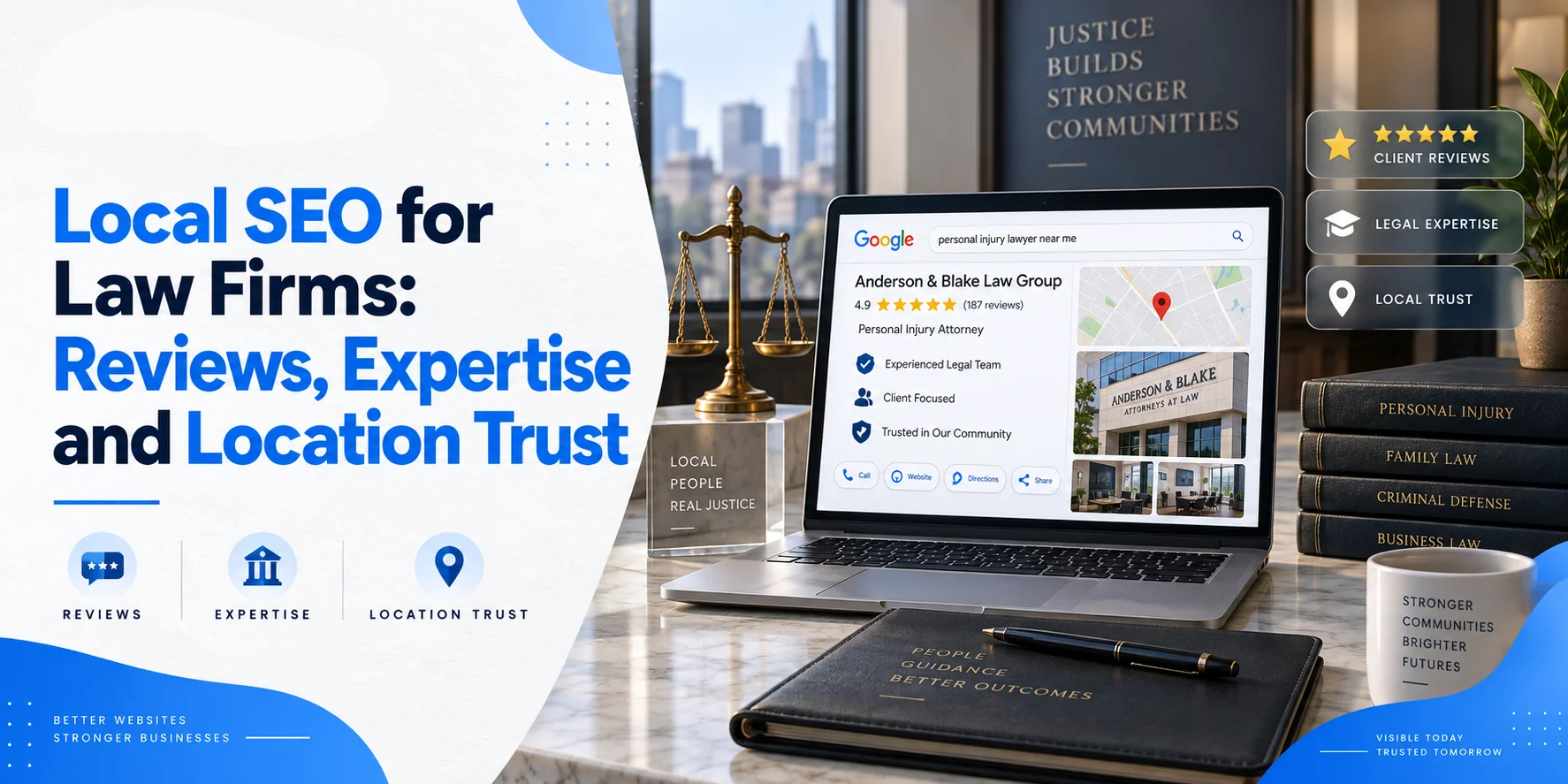
Finding a solicitor online can feel like a big decision.
A person may be dealing with a divorce, buying a home, facing an employment dispute or trying to understand their legal rights. They don’t just want the nearest law firm. They want someone who looks experienced, trustworthy and suitable for their situation.
That’s why local SEO for law firms needs more than keywords and location names.
Your firm needs to be visible in relevant local searches, but it also needs to give potential clients reasons to trust you.
That means your Google Business Profile, website, reviews, solicitor profiles, practice area pages and office information all need to work together.
The goal isn’t simply to get more website traffic.
The goal is to help the right people find your firm, understand what you do and feel confident taking the next step.
This guide explains how local SEO for law firms works, how Google Maps fits into the process, how to build location and practice area content, and how to use genuine expertise and trust signals without making unsupported claims.
What Is Local SEO for Law Firms?
Local SEO for law firms is the process of improving a firm’s visibility in Google Search and Google Maps for relevant legal searches in the areas it genuinely serves.
A potential client might search for:
“family solicitor near me”
“conveyancing solicitor London”
“employment solicitor Croydon”
“divorce solicitor Wimbledon”
“commercial solicitor Manchester”
These searches can have very different intent.
Someone searching for “what does a divorce solicitor do?” may still be researching.
Someone searching for “family solicitor near me” may already be considering contacting a firm.
Your SEO strategy needs to understand that difference.
Local SEO should therefore connect three things:
- The legal service
- The location
- The client’s need
When those three areas are clear, your website becomes much easier for users and search engines to understand.
Search urgency can vary greatly between industries. For comparison, our guide to local SEO for locksmiths looks at highly urgent local searches where customers may need to contact a business within minutes.
Why Local SEO Matters for Law Firms
Legal searches are often built around trust.
A potential client may compare several firms before making contact. They may look at reviews, solicitor profiles, areas of practice, office locations, credentials and the information available on the firm’s website.
That creates a simple problem.
A firm can have excellent solicitors and years of experience, but potential clients may never discover it.
Another firm with a stronger local presence may get the enquiry instead.
Local SEO helps close that gap.
It gives your firm a way to appear when people are looking for legal services in relevant areas.
But visibility is only the first part.
The website and local profile then need to answer the questions people have before contacting a solicitor.
How a Local Legal Search Journey Works
A typical search journey might look like this:
Google search → local results → law firm’s profile → website → practice area page → solicitor profile → enquiry
Different clients may enter at different points.
Someone may find the firm through Google Maps.
Another person may read a legal guide first and then visit a service page.
Someone else may search directly for a solicitor by name.
Your website should support all of these journeys.
It should also make it easy for a visitor to understand what happens next.
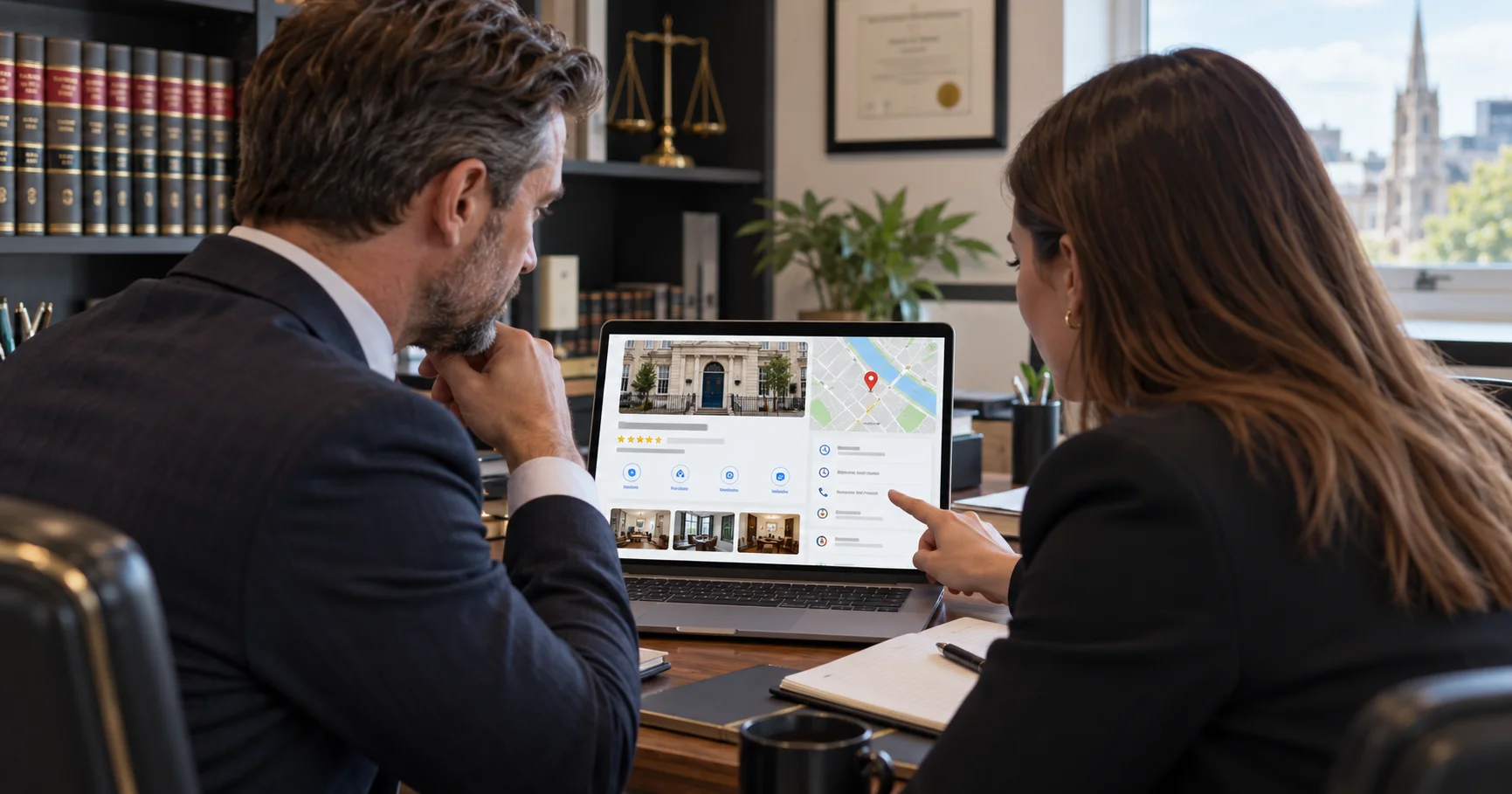
Google Business Profile for Law Firms
Your Google Business Profile is an important part of local visibility.
It can help your firm appear when people search for relevant legal services and businesses nearby.
Google says local results are mainly based on relevance, distance and prominence. It also explains that complete business information helps Google understand which searches a business is relevant to. Reviews and links from other websites can also contribute to local prominence.
You can read Google’s guidance on improving local rankings.
For a law firm, make sure the profile reflects the real business.
Important information includes:
- Correct firm name
- Accurate address
- Correct telephone number
- Opening hours
- Relevant business category
- Website
- Genuine photographs
- Appropriate services
- Genuine customer reviews
Don’t add extra locations simply to target more searches.
Don’t turn the business name into a list of keywords.
Accuracy should come first.
Choose Relevant Google Business Profile Categories
Your primary category should describe the firm’s main business as accurately as possible.
Additional categories should also reflect genuine services or business activities.
Don’t choose categories simply because you think they have more search volume.
For example, a firm focused mainly on family law should not select unrelated categories just to capture additional searches.
Your profile should match what the firm actually offers.
This sounds obvious, but local SEO gets messy when businesses try to chase every possible keyword.
Keep Law Firm NAP Information Consistent
NAP means:
Name
Address
Phone number
These details should be accurate across important online sources.
For example, if the firm’s website shows one office address but an old directory lists another, potential clients may become unsure which information is correct.
The same problem can happen after a firm moves office or changes telephone numbers.
Review important business listings and update outdated information where possible.
Consistency makes the firm’s online presence clearer.
Build Location Pages for Genuine Offices
Location pages can be useful when a law firm has multiple offices or genuinely serves different areas.
A firm with offices in London, Croydon and Reading could have separate pages explaining each office.
But each page needs to provide useful information.
A good office page might include:
Office address
Contact details
Opening hours
Directions
Services available
Solicitors working from that office
Relevant local information
This gives the page a real purpose.
It also helps visitors decide whether that office is suitable for them.
Don’t Create Hundreds of Thin Location Pages
This is an important point for local SEO for solicitors.
You don’t need a page for every postcode, neighbourhood or nearby town.
Creating pages that only swap one location name for another doesn’t give users much value.
Google’s spam policies specifically address doorway abuse, including substantially similar pages created to rank for specific searches or locations.
A better approach is to create fewer, stronger location pages.
If a firm genuinely has an office in a location, give that office useful information.
If it serves an area without having an office there, explain that honestly rather than pretending to have a local branch.
Practice Area Pages Matter
Law firms often cover several areas of law.
For example, a firm may provide:
Family law
Conveyancing
Employment law
Commercial law
Personal injury
Immigration
Wills and probate
These services have different search intent.
A person looking for a conveyancing solicitor needs different information from someone looking for an employment solicitor.
That is why important legal services should usually have their own useful pages.
Build Detailed Legal Service Pages
A good practice area page should answer the questions a potential client is likely to have.
For example, a conveyancing page could explain the type of matters handled, the usual stages, who deals with the work and what information the client may need.
An employment law page could explain the types of employment matters the firm handles and who may benefit from legal advice.
The page should remain clear and factual.
Avoid making promises about the outcome of a case.
Legal outcomes depend on the facts, evidence and circumstances of each matter.
Use Local Relevance Without Forcing Keywords
A page doesn’t need to repeat “solicitor London” in every paragraph.
Instead, make the local connection naturally.
Explain where the office is.
Mention the areas genuinely served.
Show which solicitors work from that office.
Use real local project or client information where appropriate and permitted.
Link to relevant local pages.
This gives the page genuine local context without making the copy sound forced.
Law Firm Reviews and Local Trust
Reviews can have a major effect on how potential clients judge a law firm.
Someone looking for legal help may compare several firms before deciding who to contact.
Google also says reviews and positive ratings can contribute to local prominence.
But reviews shouldn’t become a numbers game.
A better approach is to create a clear and ethical process for requesting feedback from genuine clients.
Ask at an appropriate point after the matter or service.
Make it clear that you want honest feedback.
Then respond professionally.
Trust before contact matters in other professional services too. Our guide to local SEO for dentists and clinics explains how reviews, local visibility and trust can influence a potential patient’s decision.
How Law Firms Should Handle Reviews
Positive reviews give firms an opportunity to thank clients.
Negative reviews need more care.
Don’t reveal confidential client information while responding.
Don’t discuss case details publicly.
Don’t become defensive.
A simple professional response can show that the firm takes feedback seriously without exposing private information.
For law firms, this matters because confidentiality and professional conduct should come before marketing.
Build Review Velocity Naturally
A steady flow of genuine reviews is generally more useful than a sudden burst of artificial-looking feedback.
The process can be simple.
After completing suitable work, the firm can invite the client to leave an honest review.
The request should not pressure clients to give a particular rating.
Don’t buy reviews.
Don’t create fake client accounts.
Don’t offer misleading incentives for positive feedback.
The strongest reputation is built through genuine client experiences.
Legal SEO Trust Signals
Legal services are high-trust services.
A visitor may want to know who will actually handle their matter before making contact.
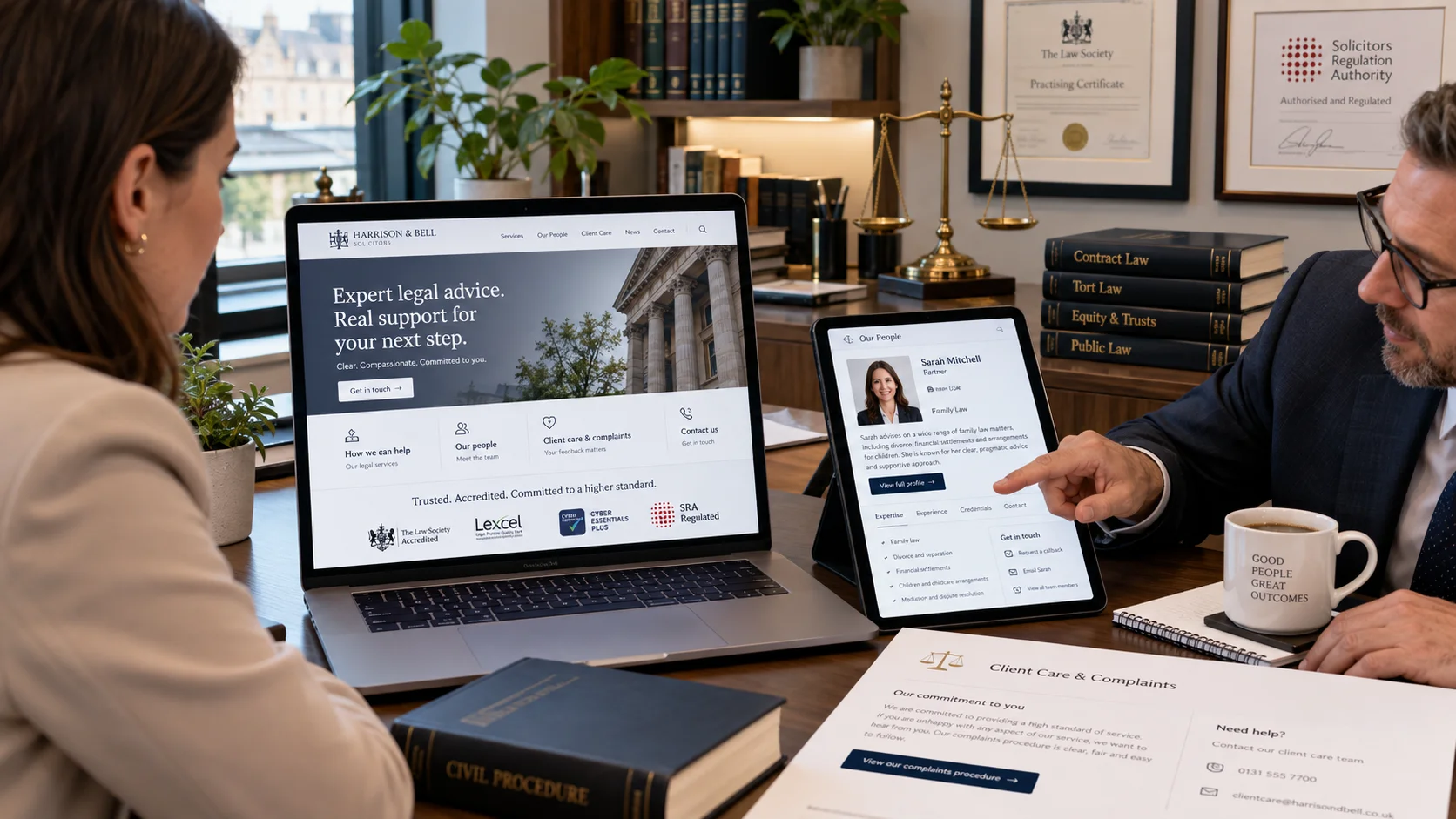
This is where strong solicitor profiles can help.
Instead of only saying:
“Our experienced team can help.”
show who the team is.
A solicitor profile could explain their role, practice areas, professional background and relevant experience.
Where appropriate, include links to fuller professional profiles.
This gives the visitor something concrete to assess.
Show Genuine Solicitor Expertise
Expertise should be demonstrated rather than claimed.
For example, a legal article about residential conveyancing could identify the solicitor who wrote or reviewed it.
Their profile could explain their relevant experience.
A complex employment article could be reviewed by a solicitor who works in employment law.
This creates a clearer connection between the advice and the person responsible for it.
Don’t use generic author names for specialist legal content if a named expert is genuinely responsible for the work.
Use the SRA Register as a Trust Resource
For SRA-regulated firms and solicitors, the Solicitors Regulation Authority provides an official register.
The SRA describes its Solicitors Register as the definitive impartial source for information about the law firms and people it regulates.
You can use the SRA Solicitors Register when checking regulatory information.
Law firms should make sure their regulatory details are accurate.
The SRA Transparency Rules require authorised bodies to display their SRA number and the SRA digital badge prominently on their website.
Only display regulatory information that applies to the actual firm.
SRA Trust Signals on Your Website
If a firm is regulated by the SRA, regulatory information should be easy for visitors to find.
This can include the firm’s SRA number and the required SRA digital badge.
The website should also make it easy for potential clients to understand who they are dealing with.
That means clear firm details, accurate solicitor information and transparent service information.
The aim isn’t to cover every page with regulatory badges.
The aim is to make important information easy to verify.
Legal Pricing and Transparency
Trust isn’t only about reviews.
People also want to understand what a legal service may involve and what it could cost.
The SRA Transparency Rules require certain regulated firms to publish price and service information for specified legal services. The rules cover areas including residential conveyancing, uncontested probate, certain immigration services, some motoring offences, employment tribunal work, certain debt recovery and business licensing services.
Where the rules apply, firms need to provide information such as costs, the basis for charges, likely disbursements, VAT treatment and what is included.
They also require information about key stages, typical timescales and the experience and qualifications of people carrying out the work.
This is useful from both a compliance and user-experience point of view.
Potential clients can make better-informed choices when important information is easy to understand.
Make Complaints Information Easy to Find
Complaints information is another important trust signal.
The SRA Transparency Rules require authorised firms to publish details of their complaints handling procedure, including information about how and when a complaint can be made to the Legal Ombudsman and the SRA.
Don’t hide this information somewhere that visitors cannot find.
Clear information helps people understand what happens if something goes wrong.
It also shows that the firm takes client care seriously.
Law Firm E-E-A-T
E-E-A-T stands for:
Experience
Expertise
Authoritativeness
Trustworthiness
For legal websites, these ideas are particularly important because legal information can affect major decisions.
However, E-E-A-T should not be treated as a simple ranking checklist.
Google’s systems use many signals, while its quality guidance places strong emphasis on helpful, reliable information and the people responsible for creating it.
The practical lesson is simple.
Show readers why they should trust the information.
Experience: Show What the Firm Actually Does
A law firm website becomes more useful when it shows real experience.
That could include genuine case studies where confidentiality allows.
For example, a firm could explain a completed commercial property matter without revealing private client information.
It might describe:
The type of matter
The main challenge
The work completed
The general outcome
Don’t publish confidential information.
Don’t invent case studies.
Don’t create fictional client stories and present them as real.
Real experience is much stronger.
Expertise: Put the Right Person Behind the Content
Legal content should have clear ownership.
If an article explains a specialist area of law, identify the writer or reviewer where appropriate.
Link to their profile.
Explain their relevant professional background.
Keep the information current.
This creates a much clearer relationship between the legal guidance and the person responsible for it.
Authority: Earn Relevant Mentions
Authority can also come from outside your website.
A law firm may earn relevant mentions from:
Professional organisations
Industry publications
Local publications
Community organisations
Legal directories
Professional events
The important word is relevant.
Don’t buy hundreds of unrelated links.
Don’t use private blog networks simply to manipulate rankings.
A genuine article, local contribution or professional resource can create a much stronger signal.
Trust: Make Verification Easy
Trust grows when visitors can check important information.
Make it easy to find the firm’s:
Office details
Solicitor profiles
Regulatory information
Practice areas
Contact details
Complaints procedure
Relevant pricing information
Reviews
The exact information required will depend on the firm’s regulatory position and services.
Accuracy matters more than having a huge list of badges.
Google Maps SEO for Solicitors
Google Maps can be particularly useful for local legal searches.
Someone may search for:
“solicitor near me”
“family solicitor near me”
“conveyancing solicitor near me”
“employment solicitor near me”
The firm’s profile needs to accurately represent the business.
But don’t assume that adding more keywords will automatically improve Maps visibility.
Google says local results depend mainly on relevance, distance and prominence.
That means the focus should be on genuine relevance and a trustworthy business presence.
Multi-Office Law Firm SEO
A firm with several offices has a different SEO challenge.
Each office may have different solicitors, opening hours, contact details and local services.
The website should make those differences clear.
A multi-office structure might look like:
Law Firm
│
├── Practice Areas
│ ├── Family Law
│ ├── Conveyancing
│ ├── Employment Law
│ └── Commercial Law
│
└── Offices
├── London
├── Croydon
└── Reading
Each office page can then link to the relevant practice areas.
This creates a useful relationship between service and location.
Link Practice Areas and Locations Together
Internal linking is often overlooked.
Suppose a firm has a family law page and a Croydon office page.
The Croydon page can link to the family law service where that service is offered from the office.
The family law page can link to the relevant office.
This helps visitors move naturally between information.
It also creates a clearer website structure.
For wider local SEO strategy, you can explore Wixdek’s Local SEO services.
Build Useful Local Legal Content
Your blog can support local SEO without becoming a collection of thin city pages.
Think about questions clients genuinely ask.
For example:
What does a conveyancing solicitor do?
What should I ask a family solicitor?
When should I speak to an employment solicitor?
What happens during a property purchase?
How does probate work?
These topics can attract people before they are ready to contact a firm.
A useful article can then link to the relevant practice area.
That creates a natural journey from information to professional help.
Legal Content Should Avoid Overpromising
This is especially important for law firm SEO.
Avoid claims such as:
“We guarantee you’ll win.”
“We always get the best result.”
“We’re the number one solicitor in London.”
Unless a claim can be properly supported and is appropriate under applicable professional rules, don’t use it.
Legal matters are rarely that simple.
The better approach is to explain the firm’s experience, services and process clearly.
Let the evidence speak for itself.
Use Clear Legal Disclaimers Where Needed
Informational content should not accidentally look like personalised legal advice.
For suitable articles, a short disclaimer can explain that the information is general and doesn’t replace advice on a person’s individual circumstances.
The wording should match the firm’s own legal and compliance requirements.
Don’t use a disclaimer as an excuse for poor content.
The article should still be accurate, useful and reviewed when needed.
Technical SEO for Law Firms
Technical SEO supports everything else.
A legal website should be easy for users and search engines to navigate.
Important areas include:
- Crawlable pages
- Indexable content
- Logical URL structures
- Fast mobile performance
- Clear internal links
- Accurate page titles
- Useful headings
- Optimised images
- Secure HTTPS
- Working contact forms
You don’t need to make the website complicated.
You need to make it reliable.
LocalBusiness Structured Data
Structured data can help Google understand business information.
Google provides guidance for LocalBusiness structured data.
It can be used to provide information such as business details, opening hours and other relevant information where appropriate.
However, structured data should accurately represent the page.
Google’s structured data guidelines say the marked-up information should be visible to users and should not be misleading.
Don’t add fake reviews.
Don’t add fake locations.
Don’t add services the firm doesn’t provide.
Don’t use schema as a shortcut to rankings.
Article and Breadcrumb Structured Data
For a legal guide like this, Article and Breadcrumb structured data may also be appropriate where implemented correctly.
Google supports both Article and Breadcrumb structured data types.
The markup should match the visible content.
If the article has a named author, make sure the page actually identifies that author.
If the page has breadcrumbs, make sure those breadcrumbs reflect the site’s real hierarchy.
The technical implementation should be tested before and after publishing.
Local Citations for Solicitors
Local citations are mentions of the firm’s business information across relevant websites.
These might include reputable business directories, legal directories, professional organisations and local sources.
The goal isn’t to collect hundreds of listings.
The goal is to maintain accurate information in places that matter.
Review older listings when the firm changes office, phone number or business name.
Remove or correct outdated information where possible.
Don’t Chase Quantity With Citations
A spreadsheet showing 500 directories may look impressive.
It doesn’t necessarily mean the firm has a stronger local presence.
Ten accurate and relevant listings can be more useful than hundreds of low-quality pages.
Focus on sources that potential clients may actually use.
Keep the firm’s information consistent.
That is the sensible approach.
Local Legal Search and User Intent
One of the strongest ways to improve legal SEO is to match content with what the searcher wants.
Consider these examples.
“solicitor near me”
The user may want to find a nearby firm.
“family solicitor London”
The user may be comparing providers.
“what does a conveyancing solicitor do”
The user is still learning.
“conveyancing solicitor fees”
The user may be researching costs.
Each search needs a different type of page.
Trying to answer everything on one generic page usually creates a weaker experience.
Build a Search Intent Map
You can map searches into simple groups.
| Search intent | Example | Best page type |
| Local | family solicitor Croydon | Location or service-location page |
| Service | family solicitor | Practice area page |
| Informational | what does a family solicitor do | Guide or blog |
| Commercial research | conveyancing solicitor fees | Service or pricing page |
| Brand | Firm name solicitor | Homepage or firm page |
This helps prevent keyword cannibalisation.
It also keeps the content plan focused.
Measure Local SEO Beyond Rankings
Rankings are useful, but they aren’t the whole story.
A law firm should also look at actions that have business value.
These can include:
- Phone calls
- Contact form submissions
- Consultation requests
- Enquiry emails
- Appointment requests
- Relevant website visits
- Google Business Profile interactions
Then connect those actions with the firm’s own lead data where possible.
The aim is to understand which searches and pages bring suitable enquiries.
Google Search Console for Law Firms
Google Search Console can help you see which searches and pages are generating impressions and clicks.
Look for patterns.
Are people finding the firm through practice area searches?
Are location pages receiving visibility?
Are informational articles bringing relevant visitors?
Are branded searches increasing?
Compare this information over time.
Don’t panic over a small ranking change from one week to another.
SEO usually needs a longer view.
Common Local SEO Mistakes for Law Firms
Creating Too Many Location Pages
More pages don’t automatically create more local visibility.
Build pages where there is a genuine reason for them to exist.
Using Generic Solicitor Profiles
A page saying “our experienced team” isn’t very useful.
Introduce the actual people behind the service.
Copying Practice Area Pages
Don’t create five pages with almost identical wording.
Each service should have a clear purpose.
Keyword Stuffing
Repeating “best solicitor London” throughout the page doesn’t make it more useful.
Write naturally.
Fake Reviews
Never create or purchase fake client reviews.
Trust is far too important in legal services.
Fake Local Offices
Don’t create virtual locations simply to target more local searches.
Show genuine offices and service areas.
Unsupported Claims
Avoid promises about legal outcomes.
Explain experience and services instead.
Hiding Regulatory Information
Where applicable, make required regulatory and transparency information easy to find.
The SRA provides clear requirements for authorised firms.
A Practical Local SEO Framework for Law Firms
A useful strategy can be built around six areas.
1. Build a Strong Google Business Profile
Keep the firm’s real business details accurate and complete.
2. Create Strong Practice Area Pages
Give important legal services their own useful pages.
3. Build Genuine Location Coverage
Create useful office pages where the firm genuinely operates.
4. Show Real Expertise
Use named solicitors, author profiles, professional information and genuine experience.
5. Build Reputation Carefully
Collect honest reviews and manage them professionally.
6. Measure Enquiries
Connect local visibility with calls, enquiries and consultations.
This keeps the SEO strategy tied to the firm’s real goals.
A Simple Law Firm SEO Example
Imagine a law firm with offices in London and Croydon.
It handles family law, conveyancing and employment law.
Instead of creating dozens of thin pages, the firm builds three strong practice area sections.
It then creates useful pages for its genuine offices.
The Croydon office page explains the location, contact details, services and solicitors working there.
The family law page links to the relevant offices.
Individual solicitor profiles explain professional experience and areas of practice.
The firm’s Google Business Profile contains accurate information.
Genuine clients leave reviews.
The website provides appropriate regulatory and transparency information.
Now the pieces work together.
The firm has local visibility, useful service information and evidence that helps potential clients assess whether it is suitable.
Professional-service businesses often share similar local SEO challenges. Our guide to local SEO for accountants explains how accountancy firms can attract high-intent business enquiries through local visibility, service pages and trust signals.
How Wixdek Approaches Local SEO for Law Firms
At Wixdek, we believe local SEO for law firms should start with trust.
A legal website isn’t simply trying to attract clicks.
It’s helping people make an important decision about professional support.
We start by looking at the firm’s practice areas, offices, competitors, existing local visibility and website structure.
Then we identify gaps.
That might mean improving the Google Business Profile.
It might mean rebuilding weak practice area pages.
It could involve strengthening office pages, solicitor profiles, internal links or technical SEO.
For legal content, we also look closely at expertise and trust.
The right person should be connected to specialist content.
Regulatory information should be accurate.
Reviews should be genuine.
Claims should be supported.
For wider SEO support across different sectors, explore the industries we work with. For wider local search strategy, explore Wixdek’s Local SEO service.
Local SEO for Law Firms Checklist
Before launching or reviewing a campaign, check the following:
- Is the Google Business Profile accurate?
- Is the business name correct?
- Is the address current?
- Is the phone number correct?
- Are the categories relevant?
- Are important practice areas covered?
- Are genuine office locations clearly shown?
- Are solicitor profiles detailed and current?
- Are relevant regulatory details easy to find?
- Are applicable pricing requirements being met?
- Is the complaints information easy to find?
- Are genuine reviews being collected?
- Are location pages useful rather than copied?
- Are practice area pages distinct?
- Is the website easy to use on mobile?
- Are important pages internally linked?
- Is structured data accurate?
- Are local citations consistent?
- Are calls and enquiries being tracked?
- Is SEO performance being measured beyond rankings?
If several answers are no, there is probably room to improve.
Final Thoughts
Local SEO for law firms isn’t about putting a location name on every page.
It’s about helping the right people find the right legal service and giving them enough information to make a confident decision.
Google Business Profile helps establish the firm’s local presence.
Practice area pages explain what the firm actually does.
Location pages show where it genuinely operates.
Reviews provide real customer feedback.
Solicitor profiles demonstrate who is behind the service.
Regulatory and transparency information make important details easier to verify.
And useful legal content helps people understand their options before they make contact.
Don’t chase shortcuts.
Don’t create fake offices.
Don’t buy reviews.
Don’t make promises about legal outcomes.
Instead, build a local presence around accurate information, genuine expertise and clear evidence.
That’s what turns local SEO from a rankings exercise into a useful client acquisition channel.
Frequently Asked Questions
What is local SEO for law firms?
Local SEO for law firms is the process of improving a firm’s visibility in Google Search and Google Maps for relevant legal searches in the areas it genuinely serves. It can include Google Business Profile optimisation, practice area pages, location pages, reviews, citations, technical SEO and professional trust signals.
Why is local SEO important for law firms?
People often search for legal help by combining a service with a location. Local SEO can help a firm become more visible for these searches and give potential clients useful information before they make contact.
Does Google Business Profile help law firms?
Yes. A complete and accurate Business Profile can help Google understand the firm and match it with relevant local searches. Google says local results mainly depend on relevance, distance and prominence.
How do solicitors improve Google Maps visibility?
There is no guaranteed method for reaching a particular Maps position. Firms should focus on accurate business information, relevant categories, genuine reviews, useful website content and a strong local presence. Google says businesses cannot request or pay for better local ranking.
Are reviews important for law firm SEO?
Reviews can influence how potential clients judge a firm, and Google says reviews and positive ratings can contribute to local prominence. Firms should focus on genuine client feedback rather than buying or creating reviews.
Should law firms create a page for every town they serve?
Not necessarily. A location page should provide genuine value and accurately represent the firm’s relationship with that area. Large numbers of near-identical pages created mainly to capture location searches should be avoided.
Should solicitors create separate practice area pages?
Yes, where different services have different search intent and require different information. A family law page, conveyancing page and employment law page can each answer different client questions.
What trust signals should a law firm website show?
Useful trust signals can include genuine solicitor profiles, professional experience, regulatory information, reviews, office details, transparent service information and appropriate pricing information.
What is the SRA Register?
The SRA Solicitors Register is the official register for solicitors and law firms regulated by the Solicitors Regulation Authority. The SRA describes it as the definitive impartial source for checking regulated firms and solicitors.
Should law firms show their SRA number?
For authorised bodies regulated by the SRA, the SRA Transparency Rules require the firm’s SRA number and SRA digital badge to be displayed prominently on its website.
Do law firms need to publish legal service prices?
Certain SRA-regulated firms must publish price and service information for specified legal services. The requirements cover areas such as residential conveyancing, uncontested probate, certain immigration services and specified employment, motoring, debt recovery and licensing work.
Should legal articles have named authors?
Where appropriate, specialist legal articles should identify the person responsible for creating or reviewing the content. A linked solicitor profile can help readers understand the professional background behind the information.
How should law firms use E-E-A-T?
Focus on demonstrating real experience, professional expertise, authority and trust. Use named experts, accurate regulatory details, genuine examples, clear service information and trustworthy sources rather than simply claiming to be an expert.
How can a multi-office law firm handle local SEO?
Create useful pages for genuine offices and connect them with relevant practice areas. Each office page should provide useful local information rather than simply copying another office page.
How can law firms measure local SEO leads?
Track calls, consultation requests, enquiry forms and other meaningful actions. Then compare those enquiries with the firm’s own lead and client records where possible.
How long does local SEO for law firms take?
There is no fixed timeframe. Some technical or profile improvements can appear sooner, while stronger organic and local visibility can take longer, especially in competitive legal markets.
Ready to Build a More Trustworthy Local Search Presence?
If your law firm is visible online but isn’t generating enough relevant enquiries, rankings may not be the only issue.
Your Google Business Profile, practice area pages, office locations, solicitor profiles, reviews and website experience all work together.
Wixdek can review your current local search presence and identify where potential clients may be getting lost.
Request a Local SEO Review