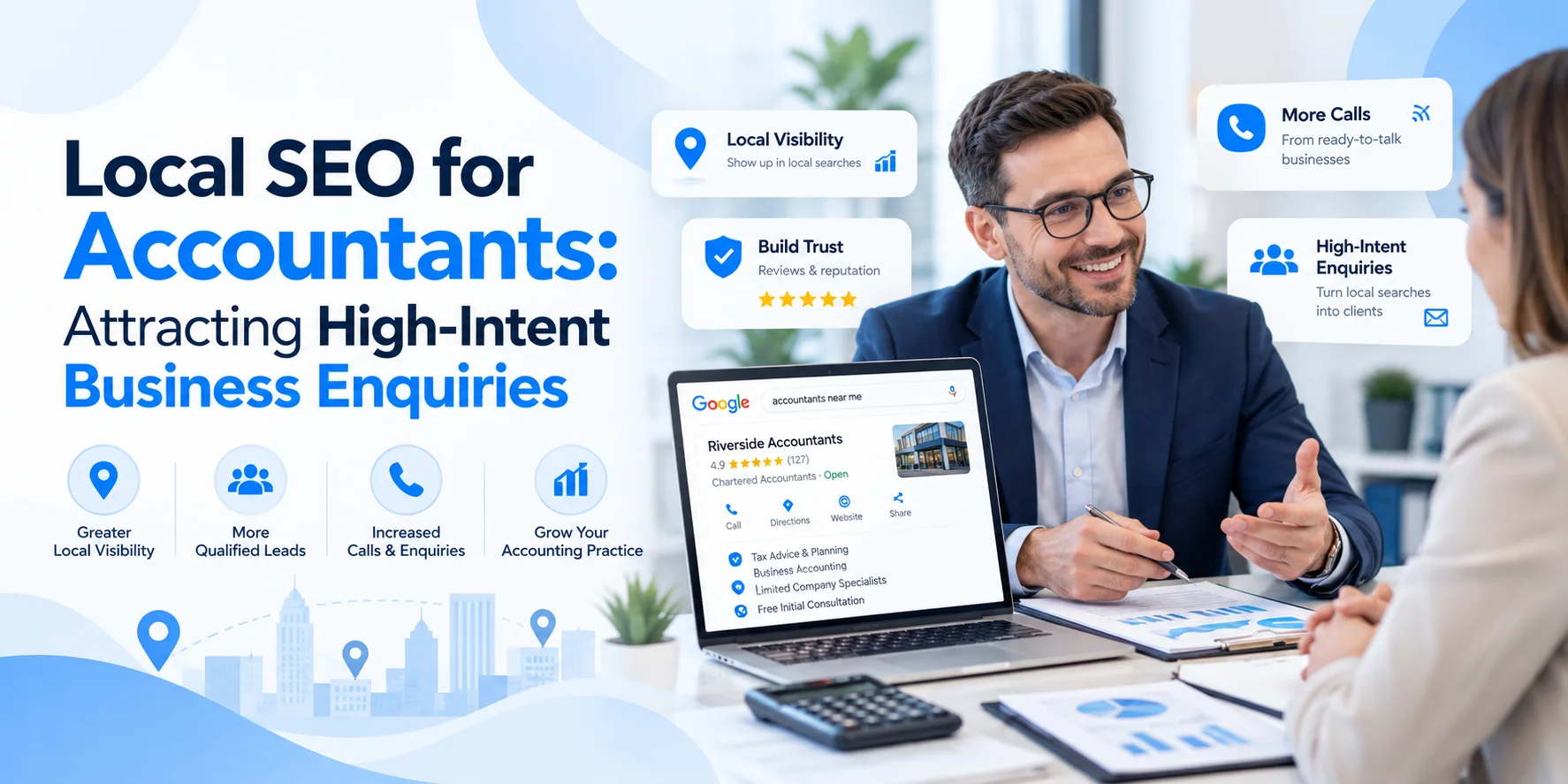
Finding a new accountant isn’t usually a quick decision. A business owner may compare several firms before making contact. They may check Google reviews, look at the services offered, read the website and search for a firm close to their office or home. This is where local SEO for accountants can make a real difference.
Local SEO helps accounting firms attract high-intent local business owners by ranking prominently in Google Maps and searches such as “accountant near me”. The goal isn’t simply to bring more visitors to your website. It’s to attract people who are actually looking for accounting help and are more likely to enquire.
That difference matters.
A website can receive plenty of traffic from people looking for free tax calculators, accounting definitions or general financial information. Those visitors may never become clients. A local business owner searching for “accountant for small business in London” has a very different reason for searching. They’re closer to making a decision. A good accountant SEO strategy focuses on these valuable searches while building the trust needed to turn visibility into genuine business enquiries.
This guide explains how local SEO for accountants works, which services and locations deserve dedicated pages, how Google Business Profile supports local visibility, and how accounting firms can build trust without relying on spammy SEO tactics.
What Is Local SEO for Accountants?
Local SEO for accountants is the process of improving an accounting firm’s visibility in local Google searches and Google Maps.
It helps search engines understand three important things:
- What you offer.
- Where you operate.
- Why potential clients should trust you.
For an accounting firm, this could mean appearing when someone searches for:
- “accountant near me”
- “accountant in London”
- “small business accountant London”
- “tax accountant near me”
- “accounting firm Manchester”
- “bookkeeping services Birmingham”
- “accountant for contractors Leeds”
These searches can have very different levels of intent. Someone searching “what is corporation tax” is still learning. Someone searching “accountant for small business near me” is looking for a provider. Your SEO strategy needs to understand that difference.
Why Local SEO Matters for Accounting Firms
Accountancy is a trust-based service.
Business owners are handing over sensitive financial information, asking questions about tax and relying on professional advice. They need to feel comfortable before they make contact. This is why a strong online presence needs to do more than rank. It needs to answer the questions a potential client has before picking up the phone.
- Who are you?
- Where are you based?
- What types of businesses do you help?
- Which accounting services do you provide?
- What do your clients say about you?
- What professional qualifications or memberships do you have?
- Can I easily contact you?
The stronger the answers, the less uncertainty there is. Local SEO helps put those answers in front of people when they are already looking for an accounting firm. Accountancy is also part of the wider professional-services search landscape. Our guide to SEO for professional services explores how expertise, service-led content and trust can support visibility across professional firms.
Local SEO Should Focus on Qualified Enquiries
One of the biggest mistakes in accounting SEO is chasing traffic without considering its quality. Suppose an accounting website receives 10,000 visits from people searching for general tax information.
That sounds impressive.
But if only a handful of those visitors need accounting services, the traffic may have limited business value.
Now imagine another firm receives 1,000 visitors, but many are searching for:
- “accountant for limited company”
- “small business accountant near me”
- “VAT accountant in London”
- “self assessment accountant near me”
Those searches can be much closer to a business decision. This is why local SEO for accounting firms should focus on relevance and intent rather than traffic alone.
Understanding Search Intent for Accountants
Search intent is the reason behind a person’s search. Understanding it helps you decide which pages your website needs.
Informational Searches
These searches are usually about learning.
Examples include:
- “How does VAT work?”
- “When is corporation tax due?”
- “What does an accountant do?”
- “What records does a limited company need?”
These searches can be useful for building awareness.
Commercial Investigation Searches
These people are comparing their options.
Examples include:
- “best accountant for small businesses”
- “accounting firms in London”
- “accountant for contractors”
- “small business accounting services”
They may not be ready to call yet, but they’re getting closer.
Transactional and High-Intent Searches
These searches often show stronger buying intent.
Examples include:
- “accountant near me”
- “bookkeeping service near me”
- “tax accountant London”
- “accountant for limited company Manchester”
- “accountancy firm Birmingham”
These are especially valuable for local lead generation. The website should make it easy for these visitors to take the next step.
Google Business Profile for Accountants
Your Google Business Profile is one of the most important assets in local search. It can appear in Google Search and Google Maps when people look for accountants and related services in their area. Think of it as your firm’s local shop window. Before someone visits your website, they may already see your business name, location, opening hours, reviews, photographs and other information.
That first impression matters.
Your profile should be claimed and verified, then kept accurate as the business changes. Make sure important information matches your real business. This includes your business name, address, phone number and opening hours.
Choose Relevant Google Business Profile Categories
Your primary category should accurately describe the business. Secondary categories can be used where they genuinely apply. Don’t choose unrelated categories just because you think they might bring more searches. For example, an accounting firm should not add services or categories it doesn’t actually provide.
Local SEO isn’t about telling Google what you wish the business offered. It’s about helping Google understand what the business really does.
Keep Your NAP Information Consistent
NAP means Name, Address and Phone number. These details should be accurate across your important online listings.
For example, if your website uses:
Smith & Partners Accountants
and your Google profile uses:
Smith and Partners Accounting Services Ltd
there may be a mismatch that needs checking. The same applies to old addresses and telephone numbers. This becomes especially important when an accounting firm moves office or changes its phone system. Review your major business listings after important changes.
Don’t assume old directory information will disappear by itself.
Google Maps SEO for Accountants
Google Maps can be particularly valuable for local accounting firms. A business owner may search for an accountant while sitting at their desk, travelling to work or looking for professional services in a nearby town. They may compare several firms directly in the map results. This means your Google Business Profile needs to work alongside your website.
Your website can explain your services in depth. Your Business Profile can provide the quick information needed to make the first decision. Reviews, accurate contact information and a genuine local presence can all help build confidence.
Reviews and Trust for Accounting Firms
Choosing an accountant involves trust.
Potential clients may read reviews before contacting a firm because they want to know what working with the business is actually like. Reviews can talk about communication, responsiveness, professionalism and the overall client experience. Accounting firms should build reviews naturally. Ask genuine clients for honest feedback where appropriate.
Don’t buy reviews.
Don’t write fake reviews.
Don’t ask clients to use misleading wording. A steady flow of genuine feedback is much more useful for long-term trust.
How Accountants Should Respond to Reviews
Responding to reviews shows that the firm is paying attention. A positive review can receive a simple thank-you. A negative review needs a calm and professional response. Don’t discuss confidential client information publicly.
Don’t reveal details about a client’s accounts or financial situation. Instead, acknowledge the feedback and invite the person to continue the conversation privately where appropriate. This is not just about SEO.
It’s basic professional reputation management.
Build Trust With Professional Credentials
Accounting services involve financial decisions, so professional credibility matters. Your website should clearly explain relevant qualifications, memberships, registrations and areas of professional expertise where applicable. Don’t hide important credentials deep inside the website. A potential client should be able to understand who is behind the firm.
However, avoid turning this into a wall of badges. A list of logos doesn’t automatically create trust. Explain what the qualification, membership or professional status means when it is useful to the reader. Trust plays a similar role in other high-consideration services. Our guide to local SEO for dentists and clinics explains how professional information, reviews and local visibility can build confidence before someone makes contact.
Local SEO and E-E-A-T for Accountants
E-E-A-T stands for Experience, Expertise, Authoritativeness and Trustworthiness. For accounting websites, these ideas are particularly useful because financial information can affect important business decisions. The goal isn’t to repeat the term E-E-A-T throughout your website. The goal is to demonstrate it.
- Show who writes your content.
- Show who reviews specialist information.
- Explain professional experience.
Use reliable sources when discussing tax, accounting rules or financial requirements. Keep important information up to date. Make it easy for visitors to understand who is responsible for the advice or information they are reading.
Create Real Accountant Profiles
A strong accounting firm website should introduce its people. Create useful profiles for partners, accountants and other relevant team members. A profile can include their role, professional background, qualifications, areas of expertise and the types of clients they work with.
Use genuine photographs.
Avoid generic stock portraits.
If an article discusses a specialist accounting topic, consider identifying the author and relevant reviewer. This creates a clearer connection between the information and the person responsible for it.
Build Service Pages Around Real Client Needs
Accounting firms often provide many services.
These may include:
- Annual accounts
- Bookkeeping
- Payroll
- VAT services
- Corporation tax
- Self Assessment
- Management accounts
- Business advisory
- Tax planning
- Contractor accounting
- Limited company accounting
Each service can have different search intent. A business searching for “payroll services London” has a different need from someone searching for “corporation tax accountant London”. This is why useful accounting service pages can be an important part of SEO for accountants.
What Makes a Good Accounting Service Page?
A good service page should explain the service clearly. Don’t simply write 500 words about why your firm is great. Answer the questions the potential client actually has.
Explain what the service includes.
Explain who it is suitable for.
Explain how the process works.
Explain what information the client may need to provide.
Explain what happens next.
Where relevant, explain factors that can affect cost or timescales. If there are legal or tax rules involved, make sure the information is current and properly reviewed. The page should help someone decide whether the service is relevant to them.

Build Pages for High-Intent Accounting Services
Some accounting services are closely connected to commercial searches.
For example, a limited company owner may search for:
- “limited company accountant”
- “limited company accountant near me”
- “limited company tax accountant London”
A contractor may search for:
- “contractor accountant”
- “accountant for contractors near me”
A small business owner may search for:
- “small business accountant”
- “small business accountant London”
These searches can reveal much more about the user’s needs than broad terms such as “accountant”. Build content around real services rather than forcing every keyword onto one page.
Create Useful Accountant Location Pages
Location pages can help firms that genuinely serve several areas.
For example, an accounting firm based in London may work with businesses across:
- Richmond
- Wimbledon
- Kingston
- Croydon
- Twickenham
- Wandsworth
However, each location page needs a genuine reason to exist. Don’t create fifty pages that simply replace one town name with another.
That approach adds little value.
Instead, make location pages useful to people in that area.
Explain where the office is.
Explain which clients the firm serves there. Mention relevant local business areas where appropriate. Include useful travel or office information.
Link to relevant accounting services.
Use genuine local client evidence where it can be published responsibly.
Avoid Thin Location Pages
Thin location pages are one of the easiest ways to create a large website that doesn’t offer much value.
Changing this sentence:
“Accountants in London can help local businesses.”
to:
“Accountants in Richmond can help local businesses.”
doesn’t create a genuinely different page. The page needs useful local context. If there isn’t enough unique information to justify a separate location page, don’t create one just for the keyword. One strong page is often better than several weak pages.
Service Plus Location Pages
A stronger local structure can combine genuine service and location intent.
For example:
- Accountant for Small Businesses in Wimbledon
- Bookkeeping Services in Richmond
- Tax Accountants in Kingston
These pages should only be created where the firm genuinely provides the service in that area. The content should also explain something useful about the service. Don’t simply combine keywords in a page title and call it SEO. The page needs a clear purpose.
Internal Linking for Accounting Websites
Internal links help visitors move between related pages. They also help search engines understand how your website is organised.
For example, a small business accounting page could link to:
- Bookkeeping
- VAT services
- Payroll
- Corporation tax
- Business advisory
A location page could link to relevant services available in that area. An educational article about corporation tax could link naturally to the firm’s corporation tax service page. These links should help the reader. Don’t add links just to increase the number of internal links on a page.
Local Citations for Accountants
Local citations are online mentions of your business details. They can appear on business directories, professional listings, local organisations and other relevant websites. The priority should be quality and accuracy. You don’t need to submit your accounting firm to every directory you can find.
Focus on sources that are relevant, trustworthy and useful. Check that the business name, address and telephone number are correct. If you find old information, update it where possible.
Local Backlinks Can Strengthen Authority
Local links can also support an accounting firm’s visibility.
Useful opportunities may come from genuine relationships with:
- local business organisations
- chambers of commerce
- business networks
- local publications
- professional associations
- community organisations
- business partners
- The important word is genuine.
Don’t buy hundreds of low-quality links.
Don’t create fake partnerships.
Don’t use automated link schemes.
A relevant local mention from a trusted organisation can be far more useful than a pile of unrelated links.
Create Content for Business Owners
Accountants have an advantage when it comes to content. Their potential clients ask lots of questions.
A business owner may want to understand:
- “How much does an accountant cost?”
- “Do I need an accountant for my limited company?”
- “What does a small business accountant do?”
- “When should I register for VAT?”
- “What records should my business keep?”
- “Should I use an accountant or accounting software?”
These questions can become useful informational content. The aim isn’t to answer every question with a sales pitch. Give the reader a useful explanation first. Then link to a relevant service when it makes sense.
Don’t Chase Broad Finance Traffic
This is an important part of accountant SEO. An accounting firm doesn’t necessarily need to rank for every finance-related search. Broad financial keywords can bring large amounts of traffic but may have little connection with your ideal client. For example, someone searching “mortgage calculator” isn’t necessarily looking for an accountant.
Someone searching “accountant for small business near me” is much more relevant. Build the strategy around the clients you actually want.
Target SME Search Intent
Small and medium-sized businesses often search for practical accounting help.
They may need help with:
- bookkeeping
- payroll
- VAT
- accounts
- tax returns
- business planning
- cash flow
- management accounts
- tax compliance
Your website should reflect those needs. Instead of writing one huge page called “Accounting Services”, create a clear structure that helps business owners find the service that matches their problem. B2B search strategies also vary depending on how a company sells its services or products. For digital-first businesses, our guide to SEO for SaaS companies explains how search intent, solution pages and buyer journeys can support growth.
Mobile SEO for Accountants
Business owners increasingly search from mobile devices. This matters for local search because Google Maps and mobile search can put a potential client very close to making contact. Your website should work properly on smaller screens. Phone numbers should be easy to tap.
Forms should be simple.
Menus should be easy to use. Important services shouldn’t be buried several clicks deep. The page should also load quickly enough that visitors don’t give up while waiting. A good mobile experience removes unnecessary friction.
Make Business Enquiries Easy
A visitor may be ready to contact you after reading only a few sections. Don’t make them hunt for your contact details. A good accounting website can offer several clear routes.
For example:
- Call the firm
- Request a consultation
- Complete an enquiry form
- Book a meeting
The right option depends on the firm’s sales process. The key is to make the next step obvious without becoming pushy.
Track Calls, Forms and Qualified Leads
SEO performance shouldn’t stop at clicks. An accounting firm should also understand what happens after the visitor arrives. Track useful actions such as phone calls, enquiry forms and consultation requests.
Then look at lead quality.
A form submission from someone looking for free tax advice isn’t equal to an enquiry from a company looking for ongoing accountancy support. Where possible, connect website enquiries with your sales process. This helps you understand which pages are generating real business opportunities.

Accountant Keyword Research
Keyword research should start with services, locations and client types. Start with the services you actually offer. Then consider the locations you genuinely serve. Finally, look at the types of businesses you want to attract.
For example:
- Service: bookkeeping
- Location: Wimbledon
- Client type: small businesses
This could lead to a useful topic such as:
“Bookkeeping Services for Small Businesses in Wimbledon”
The important part is not the exact phrase.
It’s the intent behind it.
Build a Local Keyword Map
Don’t use every keyword on every page. Instead, assign topics to the pages that best answer them.
For example:
| Page | Main search intent |
| Homepage | Accounting firm and broad local searches |
| Bookkeeping | Bookkeeping services |
| Corporation Tax | Corporation tax services |
| Small Business Accounting | SME accounting |
| Wimbledon Location | Accountant in Wimbledon |
| Contractor Accounting | Contractor accountant |
| Blog | Informational accounting questions |
This reduces keyword cannibalisation and gives each page a clear job.
Technical SEO for Accounting Websites
Good content won’t perform at its best if the website has major technical problems. Check that important pages can be crawled and indexed.
Make sure internal links work.
Fix broken pages and important 4xx errors. Use clear page titles and meta descriptions. Make sure canonical tags are correct.
Keep XML sitemaps clean.
Use HTTPS.
Make sure the mobile version contains the important content found on desktop. Technical SEO doesn’t need to be complicated for the visitor. In fact, the best technical work is often invisible.
Use Structured Data Carefully
Structured data can help search engines understand certain information about your business and content. For a local accounting firm, relevant structured data may describe the business, its location and other suitable details. The markup must reflect the information shown on the page. Don’t add fake reviews or information that visitors cannot see.
Don’t use structured data as a shortcut to claim something the business cannot support. Technical SEO should reinforce accurate information.
Accounting Website Speed Matters
A slow website can frustrate potential clients. This is particularly important for mobile visitors. Large images, unnecessary scripts and poorly configured plugins can all contribute to slower pages. Review important landing pages and test how they perform.
Focus on real user experience rather than chasing a perfect score for its own sake. A fast, simple website is usually a good starting point.
Common Local SEO Mistakes for Accountants
Focusing Only on “Accountant”
The keyword is broad and highly competitive. It also doesn’t tell you what type of client the searcher wants. Build around services, locations and client needs.
Creating Dozens of Duplicate Location Pages
Location pages need real local value. Don’t create them simply to increase the number of indexed pages.
Ignoring Google Business Profile
A strong website can’t fully replace an incomplete or inaccurate local profile.
Keep the profile current.
Buying Reviews
Fake reviews can damage trust and reputation.
Build genuine feedback instead.
Hiding Professional Information
Potential clients want to know who they’re dealing with. Make relevant credentials and professional information easy to find.
Writing Generic Finance Content
Not every finance keyword is valuable to an accounting firm. Focus on topics that connect with your target clients.
Making Every Page a Sales Pitch
Informational searches need useful answers.
Help first, then guide readers towards relevant services.
Ignoring Mobile Visitors
A potential client should be able to call or enquire from their phone without hassle.
Forgetting Existing Clients
SEO shouldn’t only focus on attracting new visitors. Useful resources can also support existing clients and strengthen the firm’s wider authority.
A Practical Local SEO Strategy for Accountants
A strong strategy can be built around several connected areas.
Start With Your Business
Identify your real services, locations and ideal client types. Don’t start with a list of keywords.
Start with the business.
Improve Your Google Business Profile
Check the business information, categories, services, photographs, reviews and contact details.
Keep everything accurate.
Build Useful Service Pages
Create detailed pages for services that matter commercially. Explain the service in a way a business owner can understand.
Build Genuine Local Relevance
Create useful location pages only where the firm genuinely serves the area.
Add real local information.
Strengthen Trust
Show professional credentials, team profiles, reviews and clear business information.
Improve Conversion Paths
Make calls, forms and consultation requests easy to complete.
Measure Qualified Enquiries
Track more than rankings and traffic. Look at calls, forms, consultations and actual business opportunities.
Example: Turning Local Visibility Into a Business Enquiry
Imagine an accounting firm wants more limited company clients in South West London. Instead of trying to rank for every accounting keyword, the firm builds a focused structure. It has a dedicated limited company accounting page. The page explains what the service includes and who it is suitable for.
The firm also has a useful local page covering the area it genuinely serves. Its Google Business Profile contains accurate information and genuine photographs. The website introduces the accountants behind the service.
Reviews provide additional social proof.
The limited company page links naturally to related services such as corporation tax and bookkeeping. The local page links back to the relevant service. A business owner searching for a local limited company accountant can now move through a clear journey.
- Search result.
- Google Maps or website.
- Service information.
- Professional proof.
- Local information.
- Enquiry.
That’s much more useful than simply ranking for a broad keyword.
How Wixdek Approaches Local SEO for Accountants
At Wixdek, we look at local SEO as part of the wider business development process. The goal isn’t to bring an accounting firm as much traffic as possible. The goal is to help the right businesses find the firm when they need its services. We look at the firm’s current visibility, Google Business Profile, website structure, service pages, location targeting and local trust signals.
We also look at the quality of the searches already bringing visitors to the site. A page can rank well and still attract the wrong audience. That isn’t a success we’d want to celebrate. Instead, we focus on the connection between search intent, local visibility and qualified enquiries.
For broader sector-specific support, explore the industries we work with. For local search strategy and support, visit Wixdek’s Local SEO service.
How to Measure Local SEO Success
Local SEO performance should be measured over time.
Important metrics can include:
- Google Business Profile visibility
- Local search impressions
- Organic clicks
- Phone calls
- Contact form submissions
- Consultation requests
- Directions requests
- Service-page traffic
- Location-page traffic
- Qualified leads
- New clients generated from organic search
The final metric is often the most useful. If local search generates ten enquiries and three become long-term clients, that tells you much more than a ranking report alone.
Use Google Search Console to Find Opportunities
Google Search Console can show which queries and pages are receiving impressions and clicks. Look for relevant searches that are already appearing but not performing strongly. For example, an accounting firm may discover that a service page receives impressions for “small business accountant London” but ranks below the first page. That could be an opportunity to improve the page.
Check whether the content answers the search properly.
Look at the page structure.
Review internal links.
Check whether the location is genuinely relevant. Don’t change a page simply because a keyword isn’t ranking today. Look at the wider pattern first.
Give SEO Time to Work
SEO isn’t an overnight fix.
Google needs time to crawl, understand and reassess changes. Local visibility can also change as competitors improve their websites, reviews and Business Profiles. After significant changes, allow enough time to collect useful data. A sensible review point is around 90 days, followed by further reviews every six to twelve months depending on performance and business changes.
Don’t keep rewriting pages every few weeks because rankings moved slightly. Give good work time to settle.
What Accountants Should Review Every Few Months
A useful review should cover the whole local search journey. Check whether your Google Business Profile information is still accurate.
Check important service pages.
Review location pages for accuracy and usefulness.
- Look at recent reviews.
- Check practitioner and team information.
- Review local citations.
- Look at Search Console queries.
- Check which pages generate enquiries.
- Look for technical issues.
Then decide what actually needs improving. Don’t change content simply for the sake of making changes.
Local SEO for Accountants: Final Checklist
Before considering your local SEO strategy complete, check that:
- Your Google Business Profile is claimed and accurate.
- Your primary business category is relevant.
- Your NAP details are consistent.
- Your main accounting services have useful pages.
- Your important locations have genuine local relevance.
- Your location pages aren’t duplicated.
- Your accountants have clear professional profiles.
- Your reviews are genuine and current.
- Your website works well on mobile.
- Your phone number is easy to find.
- Your enquiry forms work properly.
- Your internal links connect related services and locations.
- Your important pages can be crawled and indexed.
- Your structured data matches visible information.
- Your local citations are accurate.
- Your content answers real business-owner questions.
- Your calls and enquiries are being tracked.
- Your SEO reporting measures qualified leads, not just traffic.
Frequently Asked Questions
What is local SEO for accountants?
Local SEO for accountants helps an accounting firm appear in relevant local Google searches and Google Maps results. It combines local business information, service pages, location content, reviews, professional trust signals and technical SEO.
Why is local SEO important for accounting firms?
Local SEO can help nearby business owners find an accounting firm when they are actively looking for professional help. It can also give potential clients useful information that helps them decide whether to make an enquiry.
Does Google Business Profile help accountants?
Yes. A complete and accurate Google Business Profile gives Google and potential clients useful information about the accounting firm. It can also support visibility in local Search and Maps results.
How can accountants improve Google Maps visibility?
There is no guaranteed way to reach a particular Maps position. Accountants should focus on accurate Business Profile information, relevant categories, genuine reviews, local relevance and a useful website that supports the profile.
Are reviews important for accountant SEO?
Reviews can help potential clients judge the firm’s reputation and can support local visibility. Accounting firms should collect genuine reviews and respond professionally without revealing confidential client information.
Should an accounting firm create location pages?
Location pages can be useful when an accounting firm genuinely serves several areas. Each page should provide useful local information rather than simply changing the town name on an otherwise identical page.
What services should accountants create SEO pages for?
The answer depends on the firm’s actual services. Common examples include bookkeeping, payroll, VAT, corporation tax, annual accounts, self assessment, contractor accounting and small business accounting.
How can accountants attract better leads through SEO?
Start with the types of clients you want and the services they need. Then build pages around relevant service, location and client-intent searches rather than chasing broad finance traffic.
What is accountant keyword research?
Accountant keyword research identifies the searches potential clients use when looking for accounting services. Good research considers services, locations, business types and search intent.
Does mobile SEO matter for accountants?
Yes. Local searches often happen on mobile devices, so potential clients should be able to find your services, telephone number and enquiry options without struggling with the website.
How does E-E-A-T apply to accounting websites?
Accounting websites can demonstrate E-E-A-T by showing genuine professional expertise, clear author information, relevant qualifications, accurate financial information, trustworthy sources and transparent business details.
Should accountants show professional qualifications online?
Relevant qualifications, memberships and professional information can help potential clients understand the expertise behind the firm. All claims should be accurate and kept up to date.
How should accounting firms use local citations?
Focus on relevant and trustworthy directories, professional listings and local sources. Keep the firm’s name, address and phone number accurate rather than trying to build hundreds of low-quality listings.
How long does local SEO for accountants take?
There isn’t one fixed timeframe. Some changes may be noticed sooner, while stronger local and organic visibility can take longer. Performance should be reviewed using Search Console, local visibility and actual enquiries.
Should accountants focus on rankings or leads?
Leads are usually more useful as a business measure. Rankings and traffic help explain visibility, but calls, enquiries, consultations and new clients show whether that visibility is creating business value.
Final Thoughts
Local SEO for accountants isn’t about being visible for every finance-related search. It’s about being visible when the right business owner needs the services you provide. A strong Google Business Profile can help you appear locally. Useful service pages can answer specific needs.
Location pages can build genuine local relevance.
Reviews can provide social proof.
Professional profiles can demonstrate expertise.
Technical SEO can make the whole website easier to find and use. When these elements work together, your website becomes more than an online brochure. It becomes part of the decision-making process. A business owner can find your firm, understand what you offer, see who is behind the service, check your reputation and contact you without having to dig around.
That’s the real value of local SEO for accounting firms. Don’t chase traffic for the sake of a bigger number. Focus on the searches that matter, give people useful answers and make it easy for the right clients to take the next step.
Need Help Improving Your Local Visibility?
If your accounting firm is getting website traffic but not enough relevant business enquiries, the problem may not be rankings alone. Your service pages, Google Business Profile, local targeting, trust signals and conversion journey all need to work together. Wixdek can review these areas and identify where your local search strategy has room to improve.
Request a Local SEO Review