If you’re an electrician, being visible when someone needs electrical work can make a real difference.
A customer with a power fault, faulty socket or electrical emergency usually wants help quickly. They search Google, check nearby businesses and look for an electrician they can trust.
That’s where local SEO for electricians comes in.
A good local SEO for electricians strategy helps your business appear for relevant searches in the areas you actually serve. It also helps customers understand your services, qualifications, reviews and contact options before they pick up the phone.
But getting website traffic isn’t the main goal.
The real goal is to turn local searches into calls, enquiries, quotes and booked electrical work.
This guide explains how local SEO for electricians work, which services and areas to target, how Google Maps fits into the strategy, and which trust signals can help customers feel confident choosing your business.
What Is Local SEO for Electricians?
Local SEO for electricians is the process of improving an electrical company’s visibility in Google Search and Google Maps for relevant local searches.
For example, someone might search:
“electrician near me”
“emergency electrician London”
“electrician Croydon”
“EICR electrician Wimbledon”
“consumer unit replacement Ealing”
These searches don’t all mean the same thing.
Someone searching for “how to reset a tripped fuse” may simply need information. Someone searching for “emergency electrician near me” is much closer to contacting a business.
Your SEO strategy needs to reflect those differences.
Google explains that local results are mainly influenced by relevance, distance and prominence. It also recommends keeping Business Profile information complete and accurate. You can read Google’s official guidance on improving local ranking.
So local SEO for electricians isn’t about putting the word “electrician” on every page.
It’s about helping Google understand the business while giving potential customers useful information.
Why SEO Matters for Electrical Companies
Electrical work is often linked to a clear customer problem.
A homeowner may have lost power.
A landlord may need an EICR.
A business may need electrical testing.
Someone renovating their home may need a new consumer unit or additional circuits.
In each case, the customer wants to find someone suitable.
They may check the company’s:
- Services
- Location
- Reviews
- Qualifications
- Accreditations
- Opening hours
- Website
- Contact details
- Previous work
If your business isn’t visible when the search happens, another electrician may get the enquiry.
That’s the frustrating part.
You can provide excellent electrical work, but customers can’t choose you if they don’t find you.
A strong local SEO strategy helps close that gap.
How the Electrician Search Journey Works
Not every electrical customer searches in the same way.
A useful local SEO for electricians strategy should cover several types of search intent.
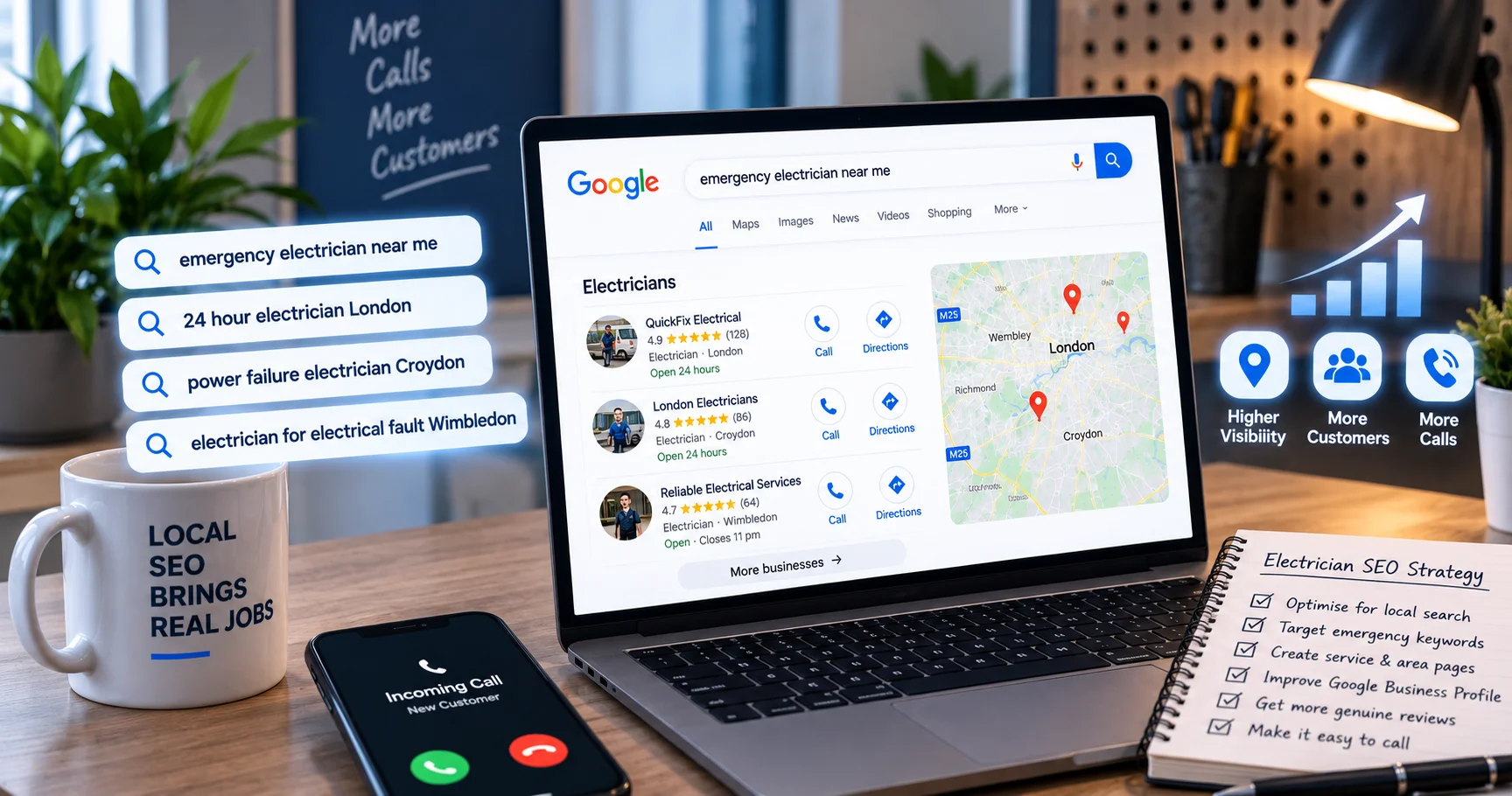
Emergency Electrical Searches
Emergency searches can have very strong commercial intent.
Examples include:
“emergency electrician near me”
“24 hour electrician London”
“power failure electrician Croydon”
“electrician for electrical fault Wimbledon”
The customer may be worried and wants a clear next step.
Your emergency page should therefore make important information easy to find.
Explain the problems you handle, the areas you cover and how customers can contact you.
Don’t make someone search through five menus while their house has lost power.
This high-urgency search behaviour is common across other emergency trades too. Our guide to local SEO for locksmiths explains how local visibility can support customers who need immediate help.
Residential Electrical Searches
Homeowners search for many planned electrical services.
These might include:
Consumer unit upgrades
House rewiring
Partial rewiring
EV charger installation
Lighting installation
Additional sockets
Electrical fault finding
Smoke and heat alarm installation
Each important service can have its own page when it has a clear purpose and enough useful information.
The page should explain what the service involves, who may need it and what customers can expect.
Commercial Electrical Searches
Commercial customers often have more specific requirements.
Searches might include:
“commercial electrician London”
“commercial electrical testing”
“three phase electrical installation”
“commercial EICR”
“electrical contractor for office”
These customers may care about experience, compliance, testing, project management and the ability to work around business operations.
A commercial electrical page should therefore speak to those needs instead of simply changing the word “domestic” to “commercial”.
Core Electrical Services to Target
Your SEO strategy should start with the services the business genuinely provides.
Trying to rank for every electrical service can make the website confusing.
Instead, group services around real customer needs.
Emergency Electrical Services
Emergency electrical work can include faults, power failures and other urgent issues.
If you provide emergency callouts, create a dedicated page that explains exactly what you handle.
Avoid unsupported claims such as “fastest electrician in London” or “30-minute guaranteed response” unless the business can genuinely prove and deliver them.
Consumer Unit Upgrades
Consumer unit work can have strong commercial intent.
The page can explain when an upgrade may be considered, what the process involves and what customers should ask an electrician before work begins.
Don’t promise that every old fuse box needs replacing.
The condition and requirements of the installation should be assessed by a competent professional.
House Rewiring
Rewiring is a major project, so customers usually need more information before contacting an electrician.
A useful page can explain common warning signs, the assessment process, what rewiring may involve and how the work can affect the property.
Electrical Safety First provides consumer guidance on electrical installations and advises that a qualified electrician should assess whether rewiring is needed.
You can read its electrical safety advice for homeowners.
EV Charger Installation
EV charger searches are increasingly specific.
Customers may search for installation in their town rather than simply “electrician”.
If the business provides this service, explain the installation process, property considerations and what customers need to check before booking.
Only describe installation schemes, qualifications or approvals that the electrician actually holds.
EICR and Electrical Testing
EICR searches can come from landlords, homeowners, letting agents and commercial customers.
The page should clearly explain who the service is for and what the inspection involves.
For landlords in England, government guidance states that electrical installations in rented properties must be inspected and tested by a qualified person at least every five years, with an EICR normally used to record the outcome.
You can check the latest GOV.UK electrical safety guidance for rented properties.
The rules can differ across the UK, so avoid presenting England-specific requirements as if they apply everywhere.
Electrician Keyword Research
Good electrician keyword research starts with the services customers actually need.
You don’t need hundreds of almost identical keywords.
Start with the core service, problem and location.
| Search type | Example | Likely intent |
| Emergency | emergency electrician London | Very high commercial |
| Service | consumer unit replacement Croydon | High commercial |
| Location | electrician Wimbledon | Commercial |
| Testing | EICR electrician Ealing | Commercial |
| Commercial | commercial electrician London | High commercial |
| Informational | signs your wiring needs replacing | Informational |
| Cost | how much does rewiring cost | Commercial investigation |
This gives each page a clear job.
The goal isn’t to force every keyword into the copy.
The goal is to answer the search behind the keyword.
Google Business Profile for Electricians
Your Google Business Profile is a major part of local search.
It can appear in Google Search and Maps when customers search for your business or relevant services nearby.
Google recommends keeping business information complete and accurate, including details that help customers understand what the business does.
For an electrical company, review:
- Business name
- Primary category
- Relevant additional categories
- Services
- Opening hours
- Phone number
- Website
- Business description
- Address or service-area information
- Photos
- Customer reviews
Keep everything truthful.
Don’t add locations you don’t serve or keywords to the official business name.
Google also states that businesses cannot pay for better local rankings. Local results are influenced by relevance, distance and prominence.
That means there isn’t a shortcut to the top of Maps.
You have to build the underlying signals properly.
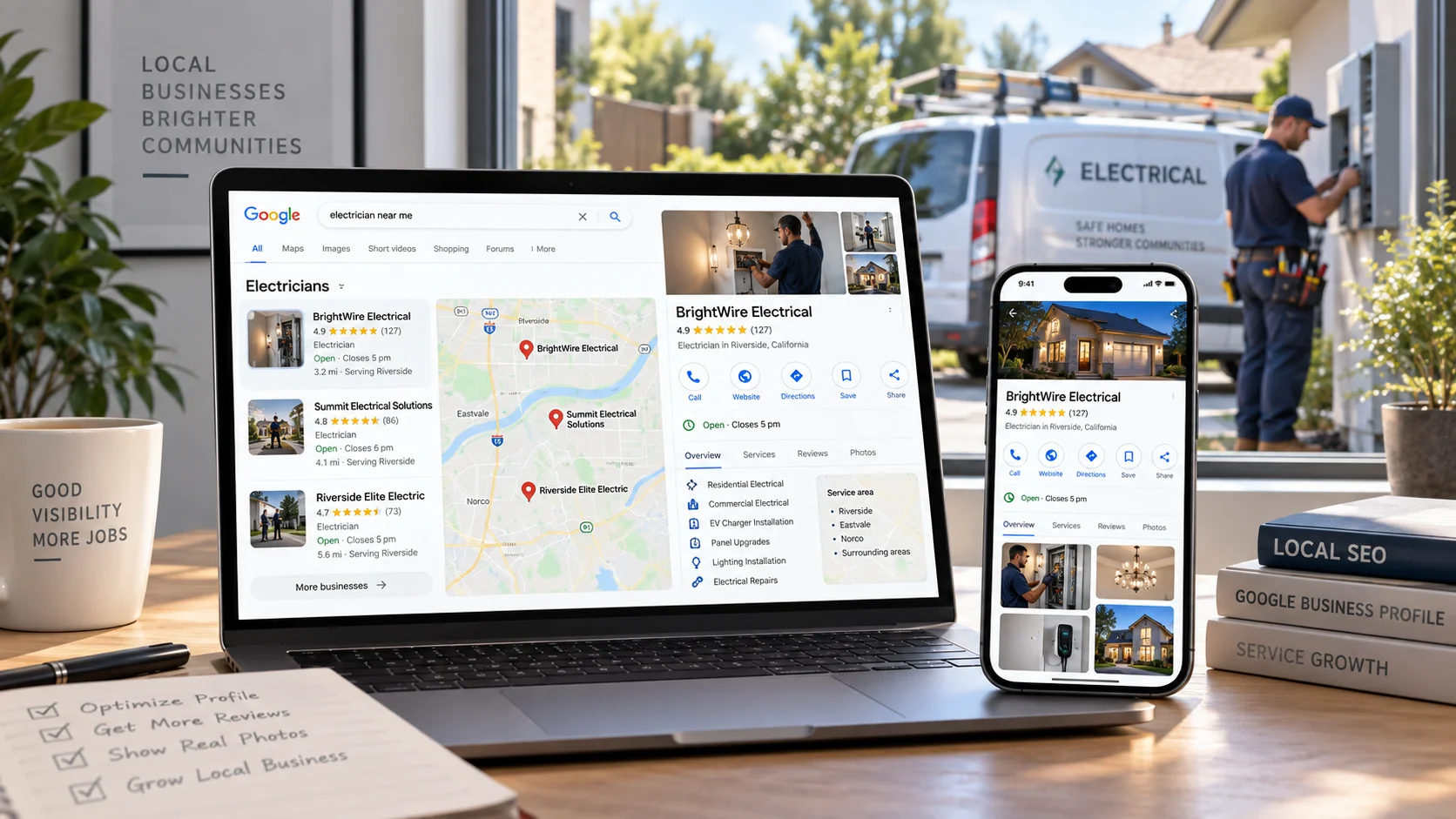
Google Maps SEO for Electricians
Google Maps can be especially important for electrical businesses.
A customer searching from a mobile phone may see Maps results before traditional organic listings.
The results can change based on the searcher’s location and the search itself.
That means an electrician might rank differently for “electrician near me” from Croydon compared with the same search from Ealing.
Don’t promise customers a permanent number-one Maps position.
Instead, focus on factors you can actually control.
Keep the Business Profile accurate.
Build genuine reviews.
Make the website useful.
Maintain consistent business information.
Create useful service and location content.
Earn relevant local mentions.
Then measure the enquiries that come from the visibility.
Service Areas and Hyper-Local SEO
Electricians often work across several towns or boroughs.
For example, an electrical contractor might serve:
Ealing
Acton
Chiswick
Hammersmith
Croydon
Wimbledon
Richmond
That creates opportunities for local landing pages.
But more pages aren’t always better.
A page for Ealing should provide something useful to someone looking for an electrician in Ealing.
It could explain the actual area covered, relevant services, nearby project examples and how customers can contact the business.
Don’t simply replace “Ealing” with “Acton” and publish another copy.
That creates little value for users.
Electrician Location Pages
A strong location page should answer practical questions.
For example:
Do you actually serve this area?
Which electrical services are available?
Do you handle emergency callouts?
Can you provide EICRs?
What types of properties do you work on?
How can customers contact you?
You can also include genuine local examples where available.
Perhaps the business recently upgraded a consumer unit in Ealing or completed an EICR for a rental property in Croydon.
Real project information can make a location page much more useful.
Don’t invent local jobs or customer experiences.
Avoid Thin Location Pages
Creating hundreds of town pages might look like an easy SEO win.
It isn’t.
If every page contains the same paragraphs with only the town name changed, customers aren’t getting much value.
Google’s spam policies specifically address doorway pages and content created mainly to manipulate search results.
You can read Google’s Spam Policies for Search before building a large location structure.
Build pages because customers need them, not simply because a keyword tool shows search volume.
Internal Linking Between Services and Locations
Internal linking helps connect your service and location content.
Imagine the main electrician page links to:
Emergency Electrical Services
Consumer Unit Upgrades
House Rewiring
EICR Testing
Areas We Serve
An Ealing location page could then link to the services actually available in Ealing.
This creates a useful path for both users and search engines.
For example:
Ealing electrician → EICR testing → landlord electrical safety
Or:
Croydon electrician → consumer unit upgrades → contact page
The links should make sense in context.
Don’t add internal links simply to increase the number of links on a page.
For broader local search guidance, see Wixdek’s Local SEO service.
Electrical Business Citations and NAP
NAP means:
Name
Address
Phone number
These details should be accurate across the important places where the business appears online.
That includes the website, Google Business Profile and relevant business directories.
For a business that has moved premises, old information can be particularly troublesome.
A customer might find an outdated phone number or address and assume the business is no longer operating.
Review important listings and correct information when needed.
Consistency isn’t about copying the same text everywhere.
It’s about making sure the core business details are accurate.
Electrician Reviews and Reputation
Electrical work involves trust.
Customers are allowing someone to work on their home, business or property.
Reviews can therefore play an important role in the decision.
Google states that reviews and positive ratings can contribute to prominence in local search.
But don’t treat reviews as a numbers game.
Ask genuine customers for honest feedback after completed work.
Respond professionally to both positive and negative reviews.
Don’t buy reviews or write fake ones.
A smaller number of genuine reviews is far more useful than a large collection that customers can’t trust.
NICEIC Trust Signals
Professional credentials can be important trust signals for electricians.
For example, NICEIC operates schemes for electrical contractors and assesses approved contractors against relevant requirements, including BS 7671.
Its Approved Contractor Scheme explains the assessment and competence requirements for participating electrical contractors.
If an electrician is NICEIC approved, the website can clearly display that status where appropriate.
If the business isn’t registered, don’t imply that it is.
The same rule applies to every certification or professional membership.
NAPIT and Other Electrical Certifications
NICEIC isn’t the only name customers may see.
Some electricians may hold registration or certification through NAPIT or other recognised schemes.
The important point is to show the credentials the actual business holds.
A trust badge means very little if it isn’t genuine.
Where relevant, explain what the certification means and link customers to the official organisation so they can verify it.
This is much stronger than simply placing a row of logos in the website footer.
Part P and Electrical Compliance
Electrical work in homes can also involve Building Regulations requirements.
Part P relates to electrical safety in dwellings in England.
The government’s Approved Document P explains requirements relating to electrical safety in dwellings, including when work needs notification.
The exact requirements depend on the type and location of the work.
For this reason, an electrician’s website shouldn’t make broad statements such as “all electrical work needs Building Control approval”.
Explain the situation carefully and direct customers to qualified professionals where an assessment is needed.
Technical SEO for Electricians
Local SEO won’t work well if the website itself creates problems.
The technical basics matter.
Important pages should be crawlable and indexable.
The website should work properly on mobile devices.
Pages should load quickly enough for users.
Internal links should help people find related services.
Page titles should describe the actual page.
Images should be compressed without damaging useful quality.
Broken links and unnecessary duplicate pages should be dealt with.
For electricians, mobile usability deserves particular attention.
Someone searching for an emergency electrician is unlikely to want to pinch and zoom around a desktop-style website.
Click-to-Call for Electrical Leads
Phone calls are often important for electricians.
Make the number easy to find.
A mobile user should be able to tap the number and call without copying it manually.
This is especially useful on emergency service pages.
You can also track phone clicks as part of your analytics setup.
That helps you understand whether local search visibility is leading to actual enquiries.
Local Business Structured Data
Structured data can help search engines understand business information on suitable pages.
Google provides guidance for LocalBusiness structured data.
Depending on the page and business, this can help describe information such as the business name, address and opening hours.
However, structured data shouldn’t contain information that isn’t supported by the visible page.
Don’t add fake locations, services or ratings just to create more search features.
Keep the markup accurate and aligned with the actual business.
Show Real Electrical Experience
This is one of the easiest ways to make Local SEO for Electricians more useful.
Generic electrical content can sound the same across dozens of websites.
Real experience makes it different.
For example, a service page could explain what an electrician checks during fault finding.
A case study could explain why a consumer unit needed upgrading and what the project involved.
An EICR article could explain common questions landlords ask before arranging an inspection.
You could show:
The original problem
What was inspected
What work was recommended
What was completed
The final result
Only use genuine examples.
Don’t invent projects, customer quotes or results.
Use Expert and Government Sources
Electrical safety is not an area where websites should guess.
When discussing safety, regulations or compliance, use reliable sources.
Electrical Safety First provides consumer and professional electrical safety guidance, including information on EICRs, consumer units and other electrical installation issues.
Its best practice guides for electrical installation work cover technical subjects for designers, installers, inspectors and other professionals.
Government sources are also useful when explaining legal requirements.
For example, current GOV.UK guidance explains electrical safety requirements for rented properties in England and the role of qualified persons in inspection and testing.
These sources give readers somewhere trustworthy to check important information.
Trust Signals That Matter to Electrical Customers
A customer may be choosing an electrician to work inside their home.
Trust matters.
Useful trust signals can include:
- Genuine qualifications
- Relevant scheme memberships
- Insurance information
- Real customer reviews
- Clear service information
- Real project photos
- Local experience
- Clear contact details
- Transparent business information
TrustMark is another useful reference point for homeowners.
It describes itself as the UK’s Government Endorsed Quality Scheme for work carried out in and around the home. Its registered businesses are vetted against requirements covering areas such as technical competence and customer service.
You can learn more through TrustMark’s homeowner guidance.
Only display TrustMark, NICEIC, NAPIT or other accreditation logos when the business genuinely holds the relevant status.
Build a Strong Electrician Website Structure
Your website doesn’t need hundreds of pages.
It needs a structure that matches what customers actually search for.
A simple example could look like this:
Electrician
│
├── Emergency Electrician
├── Consumer Unit Upgrades
├── House Rewiring
├── EICR Testing
├── EV Charger Installation
│
└── Areas We Serve
├── Ealing
├── Croydon
├── Wimbledon
└── Richmond
The exact structure depends on the services and areas the business genuinely covers.
The important thing is that each page has a clear purpose.
Local Link Building for Electricians
Local links can help build authority and awareness.
But relevance matters more than collecting hundreds of links.
An electrician may be able to earn mentions from local organisations, trade associations, community websites, suppliers, local publications or businesses involved in property services.
For example, an electrician could contribute useful advice to a local property article about electrical safety.
A genuine community project could also lead to a local mention.
Don’t buy large packages of random links.
Don’t create fake websites for the sole purpose of linking to your business.
Build relationships and earn relevant mentions where possible.
Emergency Local SEO for Electricians Needs a Different Approach
Emergency searches are often made under pressure.
The customer doesn’t want to read 2,000 words before finding a phone number.
Your emergency electrician page should quickly answer:
What emergencies do you handle?
Which areas do you cover?
When can customers contact you?
How should they contact you?
What should they do while waiting?
Safety information should always be accurate.
Don’t encourage customers to carry out risky electrical work themselves.
If there is immediate danger, customers should follow appropriate emergency safety guidance and contact the relevant emergency service where necessary.
Planned Electrical Work Needs More Detail
Planned electrical work gives you more room to educate the customer.
Someone considering a house rewire may want to understand the process before requesting a quote.
A useful page can explain the initial inspection, planning, preparation, installation, testing and certification.
Likewise, someone considering an EV charger may want to understand what information the electrician needs before installation.
This content helps customers make better decisions.
It also gives the search engine a clearer understanding of what the page covers.
Turn Electrical Content Into Lead Generation
Blog content shouldn’t exist just to increase the number of pages on your website.
It should solve real customer questions.
For example:
Why does my circuit breaker keep tripping?
When should an old fuse box be replaced?
How often does a rental property need an EICR?
What are the signs of outdated electrical wiring?
What should I check before hiring an electrician?
These topics can attract people at different stages of the customer journey.
An informational article can then point readers towards a relevant service page when professional help is needed.
That’s how content supports lead generation without turning every article into an advert.
Measure Local Leads From SEO
Traffic isn’t enough.
You need to know whether local search is creating useful enquiries.
Depending on the business, you could track:
- Phone calls
- Phone clicks
- Contact forms
- Quote requests
- Booking requests
- Emergency enquiries
- EICR enquiries
- EV charger enquiries
The customer journey might look like this:
Google search → website visit → service page → phone call → qualified lead → booked work
Google Search Console can help you review search queries, clicks, impressions and page performance.
You can compare that information with the business’s own enquiry and sales records.
That gives you a much better view of whether Local SEO for Electricians is producing useful results.
Don’t Judge Local SEO for Electricians by Rankings Alone
Ranking number one can look impressive.
But what happens after that?
If the page gets visibility but produces no enquiries, there may be another problem.
The service may not be clear.
The phone number may be difficult to find.
The page may not show enough trust.
The customer may not understand whether the electrician serves their area.
That’s why rankings should be treated as one part of the picture.
The better question is:
“Is local visibility helping us attract the right customers?”
Common SEO Mistakes Electricians Make
Creating Too Many Location Pages
More pages don’t automatically mean more leads.
If pages are nearly identical, they may offer little value.
Create local pages where there is a genuine reason to serve and explain that location.
Using One Page for Every Electrical Service
Emergency callouts, EICRs, rewiring and EV charger installation can have very different search intent.
Important services may deserve their own pages.
Stuffing Keywords Into the Copy
You don’t need to write “electrician Croydon” in every paragraph.
Use natural language.
Explain the service clearly.
Hiding Qualifications
If the electrician has genuine certifications or memberships, make them easy to verify.
Don’t bury important trust information somewhere customers will never see it.
Using Fake Reviews
Never create or buy fake reviews.
Ask real customers for honest feedback instead.
Buying Cheap Links
A large number of irrelevant links isn’t the same as strong local authority.
Focus on relevant, genuine mentions.
Ignoring Mobile Users
Many local searches happen on phones.
Make the website easy to read, navigate and contact from a mobile device.
Making Unsupported Claims
Don’t claim to be the “best electrician in London” without evidence.
Don’t promise response times the business can’t meet.
Don’t claim a certification that the business doesn’t hold.
Trust is difficult to build and easy to lose.
A Practical Local SEO Framework for Electricians
A useful strategy can be built around six areas.
1. Optimise the Business Profile
Make sure the Google Business Profile is verified, accurate and complete.
2. Map Services to Search Intent
Identify the electrical services customers genuinely search for.
3. Build Useful Service Pages
Give important services their own pages where they have distinct search intent.
4. Build Genuine Local Coverage
Create location pages for areas the business genuinely serves and where useful local information can be provided.
5. Strengthen Trust Signals
Show genuine reviews, qualifications, certifications, insurance information and real experience.
6. Measure Enquiries
Track calls, forms, bookings and other meaningful actions.
That keeps the strategy focused on business results rather than vanity metrics.
A Simple Local SEO for Electricians Example
Imagine an electrical contractor serving West London.
The company provides emergency electrical work, EICRs, consumer unit upgrades and house rewiring.
Instead of creating dozens of weak pages, the website could have four strong service pages.
It could then create useful local pages for areas such as Ealing, Acton and Chiswick where the company genuinely works.
The service pages and location pages are linked where relevant.
The Business Profile contains accurate information.
Real reviews support the business’s reputation.
Professional credentials are clearly displayed.
The website makes it easy for mobile users to call.
Now the SEO strategy has a clear purpose.
It’s helping customers find the right electrical service in the right area.
Local SEO for Other Home-Service Trades
Electricians aren’t the only home-service businesses competing for local searches. Similar principles apply to local SEO for plumbers and local SEO for roofers, although each trade has different services, customer intent and competitive pressures.
The strongest strategy should reflect how customers actually search within each industry.
How Wixdek Approaches Local SEO for Electricians
At Wixdek, we believe Local SEO for Electricians should start with the business rather than a list of keywords.
We look at the services you provide, the locations you genuinely cover and the searches that matter to your customers.
From there, we can identify gaps across the Google Business Profile, service pages, location pages, internal links, technical SEO and trust signals.
The next step is connecting visibility with enquiries.
That could mean tracking calls, quote requests, EICR enquiries, bookings or other meaningful actions.
For broader support across different sectors, explore our industry SEO services. For a wider local search strategy, you can also explore Wixdek’s Local SEO service.
Local SEO for Electricians Checklist
Before launching or reviewing a Local SEO for Electricians campaign, check the basics.
- Is the Google Business Profile accurate?
- Is the primary category appropriate?
- Are genuine services listed?
- Are business details consistent?
- Are important electrical services covered?
- Are useful location pages available where needed?
- Does the website work well on mobile?
- Is the phone number easy to find?
- Are genuine customer reviews being collected?
- Are real qualifications and certifications displayed?
- Are service and location pages internally linked?
- Is structured data accurate?
- Are calls and enquiries tracked?
- Are results measured against actual leads?
If several answers are no, there’s probably room for improvement.
Final Thoughts
Local SEO for electricians isn’t about stuffing a website with electrical keywords.
It’s about helping the right customer find the right service at the right time.
Emergency searches need quick and clear information.
Planned electrical work needs useful detail.
Location searches need genuine local relevance.
Your Google Business Profile needs accurate information, while your website needs clear services, useful local pages and strong trust signals.
Professional credentials can also make a real difference when customers are comparing electricians.
Most importantly, don’t chase shortcuts.
Build genuine trust, create pages for real customers and measure the enquiries that come from your local visibility.
That’s how Local SEO for Electricians becomes a useful lead-generation system rather than another monthly ranking exercise.
Frequently Asked Questions
What is local SEO for electricians?
Local SEO for electricians is the process of improving an electrical company’s visibility in Google Search and Maps for relevant searches in its service area. It can include Google Business Profile optimisation, service pages, location pages, reviews, citations, technical SEO and local authority building.
How does SEO help an electrician?
SEO can help an electrician appear when people search for electrical services nearby. The aim is to turn that visibility into useful actions such as calls, quote requests, enquiries and booked electrical work.
What keywords should electricians target?
Electricians should focus on services, problems and genuine locations. Examples include emergency electrician searches, EICR services, consumer unit upgrades, rewiring, EV charger installation and commercial electrical services.
Does Google Business Profile help electricians?
Yes. A complete and accurate Business Profile can help Google understand the business and match it with relevant local searches. Google says local ranking is mainly influenced by relevance, distance and prominence.
How do I improve an electrician’s Google Maps visibility?
There is no guaranteed way to achieve a specific Maps position. Focus on accurate Business Profile information, genuine reviews, relevant website content, consistent business details and other signals that support local prominence.
Should electricians create pages for every town they serve?
Not necessarily. A location page should provide useful information for customers in that area. Creating large numbers of almost identical pages simply to target local keywords can create thin or doorway-style content.
Do electricians need separate service pages?
Separate pages can be useful when services have different search intent. For example, emergency electrical work, EICR testing and house rewiring may need different information for customers.
Are reviews important for Local SEO for Electricians?
Reviews can help customers assess an electrician’s reputation, and Google says reviews can contribute to prominence in local search. Focus on genuine reviews from real customers.
Are NICEIC or NAPIT certifications useful for electrician websites?
Genuine professional memberships and certifications can provide useful trust signals. If an electrician holds a relevant certification, show it accurately and make it easy for customers to verify.
What is NAP consistency for electricians?
NAP means Name, Address and Phone number. Keeping these core business details accurate across the website, Google Business Profile and important directories helps avoid confusion for customers.
How long does local SEO for electricians take?
There is no fixed timeframe. Technical improvements and profile changes can sometimes show results relatively quickly, while stronger organic and local visibility may take longer in competitive areas.
Should electricians focus on Google Maps or organic SEO?
Ideally, both should work together. Google Maps can help capture local service searches, while organic service and location pages can provide deeper information and support other search journeys.
How can electricians measure SEO leads?
Track meaningful actions such as phone calls, phone clicks, quote requests, forms and bookings. Where possible, connect these enquiries with sales records to understand which leads become real electrical jobs.
Ready to Turn Local Searches Into Electrical Leads?
If your electrical business is getting visibility but not enough enquiries, the issue may not simply be rankings.
Your Google Business Profile, service pages, location coverage, trust signals, website experience and conversion tracking all play a part.
Wixdek can review your current local search presence and identify where potential customers may be dropping out.
Request a Local SEO Review