If you’re a plumber, being easy to find online can make a big difference.
When someone’s got a burst pipe, blocked drain or no hot water, they usually don’t fancy spending half an hour comparing websites. They search Google, check the local results and call a business that looks trustworthy.
That’s where local SEO for plumbers comes in.
A good plumber SEO strategy helps your business appear when people nearby are actively looking for plumbing help. It also makes sure your website, Google Business Profile and local pages give people a good reason to get in touch.
But getting traffic isn’t the whole job.
The real goal is to turn local searches into calls, enquiries and booked plumbing work.
This guide explains how local SEO for plumbers work, which pages and searches matter, how Google Maps visibility fits in, and how to build a lead-generation system without creating hundreds of weak pages.
What Is Local SEO for Plumbers?
Local SEO for plumbers is the process of improving a plumbing company’s visibility in Google Search and Google Maps for relevant searches in its service area.
Someone might search:
“emergency plumber near me”
“plumber in Croydon”
“boiler repair Wimbledon”
“blocked drain plumber in London”
These searches have different levels of intent.
Someone searching for “how to unblock a sink” may only want information. Someone searching for “emergency plumber near me” may need help right now.
Your SEO strategy needs to understand that difference.
Google says local results are mainly influenced by relevance, distance and prominence. Complete and accurate Business Profile information can help Google understand which searches and customers your business is relevant to.
So plumber SEO isn’t simply about adding the word “plumber” to every page.
It’s about making your business easier to understand, easier to find and easier to contact.
Why SEO Matters for Plumbing Companies
Plumbing searches often happen when someone has a problem that needs solving.
That makes local search particularly valuable.
A customer may not know which plumbing company to choose, but they can quickly compare the businesses shown in Google Search and Maps.
They may look at:
- Location
- Services
- Reviews
- Opening hours
- Photos
- Website information
- Contact details
- Trust signals
If your business isn’t visible, another plumber gets the call.
And that’s the frustrating bit.
You might be an excellent plumber with years of experience, but customers can’t choose you if they can’t find you.
A strong plumbing SEO strategy helps close that gap.
How the Plumber Search Journey Works
Not every customer searches in the same way.
A useful strategy should cover the different stages of the journey.
Emergency Plumbing Searches
These searches usually have very strong commercial intent.
Examples include:
“emergency plumber London”
“24 hour plumber near me”
“burst pipe plumber Croydon”
“emergency plumber Wimbledon”
The customer may need help immediately, so the page needs to make contacting you simple.
A clear phone number, service information, coverage area and trust signals can all help.
Don’t make someone hunt around your website for a phone number when they’ve got water pouring through the ceiling.
Planned Plumbing Searches
Not every plumbing job is urgent.
People also search for services such as:
“bathroom plumber London”
“radiator installation Croydon”
“leak detection Wimbledon”
“central heating plumber Ealing”
These searches can give you more time to explain your service.
The page can cover what you do, who the service is for, common problems, what customers should expect and how to request a quote.
Local Area Searches
Location searches are another important part of local SEO for plumbers.
A customer might search for:
“plumber Croydon”
“plumber Ealing”
“plumber Wimbledon”
“plumber Richmond”
“plumber Bromley”
These searches create an opportunity for relevant local landing pages.
However, creating a page for every postcode isn’t automatically a good idea.
The page needs to offer something useful to people in that area.
Google’s spam guidance warns against doorway pages created mainly to rank for similar regional searches.
So don’t build 100 pages that say almost the same thing.
Build useful pages for areas you genuinely serve.
Google Business Profile for Plumbers
Your Google Business Profile is one of the most important parts of local search.
It can appear when people search for your business, your services or plumbing services near their location.
Google recommends keeping Business Profile information complete and accurate. It also explains that local ranking is influenced by relevance, distance and prominence.
For a plumbing company, your profile should clearly reflect the real business.
Pay attention to:
- Business name
- Primary category
- Relevant additional categories
- Services
- Opening hours
- Phone number
- Website
- Business description
- Service area where applicable
- Photos
- Genuine customer reviews
Don’t stuff keywords into your business name or invent locations.
Keep the information accurate and consistent with the real business.
Google Business Profile Services
Your services can help customers understand what you actually offer.
For example, a plumbing company may provide:
Emergency plumbing
Leak repairs
Drain unblocking
Boiler repairs
Bathroom plumbing
Radiator repairs
Water heater services
Only list services the business genuinely provides.
The aim is to help both customers and Google understand the business.
Google Maps SEO for Plumbers
Google Maps SEO is often where local plumbing searches become highly competitive.
When someone searches for a plumber nearby, Google may show a local pack or Maps results before the traditional organic listings.
Your position can vary depending on the searcher’s location and other local factors.
There isn’t a button you can press to guarantee a top Maps position. Google itself says businesses can’t request or pay for better local rankings.
Instead, focus on the things you can control.
- Keep your Business Profile accurate.
- Build genuine customer trust.
- Make your website useful.
- Keep business information consistent.
- Create strong service and location content.
- Earn relevant mentions and links.
- Then measure what happens.
If you want to understand what influences local visibility in more detail, see our guide to Google Maps ranking factors and the signals UK businesses can realistically improve.
Build a Strong Plumber Website
Your website should answer the customer’s basic questions quickly.
A plumbing website doesn’t need to be complicated.
It does need to be useful.
Someone landing on your site should quickly understand:
What do you do?
Where do you work?
Can you help with my problem?
How can I contact you?
Why should I trust you?
That means your homepage should clearly explain the business and its main services.
Your service pages should then provide more detail about individual plumbing services.
Create Dedicated Plumbing Service Pages
A common mistake is putting every service on one large page.
That makes it harder to target different search intent.
A better structure might look like:
Emergency Plumbing
Drain Unblocking
Leak Detection and Repair
Boiler Repairs
Bathroom Plumbing
Radiator Repairs
Water Heater Repairs
Each page should have a clear purpose.
For example, an emergency plumbing page should focus on urgent plumbing problems, response information, service coverage and how to contact the business.
A drain unblocking page should answer different questions.
It might explain common blockage problems, what the service involves and when professional help is needed.
This gives every page a real job.
Plumber Keyword Research
Good plumber keyword research starts with services and customer problems.
Don’t begin by finding hundreds of keyword variations.
Start with what customers actually need.
For example:
| Search type | Example | Likely intent |
| Emergency | emergency plumber London | Very high commercial |
| Service | drain unblocking Croydon | High commercial |
| Location | plumber Wimbledon | Commercial |
| Problem | leaking pipe plumber | Commercial |
| Information | why is my radiator cold | Informational |
| Cost | how much does a plumber cost | Commercial investigation |
This helps you decide which pages deserve the most attention.
A page should satisfy the search behind the keyword.
That’s far more useful than forcing the exact phrase into every heading.
Build Service Area Pages Carefully
Service area pages can be useful for plumbers that genuinely serve several towns or areas. For example, a plumbing company based in West London may serve:
- Ealing
- Acton
- Chiswick
- Hammersmith
- Richmond
- Wimbledon
But don’t create a page simply because a town has search volume. Each location page should provide genuine local value. You could explain the areas served, common plumbing requirements, response arrangements, relevant services and useful local information.
If there are no meaningful differences between two pages, you may not need both. That keeps your website cleaner and reduces the risk of thin or doorway-style location content.
Location Pages Should Support Real Customers
Imagine someone searches for “plumber Ealing”.
They land on your Ealing page.
What would they actually want to know?
They may want to know whether you serve their postcode, whether you handle emergency plumbing, what services you provide and how quickly they can contact you.
Give them those answers.
Don’t simply write:
“We are the best plumber in Ealing.”
That doesn’t tell the customer anything useful.
Instead, explain what you do and why the service is relevant to customers in that area.
Local Citations and NAP Consistency
NAP means:
- Name
- Address
- Phone number
These details should be accurate wherever your business is listed. That includes your website, Business Profile and relevant business directories. Inconsistent information can create confusion.
For example, if your website shows one phone number while an important directory shows another, customers may not know which one is correct.
The same applies to outdated addresses. Keep your core business information accurate and update old listings when necessary.
Plumber Reviews and Reputation
Reviews matter because customers want reassurance before inviting a tradesperson into their home.
Google also includes reviews among the information that can contribute to prominence in local search.
But don’t treat reviews as a numbers game.
The best approach is to build a genuine process for asking satisfied customers for honest feedback.
Respond to reviews professionally.
Thank customers who leave positive feedback.
If someone complains, respond calmly and try to resolve the issue.
Never buy reviews or create fake ones.
That sort of shortcut can damage trust and create bigger problems later.
Show Real Plumbing Experience
This is where plumber SEO can become much stronger.
A generic article about plumbing can be written by almost anyone.
A useful article should show that someone understands the trade and the problems customers face.
For example, explain what a plumber checks when diagnosing a leak.
Explain why some blockages keep returning.
Explain what information a customer should have ready when calling an emergency plumber.
Where appropriate, include genuine project examples.
You could explain:
The problem
What was inspected
What work was completed
What the customer needed
The outcome
Don’t invent case studies or results.
Real experience is much more valuable.
Use Trusted Industry Sources
Plumbing is a practical trade, and some plumbing problems can involve safety risks.
That makes trustworthy information important.
The Chartered Institute of Plumbing and Heating Engineering, or CIPHE, provides public guidance and a directory for finding professional plumbing and heating engineers.
Its guidance also covers plumbing emergencies and safety issues.
For example, CIPHE advises people to use professional help for certain drainage problems rather than attempting risky DIY work.
A plumbing website can use trusted industry sources like these when explaining safety-related subjects.
That gives readers somewhere reliable to learn more.
Trust Signals for Plumbing Websites
Customers are often choosing someone to work inside their home.
Trust therefore matters just as much as visibility.
Depending on the business, useful trust signals can include genuine qualifications, professional memberships, insurance information, clear service details and authentic customer reviews.
CIPHE provides a professional directory where consumers can search for plumbing and heating engineers.
TrustMark is another UK quality scheme that helps consumers find registered tradespeople and describes itself as a Government Endorsed Quality Scheme.
Only display memberships, registrations or accreditations that the business actually holds.
Don’t add logos simply because they look reassuring.
Technical SEO for Plumbers
local SEO for plumbers still depends on a technically sound website.
Customers won’t thank you for a beautifully written page if it takes forever to load or doesn’t work properly on mobile.
Start with the basics.
Your important pages should be crawlable and indexable.
Internal links should help users move between related services and locations.
Page titles and headings should describe the actual content.
Images should be properly sized and have useful alternative text where appropriate.
The site should also work well on mobile devices.
Click-to-Call Buttons
Plumbing customers often want to call.
Make the phone number easy to find.
A click-to-call button can make the process easier for mobile users.
This is particularly useful for emergency plumbing pages.
Don’t hide the contact details at the bottom of a long page.
Put the next step where customers can see it.
Local Business Schema for Plumbers
Structured data can help search engines understand what a page represents.
For an appropriate local business page, LocalBusiness structured data may include information such as business details, address and opening hours when those details are genuinely present and accurate.
Google provides guidance on using LocalBusiness structured data.
The important point is consistency.
Don’t put information into structured data that visitors can’t find on the page.
Your structured data should represent the visible business information accurately.
Internal Linking for Plumbing SEO
Internal links help customers and search engines discover related pages.
Imagine your main plumbing page links to:
Emergency Plumbing
Drain Unblocking
Boiler Repairs
Areas We Serve
Then your Ealing location page could link to relevant services available in Ealing.
This creates a useful relationship between services and locations.
It also helps users move from a general page to the information they actually need.
For broader local SEO principles, see Wixdek’s Local SEO services.
Build a Logical Plumbing Website Structure
A simple structure might look like this:
Plumbing
│
├── Emergency Plumbing
├── Drain Unblocking
├── Leak Repairs
├── Boiler Repairs
│
└── Areas We Serve
├── Ealing
├── Croydon
├── Wimbledon
└── Richmond
You don’t need hundreds of pages.
You need a structure that makes sense.
Every page should have a clear purpose and a useful connection to the rest of the website.
Local Link Building for Plumbers
Links from other websites can help build authority and awareness.
But relevance matters.
A local plumbing company could potentially earn mentions from local organisations, trade bodies, community websites, suppliers, local publications or genuine industry resources.
Don’t buy hundreds of random links.
Don’t create fake websites just to link to your own business.
Focus on earning mentions that make sense.
A useful local story, community project or genuine industry contribution can be much more valuable than a pile of unrelated directory links.
Emergency Plumber SEO Needs a Different Approach
Emergency searches are different because the customer is often under pressure.
Someone searching for “emergency plumber near me” doesn’t want a ten-minute history of the company.
They want reassurance and a clear next step.
Your emergency plumbing page should make important information easy to find.
Explain the problems you handle.
Explain the areas you cover.
Make the phone number obvious.
Show genuine trust signals.
Avoid making claims such as “guaranteed response in 30 minutes” unless the business can actually provide that service.
Clear and honest information builds more trust than exaggerated promises.
Planned Plumbing Services Need More Detail
Planned work gives you more room to educate customers.
For example, someone researching a bathroom plumbing project may want to know what is involved before requesting a quote.
A service page can explain the process in simple language.
You could cover the initial assessment, planning, installation work and what happens after completion.
This helps the customer understand the service before they make contact.
It also gives search engines useful context about the page.
Turn Plumbing Content Into Lead Generation
Blog content shouldn’t exist simply to increase word count.
It should answer real questions that potential customers ask.
For example:
How do I know if I have a hidden water leak?
What causes low water pressure?
When should I call an emergency plumber?
Why does my radiator stay cold?
How much does an emergency plumber cost?
These topics can attract people at different stages of the buying journey.
An informational article can then guide relevant readers towards a service page when professional help is needed.
That’s how content supports lead generation without turning every article into an advert.
Measure Plumbing SEO Leads
Traffic alone doesn’t tell you whether plumber SEO is working.
Track actions that have commercial value.
These might include:
- Phone calls
- Contact forms
- Quote requests
- Booking requests
- WhatsApp enquiries
- Emergency call clicks
Then look at what happens after the enquiry.
A useful journey might look like:
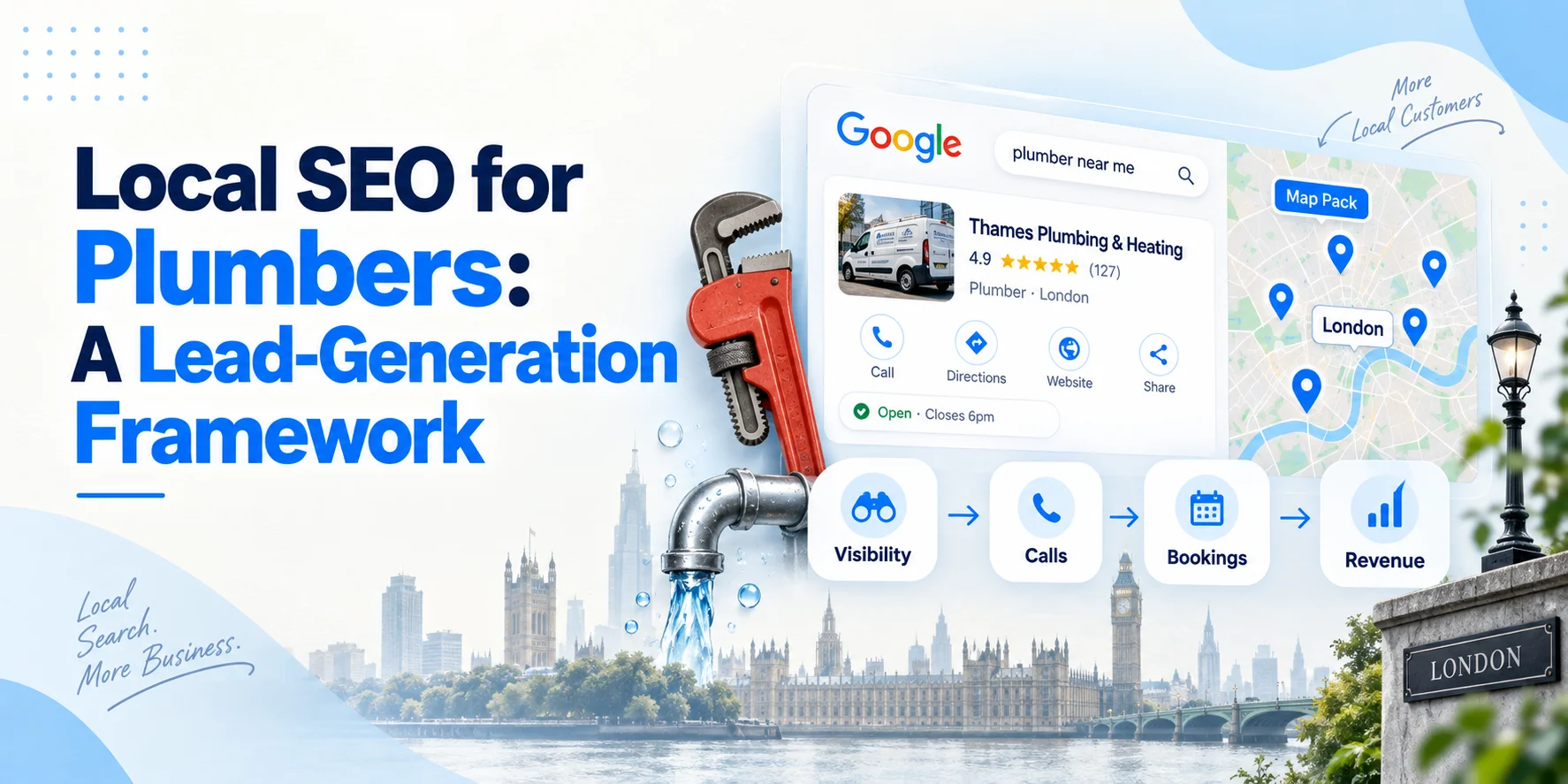
Google search → website visit → service page → phone call → qualified lead → booked job
That gives you a much clearer picture of performance.
Google Search Console can help you see which queries and pages are bringing search visibility and clicks.
You can then compare that information with your own lead and sales data.
Don’t Judge Plumber SEO by Rankings Alone
Ranking number one sounds great.
But what happens next?
If a page ranks well but nobody calls, there may be a conversion problem.
Perhaps the page doesn’t explain the service clearly.
Perhaps the phone number is difficult to find.
Perhaps customers don’t trust the business yet.
That’s why local SEO for plumbers should connect visibility with leads.
The real question isn’t simply:
“Did we rank?”
It’s:
“Did the visibility help bring the right customers?”
Common SEO Mistakes Plumbing Companies Make
Creating Hundreds of Location Pages
More pages don’t automatically mean more customers.
Weak location pages can create a poor user experience and may look like doorway content.
Build pages only where they provide genuine value.
Using the Same Service Page for Everything
A single page covering emergency plumbing, drainage, boilers and bathrooms may struggle to satisfy all those different searches.
Give important services their own useful pages where appropriate.
Stuffing Locations Into Every Sentence
You don’t need to write “plumber Croydon” ten times.
Use natural language.
Google and customers both benefit from content that reads normally.
Buying Fake Reviews
Fake reviews can destroy trust.
Build genuine reviews through good service and honest customer feedback.
Buying Cheap Links
Thousands of low-quality links don’t create real local authority.
Focus on relevant and trustworthy mentions instead.
Ignoring Mobile Users
Many emergency plumbing searches happen when people are away from a desktop.
Make your website easy to use on a phone.
Making Unsupported Claims
Don’t claim to be “the UK’s number one plumber” unless you have evidence that supports it.
Don’t promise response times you can’t meet.
Don’t list qualifications the business doesn’t have.
Trust is hard to build and easy to lose.
A Practical Plumber SEO Framework
A useful plumber SEO strategy can be built around six areas.
1. Get the Business Profile Right
Make sure your Google Business Profile is verified, accurate and complete.
2. Map Services to Search Intent
Identify your important plumbing services and understand what customers search for.
3. Build Useful Service Pages
Give important services their own pages when they have distinct search intent.
4. Create Genuine Local Coverage
Build location pages only for areas the business genuinely serves and where useful local information can be provided.
5. Build Trust
Use real reviews, genuine experience, qualifications and relevant professional information.
6. Measure Leads
Track calls, enquiries, bookings and jobs rather than stopping at rankings.
That framework keeps the strategy focused on the customer.
A Simple Plumber SEO Example
Imagine a plumbing company serving London. It offers emergency plumbing, drain unblocking and boiler repairs.
Instead of creating dozens of nearly identical pages, the business could build three strong service pages.
It could then create useful location pages for areas it genuinely serves, such as Ealing, Acton and Chiswick.
The internal links connect those services and locations.
The Business Profile supports the same core business information.
Reviews provide genuine customer feedback.
The website makes calling easy.
Now the SEO strategy has a clear structure.
It isn’t trying to rank every possible keyword.
It’s helping customers find the right service in the right area.

Local SEO for Other Trades
The same local search principles apply across many home-service businesses, although customer intent and competition can differ by trade. If you work across related services, explore our guides to local SEO for electricians and local SEO for roofers.
Each trade needs its own mix of service pages, local targeting, trust signals and lead tracking rather than one generic SEO approach.
How Wixdek Approaches Local SEO for Plumbers
At Wixdek, we believe plumbing SEO should be built around real customer journeys.
A plumber doesn’t need more traffic for the sake of having more traffic.
The aim is to attract people who actually need plumbing services.
That starts with understanding the business, its services, its locations and the searches that matter.
From there, we can identify gaps across the Google Business Profile, website, service pages, local pages, internal links and technical SEO.
The next step is measuring what happens after someone finds the business.
That could be a phone call, quote request, booking or another meaningful enquiry.
For broader industry SEO support, explore the industries we work with. For wider local search strategy, you can also explore Wixdek’s Local SEO services.
Local SEO for Plumbers Checklist
Before launching or reviewing a plumbing SEO campaign, check the basics.
- Is the Google Business Profile accurate?
- Is the correct primary category selected?
- Are the real plumbing services listed?
- Are the business details consistent?
- Are important plumbing services covered by useful pages?
- Are location pages genuinely useful?
- Is the website easy to use on mobile?
- Can customers quickly find the phone number?
- Are genuine reviews being collected and managed?
- Are relevant qualifications and trust signals shown?
- Are internal links connecting services and locations?
- Is local business structured data accurate?
- Are calls and enquiries being tracked?
- Are SEO results being measured against actual leads?
If several answers are no, there’s probably room for improvement.
Final Thoughts
Local SEO for plumbers isn’t about stuffing a website with plumbing keywords.
It’s about helping the right customer find the right service at the right time.
Emergency searches need quick reassurance.
Planned searches need useful information.
Location searches need genuine local relevance.
Your Google Business Profile needs accurate information, while your website needs clear services, useful local content and easy ways to get in touch.
Most importantly, don’t chase shortcuts.
Build genuine trust, create pages for real customers and measure the leads that come from your visibility.
That’s how plumber SEO becomes a lead-generation framework rather than another monthly ranking exercise.
Frequently Asked Questions
What is local SEO for plumbers?
Local SEO for plumbers is the process of improving a plumbing company’s visibility in Google Search and Maps for relevant searches in its service area. It covers areas such as Google Business Profile optimisation, service pages, location pages, reviews, technical SEO and local authority.
How does SEO help a plumbing company?
SEO can help a plumbing company appear when potential customers search for relevant services nearby. The goal is to turn that visibility into useful actions such as phone calls, quote requests, enquiries and booked work.
What keywords should plumbers target?
Plumbers should focus on searches linked to their actual services, problems and locations. Examples include emergency plumber searches, drain unblocking, leak repairs, boiler repairs and genuine service-area searches.
Does Google Business Profile help plumbers?
Yes. A complete and accurate Google Business Profile can help Google understand the business and its relevance to local searches. Google says local ranking is mainly based on relevance, distance and prominence.
How do I rank a plumber in Google Maps?
There is no guaranteed method for achieving a specific Maps position. Focus on accurate Business Profile information, strong local relevance, genuine customer reputation, useful website content and other signals that support local prominence.
Should plumbers create a page for every town they serve?
Not necessarily. A location page should exist when it provides useful information for customers in that area. Creating large numbers of nearly identical pages simply to target towns can create thin or doorway-style content.
Do plumbers need separate service pages?
Separate service pages can be useful when services have different search intent and customers need different information. For example, emergency plumbing and drain unblocking may deserve separate pages if both are important services.
Are reviews important for plumber SEO?
Reviews can help customers judge whether a plumbing company is trustworthy, and Google says reviews can contribute to local prominence. Focus on genuine feedback from real customers rather than trying to manufacture reviews.
How long does local SEO for plumbers take?
There is no fixed timeframe. Some technical or profile improvements may show changes relatively quickly, while stronger organic and local visibility can take longer, especially in competitive areas.
Should a plumbing company focus on Google Maps or organic SEO?
Ideally, both should work together. Maps can help capture local service searches, while organic pages can provide deeper information about services, problems and locations.
How can plumbers measure SEO leads?
Track meaningful actions such as calls, quote requests, contact forms and bookings. Then connect those enquiries with your sales records where possible, so you can see which leads become actual plumbing jobs.
Ready to Turn Local Searches Into Plumbing Leads?
If your plumbing business is getting visibility but not enough enquiries, the problem may not simply be rankings.
Your Google Business Profile, service pages, location coverage, website experience and conversion tracking all play a part.
Wixdek can review your current local search presence and identify where potential customers are being lost.
Request a Local SEO Review