A service content can look polished and still leave people confused. The headline may sound clever. The design may look expensive. The page may mention the target keyword several times. But after reading it, a customer still may not know exactly what the business does, where it works, who the service is for or what happens next.
That is a content problem before it is an SEO problem. It also makes life harder for search systems. Google needs to understand the subject and purpose of a page. Newer AI-powered search experiences also need clear, useful information when they retrieve web content. This does not mean you need to rewrite your website in strange robot language. Quite the opposite.
Google’s current guidance for generative AI Search says there is no special way you need to write purely for AI systems. It also says its AI Search features continue to use normal Search ranking and quality systems. The practical goal is much simpler. Make your service content clearer for the person who needs the service. Define what you do, explain important details, connect related pages and show real evidence.
Make business information consistent and use technical markup where it genuinely fits. When the page becomes easier for customers to understand, it normally becomes easier for search systems to interpret too.
Understanding Clear Service Content

What Does “Easier to Understand” Actually Mean?
A clear service content answers basic questions without making the visitor hunt. Someone landing on a commercial cleaning page should quickly understand what kind of cleaning is offered. Someone visiting a technical SEO page should understand what problems the service deals with. Someone looking for an emergency plumber should know whether the company serves their area.
This sounds obvious, but many service pages hide basic information inside vague marketing copy.
You might see phrases such as:
- Powerful solutions for modern businesses.
- Or:
- We take your online presence to the next level.
Those phrases may sound nice, but they do not make the service clear. A customer still needs to know what service is being offered, who needs it, which problems are solved, where the service is available and what the company actually does. Clear content answers those questions.
Start With the Customer, Not the AI System
Before changing a service content for AI search, forget AI for a moment. Ask whether a normal person can understand it. Google’s people-first guidance says content should primarily help the intended audience. It asks whether visitors will leave feeling they have learned enough to achieve their goal. That is a good test for service content SEO too.
If somebody lands on your page after searching for office cleaning in Westminster, can they work out whether you provide it? If someone needs technical SEO support, can they see what the service covers? If they want a quote, can they find the next step? If those answers are unclear, adding more schema will not fix the real problem.
Practical Service Content Improvements
1. Define the Service Clearly
Every service page content should make its main subject obvious. Do not make the customer decode your marketing language. A useful opening normally explains the service in plain words.
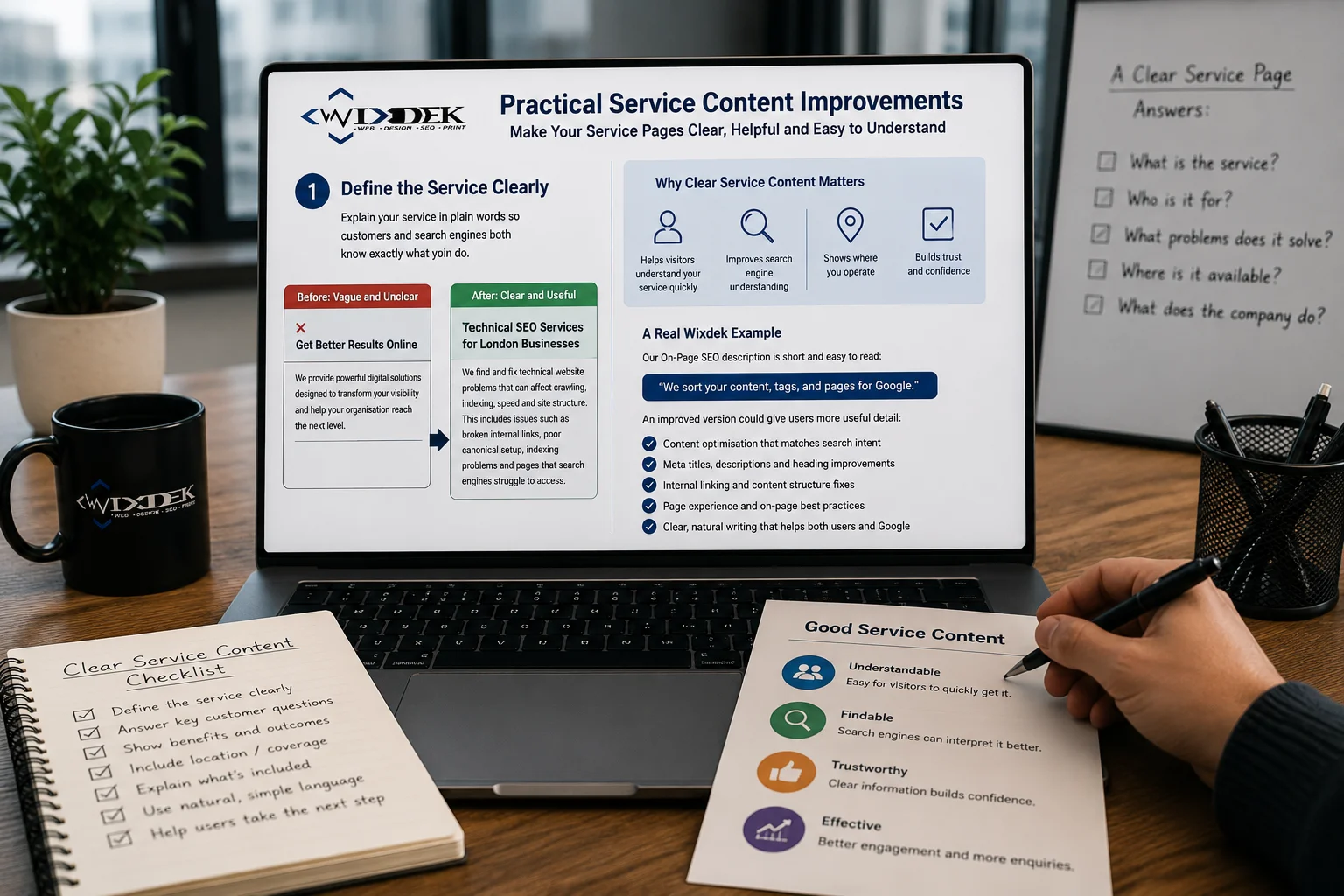
Before
Get Better Results Online
We provide powerful digital solutions designed to transform your visibility and help your organisation reach the next level. It sounds positive, but it says very little.
After
Technical SEO Services for London Businesses
We find and fix technical website problems that can affect crawling, indexing, speed and site structure. This includes issues such as broken internal links, poor canonical setup, indexing problems and pages that search engines struggle to access. The second version gives both the customer and the search engine more useful context. The company has not stuffed the paragraph with keywords. It has simply explained the service properly.
A Real Wixdek Example
Wixdek’s current SEO Services page uses a very short description for On-Page SEO:
“We sort your content, tags, and pages for Google.”
It is easy to read, which is good. But a full service section could give users more useful detail. An improved version might read:
On-Page SEO
We improve the content and search signals on important pages so they match what customers are actually looking for. This can include page titles, headings, service copy, internal links and search-intent alignment. The aim is to make each page clearer for customers while helping search engines understand its main purpose. This version explains what the service includes and why the work matters.
That is more useful than simply adding another mention of “on-page SEO”.
2. Give Clear Answers Where Customers Need Them
People often come to service websites with direct questions. They may want to know how much something costs, whether you cover their area, whether you can deal with their problem, how quickly you can help and what the service includes. Give useful answers where you genuinely can. Do not make somebody read eight paragraphs before discovering whether you even offer the service.
Before
Do You Offer Emergency Plumbing?
Our experienced and committed team provides outstanding solutions built around your individual requirements. That does not answer the question.
After
Do You Offer Emergency Plumbing?
Yes. We provide emergency plumbing support for urgent problems such as major leaks, burst pipes and serious plumbing faults across the areas listed on this page. Availability can vary, so contact us to confirm current response times. The second answer is clearer. It also avoids making an unrealistic promise.
Direct Answers Do Not Need a Fixed Word Count
You may hear that every answer needs to be 30, 40 or 50 words so an AI system can extract it. Google does not give that requirement. Its current generative AI guidance says there is no need to break content into tiny pieces for AI systems. Google says its systems can understand multiple topics on a page and there is no ideal page length.
So use short answers when a short answer helps. Use more detail when the subject needs more detail. The reader decides the depth, not an invented AI formula.
3. Make the Business Entity Clear
“Entity” can sound more complicated than it needs to be. For a service business, think of it as the real business and the facts connected with it. Your website should clearly explain who you are, what you offer, where you operate, how people can contact you, what expertise you can prove and which services belong to your company.
For a local cleaning company, the core information might include its proper business name, commercial cleaning services, London service areas, contact details and genuine business information. For Wixdek, the website should consistently make clear that Wixdek is the business, what SEO and digital services it offers, and which pages explain those services. This is useful for customers first.
It also reduces ambiguity across the site.
Entity-Based Content Is Not Keyword Stuffing
Entity-based SEO does not mean repeating the company name in every sentence. It means giving enough clear context to understand relationships. For example:
Wixdek provides technical SEO for London businesses.
That sentence connects a business, a service and an audience. Now compare it with:
We provide cutting-edge solutions that deliver outstanding digital success.
The second sentence has more marketing language but less actual information. Clarity wins.
4. Make Service Areas Clear
Location matters for many UK service businesses. A locksmith in Birmingham cannot help somebody in Edinburgh just because the page ranks there. A commercial cleaner working across London should make its real coverage clear. Do not create dozens of fake location references just to appear more local. Instead, explain genuine service coverage naturally. You might say:
We provide commercial cleaning across Westminster, Camden and other areas of London covered by our team.
Then link to genuine location pages where those pages provide something useful and distinct. This helps customers work out whether the service fits their location.
5. Add Evidence Where Claims Need Support
A service page becomes stronger when it moves from promises to proof.
Before
We Deliver Outstanding SEO Results
Our experts use proven strategies to deliver incredible growth for every business. There are several problems here. What results are being discussed? Who achieved them? Which strategy was used? Where is the proof? And “every business” is an unnecessarily broad claim.
After
SEO Work Backed by Campaign Evidence
Our SEO pages include real campaign examples where we have verified data we can publish. This may include Search Console visibility, organic clicks, tracked enquiries or case-study results. We keep visibility metrics separate from leads so you can see what the evidence actually proves. This is more restrained, but it is also more credible.
Evidence Blocks Make Service Pages More Useful
An evidence block can sit close to the claim it supports. For example, a service page discussing organic lead growth could link to a relevant case study. A technical SEO page could show a real technical issue and how it was resolved. A content service page could show a before-and-after section. The evidence needs to be genuine.
Do not add a made-up customer quote because the page “needs E-E-A-T”. Do not invent numbers or fake expert names. Trust is much harder to rebuild than content.
Another Wixdek Content Example
Wixdek currently describes Technical SEO on its main SEO service page with the short line:
- “We fix what’s slowing you down behind the scenes.”
- Again, it is readable but broad.
- A more descriptive service block could say:
- Technical SEO
We review crawling, indexing, website structure, internal links and technical page issues that can limit organic visibility. We then prioritise the problems that affect important pages instead of sending you a long automated audit with no clear order of action. The improved version tells the customer what technical SEO means. It also creates clearer subject context without forcing the target keyword into every sentence.
6. Show Who Provides the Expertise
Customers often want to know whether the advice comes from somebody who understands the work. That matters even more when a page makes technical or specialist claims. Google’s people-first content guidance encourages accurate information about who created content where readers would reasonably expect it. It also suggests showing relevant background and expertise. For service content, this does not mean filling every page with a giant author biography.
Use expertise where it matters. A technical guide may benefit from a named SEO specialist reviewer. A legal page may need a genuine legal expert. A medical page needs much stronger professional review. A straightforward local cleaning service page may simply need accurate company, team and service information. The level of expert detail should fit the subject.
Expert Information Must Be Real
Avoid lines such as:
Reviewed by our award-winning expert team
if nobody can tell who that means. Where appropriate, include a genuine name, real role and relevant experience. If there is no confirmed reviewer, do not invent one. The same rule applies to certifications, awards and years of experience. Search content should build trust rather than decorate the page with claims nobody can check.
7. Use Helpful Headings
Headings should make a page easier to scan. A customer should be able to move down the page and understand what each part covers. Google recommends informative, relevant and compact headings as part of a logical website experience. Good service headings might include:
- What Our Office Cleaning Service Includes
- Areas We Cover
- How the Service Works
- What Affects the Cost
- When You May Need Technical SEO
These headings tell the reader what comes next. A heading such as Solutions That Change Everything does not.
You Do Not Need a Question for Every Heading
Some questions make excellent headings. Others do not. A heading such as How Much Does Office Cleaning Cost? makes sense because it reflects a real customer question. But Our Commercial Cleaning Process may be perfectly clear as it is. Do not force every heading into conversational prompt language simply because AI search exists. Google’s current guidance says content does not need to be rewritten in a special way for generative AI Search.
Use the heading that best helps the reader.
8. Give Each Page a Clear Job
A common problem on service websites is not unclear sentences. It is unclear page ownership.
Imagine a cleaning company has these pages:
- Commercial Cleaning London
- Professional Commercial Cleaners London
- Best Commercial Cleaning Company London
If all three pages sell exactly the same service to exactly the same customer, the site structure may be creating unnecessary overlap. A clearer website might use Commercial Cleaning London as the main service page, Commercial Cleaning Costs for pricing research, How Often Should an Office Be Cleaned? for an informational question and Commercial Cleaning Westminster for a genuine location need.
Each page now has a job. This creates a stronger semantic content structure because page relationships are easier to understand.
Page Relationships Matter as Much as Individual Copy
Search engines do not only encounter isolated sentences. They also see pages connected within a website. A commercial service page may relate to pricing content, location pages, case studies, supporting guides, FAQs and contact or quote pages. The structure should reflect those real relationships. This is why service page content structure cannot be separated from website architecture.
A beautifully written page can still sit in the wrong place.
9. Use Internal Links to Explain Relationships
Internal links help users find related information. They also help Google discover pages and understand context. Google says internal anchor text can help both people and Google make sense of a site. It also recommends that every page you care about receives a link from at least one other page on the website. Suppose you have an article explaining SEO, AEO and GEO.
When that article discusses service-page clarity, it can naturally link to this implementation guide. If this guide discusses measuring AI visibility, it can link to the planned AI search visibility audit. If a later article explains improving Google AI Overview visibility, this guide can support it where the subject genuinely overlaps. That creates useful relationships.
Use Descriptive Anchor Text
Avoid relying on vague anchors such as click here or read more when a more useful phrase is available. A link such as SEO, AEO and GEO tells the reader what the destination covers. Google recommends anchor text that is descriptive, concise and relevant to the destination page. Do not make every anchor an exact-match target keyword.
Write it naturally.
10. Keep Important Information in Accessible Page Content
Good content cannot help much if it is technically difficult to access. Google recommends using semantic HTML and making sure important text is accessible in the page’s DOM. It also recommends crawlable links and individual URLs for meaningful pages or views. For normal service sites, this often means keeping core service information in regular page content instead of hiding everything inside complicated interactions.
Fancy design is fine. Just do not make important information unnecessarily difficult to access.
Do Not Hide the Main Service Behind Tabs
Tabs and accordions can be useful. But the visitor should not have to open six sections simply to work out what the company offers. Put the core explanation in the visible page flow. Use expandable sections for additional detail when they genuinely make the page easier to use. The content hierarchy should follow customer importance.
11. Use Structured Data Where It Is Appropriate
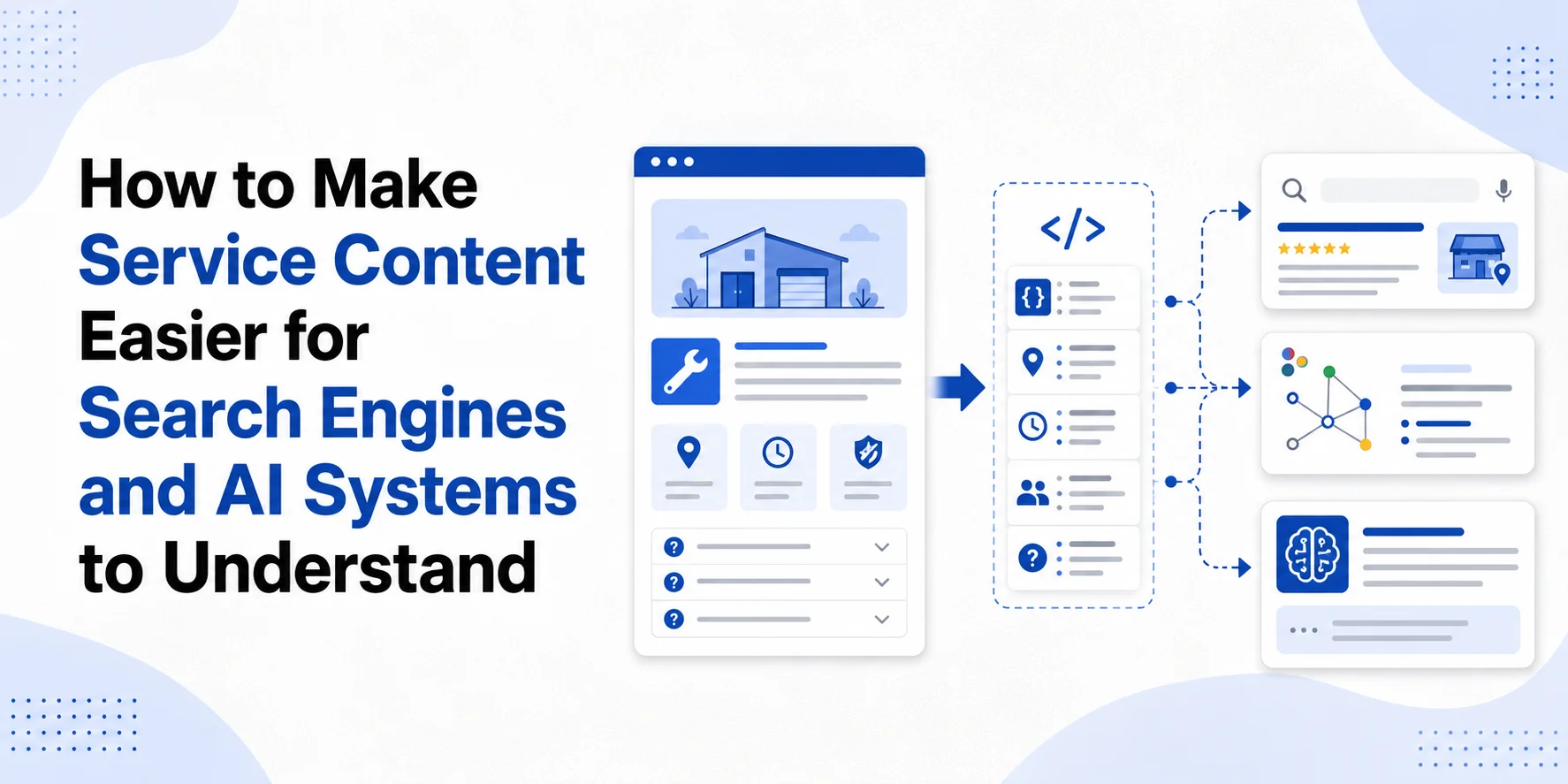
Structured data is machine-readable information added to a webpage. It can provide explicit clues about the meaning and type of information on that page. Google supports structured data for a range of Search features and says it can help Google understand page information. For a genuine local business, LocalBusiness structured data may be relevant. Google says LocalBusiness markup can provide information such as business details and recommends using the most specific applicable business subtype where possible.
Organisation information can also be useful where appropriate. But structured data needs to match the real visible content. Do not use markup to claim something the page does not actually say.
Structured Data Is Not Special AI Markup
This distinction is crucial. Google says structured data is not required for generative AI Search. It also says there is no special schema.org markup that websites need to add for AI Overviews or AI Mode. So the sensible rule is to use structured data when it accurately supports your wider search setup. Do not tell a client:
“Adding schema will make Google AI cite you.”
Google does not make that promise.
Do You Need Service Schema?
Schema.org contains many types and properties that websites can use to describe information. But adding a type does not automatically create a special Google Search feature. When working specifically with Google, check its current supported structured-data documentation rather than assuming every schema.org type produces a ranking or rich-result benefit. For many local service businesses, accurate organisation or LocalBusiness information may be more useful than loading every page with markup simply because a plugin offers it.
Use the markup you can support properly.
What About FAQ Schema?
FAQ content can still be useful. Customers often have genuine questions. But FAQ content and FAQ structured data are different things. Write FAQs because they answer something important. Do not add ten weak questions simply because somebody told you AI systems need FAQPage markup. Google’s current AI guidance says no special structured data is needed for its generative Search features.
12. Make Evidence Part of the Content Structure
Evidence should not always be pushed to the bottom of the page. Place it close to the claim it supports. Suppose your service page says your SEO work focuses on qualified enquiries. A nearby case-study block could show a relevant real example. Suppose you say your technical SEO process fixes indexing issues. You could include a short verified example of an indexing problem that was found and resolved.
The reader can then connect the promise with the proof. This is more useful than stacking twelve logos at the bottom and hoping they create trust.
What Makes a Useful Evidence Block?
A strong evidence block should explain the problem, the work completed, what happened and what can actually be proven. That last point is important. If Search Console proves visibility growth but not revenue, say visibility grew. If call tracking proves enquiries, you can discuss enquiries. Keep each claim inside the evidence you have.
13. Explain Limits as Well as Benefits
Service content often tries so hard to sell that it stops sounding trustworthy. Clear limitations can help. For example:
SEO results cannot be guaranteed because search performance depends on the website, competition, market and ongoing changes.
Or:
- Emergency availability varies, so call us to confirm the current response time.
- Or:
- A remote technical audit may identify the issue, but some fixes may require developer access.
- These details help customers make better decisions.
- They also make the service more clearly defined.
Useful content does not need to pretend every service is perfect for every customer.
14. Use Plain English Before Industry Jargon
Industry terms still have a place. A technical SEO page may need to discuss canonicals, crawlability, structured data and indexation. But explain them. Do not write:
We leverage semantic entity salience and advanced generative retrieval optimisation.
when you could say:
We make it clearer who your business is, what each page covers and how related pages connect.
You can introduce the technical term afterwards if the reader needs it. This helps customers first. It also creates clearer context around technical language.
15. Do Not Create a Separate “AI Version” of Your Service Page
Some businesses are being told they need normal pages for customers and separate AI pages for machines. That can create duplicate, thin or confusing content. Google’s current generative Search guidance says you do not need to rewrite content specifically for AI systems. It also says Google can understand synonyms and different ways users express the same need.
Build one useful page around the real service. Improve its clarity and make important details accessible. Then let that page serve customers and search systems together.
16. Do Not Create Every Possible Keyword Variation
A page for technical SEO London, another for London technical SEO and another for technical SEO services in London may not represent three different customer needs. Google says its systems can understand related wording and that websites do not need to capture every possible long-tail variation for generative Search. Create a new page when there is a genuine new intent.
Not simply because the words are in a different order.
17. Add Original Information Where You Can
Clear content is good. Clear content that says the same thing as every competitor is less useful. Google’s latest AI Search guidance puts strong emphasis on useful, unique, non-commodity content and says first-hand knowledge and original viewpoints can provide more value than simply restating information already online. For a service business, original information might come from real customer questions, project experience, before-and-after examples, internal processes, real case studies or expert commentary.
You do not need to invent a research department. Use what the business genuinely knows.
Before-and-After Service Content Examples
Complete Service Section Example
Here is a simple example of how an unclear SEO service block can become more useful.
Before
Grow Your Business With Powerful SEO
Our professional experts provide leading SEO solutions designed to increase your digital presence. We use innovative strategies and advanced methods to deliver outstanding results.
After
Technical SEO for Websites With Crawling and Indexing Problems
If important pages are missing from Google, rankings have dropped after a site change, or search engines struggle to reach parts of your website, technical SEO may be needed. We review crawling, indexing, internal links, canonical setup, site structure and other technical issues that can affect important pages. We then prioritise the problems that matter rather than asking you to fix every warning an audit tool produces.
If development work is needed, the implementation responsibility should be agreed before work starts. The second version is longer, but every sentence has a job. It defines the service, identifies customer problems, gives examples, explains the process and adds a useful limitation. That is what practical content optimisation for AI and search should look like.
Local Service Example
Before
Professional Cleaning You Can Trust
Our friendly team provides reliable solutions for every cleaning requirement using the highest standards.
After
Commercial Cleaning for London Offices and Workplaces
We provide commercial cleaning for offices and other workplaces across the London areas covered by our team. The service can be planned around the site, cleaning frequency and areas that need attention. If you need regular office cleaning, start by telling us the property size, location and preferred schedule. We can then confirm whether the service fits your requirements.
Again, there is no clever AI trick. The second version is simply clearer.
Evidence Example
Before
Proven Results
We help businesses achieve incredible online growth.
After
Campaign Results We Can Verify
Where client permission and tracking allow it, we publish campaign evidence such as Search Console growth, organic clicks, phone enquiries or bookings. Each case study explains which metric is being shown so search visibility is not presented as revenue. That sentence tells the customer what proof they can expect and how Wixdek handles the evidence.
How the Page Structure Should Fit Together
A strong service page does not need fifty sections. It needs the right sections. A useful order might begin with a clear service explanation, followed by the customer problems it solves, what is included, how the process works, evidence, relevant expertise, service areas where needed, common buying questions and a sensible next step. The exact order can change.
For an emergency service, contact information may need to appear much earlier. For a complex B2B service, evidence and process may need more space. Design around the person making the decision.
Entity and Content Relationship Diagram
The original Wixdek graphic should put the business in the centre. Around it, show the real relationships between the business and its services, genuine locations, subject experts, case studies, supporting guides and contact or conversion pages. Lines can visually connect related sections, but the published graphic should stay simple and easy to understand.
The purpose is to show that search engines and customers should be able to understand how the business, its services and its supporting information relate. Suggested alt text: Diagram showing a service business connected with its services, locations, experts, evidence, supporting content and contact information.
Before-and-After Page Design Asset
The second original visual should show the difference between an unclear service page and a clear one.
Weak Version
The weak design can show a vague hero statement, generic marketing text, no clear evidence, unclear location information and unrelated links.
Improved Version
The improved design can show a specific service heading, a plain-English description, clear service details, genuine evidence, expert information, descriptive internal links and an obvious contact action. Do not label the second version “AI optimised”.
Label it something such as:
- Clear Service Page Structure
- That keeps the point where it belongs.
- Clearer content helps people first.
How to Implement the Changes
Do not rewrite the whole website in one afternoon. Start with your highest-value service pages. Read each page as if you knew nothing about the company. Ask whether the first section clearly explains the service. Check whether vague claims can be replaced with specific information. Make sure genuine service areas are clear. Add evidence where you have it. Check whether related pages are linked naturally and review whether important business information is consistent.
Then look at structured data and technical accessibility. The order matters. Fix the actual information before trying to describe unclear information with markup.
Review the Page as a Customer
One of the easiest tests is to give the page to somebody who is not involved in the business. Ask them what service is being offered, who it is for, where it is available, why somebody might choose the company and what they should do next. If they cannot answer those questions, the page probably needs more clarity.
That test is wonderfully low-tech. It is also useful.
Review the Page Technically
Once the content itself is clear, check how it is delivered. Google recommends crawlable links, accessible page content and semantic HTML where possible. Make sure important pages can be found through normal links. Check accidental noindex rules. Review canonical setup where relevant. Make sure important text appears in accessible HTML rather than being trapped in a format search engines cannot properly use.
Technical SEO supports the content. It cannot replace it.
Measure What Changes
After improving a service page, monitor the result. Search Console can help show changes in impressions, clicks, queries and pages. Where Google’s generative AI reporting is available, it can also provide more specific visibility data for generative Search experiences. But service businesses should continue beyond visibility. Track calls, forms, bookings, quote requests and other meaningful conversions.
A page becoming easier for Google to understand is nice. A page becoming easier for customers to understand and use is better.
AI Platforms and Human-Friendly Content
What About ChatGPT?
Google’s rules do not automatically apply to every AI platform. For ChatGPT Search, OpenAI says public websites can appear in search and recommends allowing OAI-SearchBot if publishers want their content to be discovered and cited in ChatGPT search experiences. That is a platform-specific technical consideration. But OpenAI does not say that service businesses need to stuff pages with AI keywords or create a special ChatGPT version of their website.
The same practical principle holds. Publish clear, accurate public information. Make it technically accessible where appropriate. Then measure whether the platform actually discovers and refers users to it.
AI-Readable Website Content Should Still Sound Human
The phrase “AI-readable content” can give the wrong impression. Your website should not sound as if it was written for a machine. Short sentences are useful when they make the answer easier to understand. Clear headings are useful because people scan pages. Specific language is useful because vague marketing copy frustrates customers. Evidence is useful because buyers want proof.
These things happen to create clearer information for search systems too. That overlap is exactly what we want.
Common Mistakes to Avoid
Avoid unsupported schema that is sold as a guaranteed route to AI citations. Do not create hundreds of FAQ questions simply to target prompts, rewrite every heading as a question or create separate pages for tiny keyword variations. Do not invent expert credentials, fake case-study figures or artificial mentions around the web. And do not make service pages longer simply because you think AI prefers long content.
Google says there is no ideal page length for generative AI Search and continues to recommend content created for users rather than search systems first.
How This Fits Into the Wider Search Strategy
How This Fits With SEO, AEO and GEO
Our guide on SEO, AEO and GEO explains the terms in more detail. The practical lesson for this page is simple. You do not need three different versions of good service content. SEO provides the search foundation. AEO can remind us to answer important questions clearly. GEO can help us think about how the business appears across generative AI systems.
But the page itself should remain focused on the customer.
How This Fits With AI Visibility Auditing
Clearer content does not guarantee that an AI system will mention or cite your business. That needs to be measured separately. The planned AI search visibility audit explains how brand mentions, recommendations, citations, accuracy, referral traffic and leads can be recorded over time. The audit tells you what is happening. This implementation guide helps improve the underlying content when clarity is one of the problems.
Improving Google AI Overview Visibility
A future Wixdek article will look specifically at improving Google AI Overview visibility. That article should not simply repeat this guide. It owns the implementation side of service content. The AI Overview article should focus on Google’s specific search experience, eligibility, measurement and realistic visibility opportunities. That separation helps keep both pages useful.
A Simple Service Content Review
When reviewing an important service page, focus on a few core questions. Can a customer quickly understand the service? Is the business behind the service clear? Are important claims supported? Does the page show genuine expertise where needed? Do headings help people navigate? Are related pages connected naturally? Is structured data accurate where it is used?
Can search systems technically access the important content? And is there a clear next step for the customer? If those basics are strong, you are already doing much of the work that matters.
How Wixdek Approaches Service Content Optimisation
At Wixdek, clearer service content should begin with page purpose and search intent. First, we work out what the page needs to do. Then we check whether the service is defined clearly enough for somebody unfamiliar with the company. We look for missing customer information, vague claims and unsupported promises. We review how the page connects with related services, supporting content and location pages.
Technical SEO checks whether important information can be crawled and indexed properly. Structured data is used where it genuinely fits the page and supported Search features. Evidence is added when real evidence exists. The aim is not to make a page look “more AI”. The aim is to remove confusion.
Clearer Content Helps Everyone
A person needs to understand what your business does. A search engine needs enough context to understand what a page is about. AI-powered search systems need useful public information when retrieving web content. Those needs overlap. That is why the best content for search engines and AI often looks surprisingly normal. It has a useful title, explains the service, uses clear headings, provides real information, links related pages and shows evidence.
It does not hide the business behind jargon. Google’s current AI Search guidance reinforces this rather than replacing it. It says traditional SEO remains relevant, valuable original content matters, and publishers can ignore supposed shortcuts such as forced chunking, AI-only files and special generative-search schema.
Make the Page Better Before Making It “AI-Friendly”
The biggest mistake is starting with the machine. Start with the customer. If the service is unclear to a customer, define it. If the page has vague claims, make them specific. If expertise matters, show real expertise. If there is proof, make it easy to find. If related pages help the customer, link them. If structured data fits, implement it accurately.
If the technical setup blocks search systems, fix it. That is a much stronger content optimisation strategy than chasing the latest AI hack. Search technology will keep changing. Clear information will remain useful.
Get a Service Content and Technical SEO Review
If your service pages look polished but still struggle to gain useful search visibility or turn visits into enquiries, Wixdek can review the content and technical structure together. Our SEO services in London cover search intent, on-page content, internal linking, technical SEO and conversion-focused improvements. For websites with crawling, indexing, architecture or structured-data problems, our Technical SEO service can help identify what needs fixing first.
The aim is straightforward. Make it easier for customers to understand your services and easier for search systems to correctly interpret the pages that explain them.
Request an SEO or Technical Content Review
Frequently Asked Questions
How Do I Make Content Easier for Search Engines to Understand?
Start with a clear page purpose. Explain the service content in plain words, use useful headings, connect related pages with descriptive internal links and make sure important content is technically accessible.
How Do I Make Service Content Easier for AI Systems to Understand?
Focus first on clear, accurate and useful public information. Define services, business details, expertise and supporting evidence. Platform-specific technical access may also matter, but there is no universal AI-writing formula.
Does Google Require Special Content for AI Overviews?
No. Google says normal SEO best practices continue to apply to its generative AI Search features and that websites do not need to rewrite content in a special AI format.
Does Structured Data Help AI Search?
Structured data can help search engines understand supported information and may help with eligible Search features. However, Google says structured data is not required for its generative AI Search and there is no special AI schema.
Should I Use LocalBusiness Structured Data?
It can be appropriate for genuine local businesses when the markup accurately represents the business information on the page. Google provides specific LocalBusiness structured-data guidance.
Should Every Service Content Page Have FAQ Schema?
No. Add FAQ content when customers genuinely need those answers. Do not add FAQ markup purely because you believe it guarantees AI visibility.
Should Every Heading Be a Question?
No. Questions work well when they match a real customer question. Other headings should simply describe the section clearly.
Does AI-Friendly Content Need Short Paragraphs?
Not as a Google requirement. Google says there is no requirement to break content into tiny chunks and there is no ideal page length for generative AI Search.
Should I Create Separate Pages for Every Long-Tail Keyword?
No. Create a separate page when there is a distinct customer or search intent. Google says its systems can understand synonyms and different ways people express similar needs.
What Is Entity-Based Content?
Entity-based content makes important real-world relationships clear, such as which business provides a service, which locations it serves, who has relevant expertise and how related pages connect.
Do Internal Links Help Search Engines Understand Service Pages?
Yes. Google says links help it discover pages and understand relevance. It recommends descriptive, concise internal anchor text and links between related pages.
What Type of Evidence Should a Service Content Include?
Use evidence that genuinely supports the claim being made. This might include verified case studies, real project examples, expert input, genuine credentials or tracked results where publication permission exists.
Can Clearer Content Guarantee AI Citations?
No. Better content can improve clarity and usefulness, but Google and other AI platforms do not offer guaranteed citations or recommendations.
Should I Rewrite Old Service Pages or Create New Ones?
Check intent first. If an existing page already serves the customer need, improving it may be better than creating another overlapping page. Create a new URL only when it has a clear, distinct job.
How Do I Know Whether the Changes Worked?
Review Search Console visibility, page performance and relevant queries. Then check business outcomes such as calls, forms, bookings or qualified enquiries. AI-specific visibility can be measured separately where platform data is available.