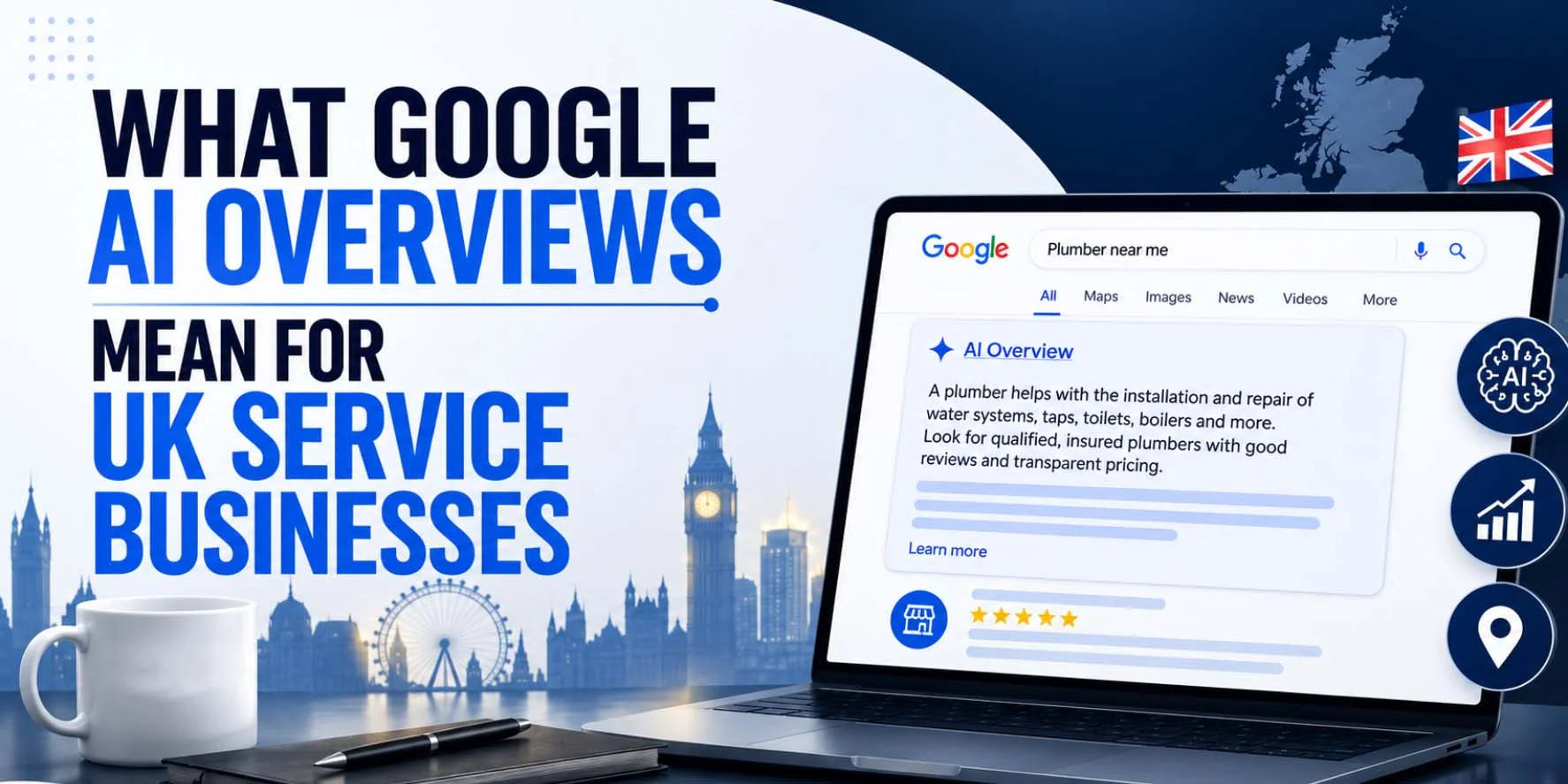
Google Search is changing how people find information and discover businesses.
For some searches, Google now displays AI-generated summaries above traditional results. These are called Google AI Overviews.
For UK service businesses, this raises practical questions:
- Will customers still click through to websites?
- Can a service business appear as a supporting source?
- Do existing pages need rewriting?
- Does SEO need to change?
Google’s current guidance is relatively simple: established SEO best practices still apply, and no special AI-only optimisation is required.
However, Google AI Overviews can change how users discover information and decide whether to visit a website.
This guide explains how they work, what Google has confirmed, what remains uncertain and what UK service businesses should do.
What Are Google AI Overviews?
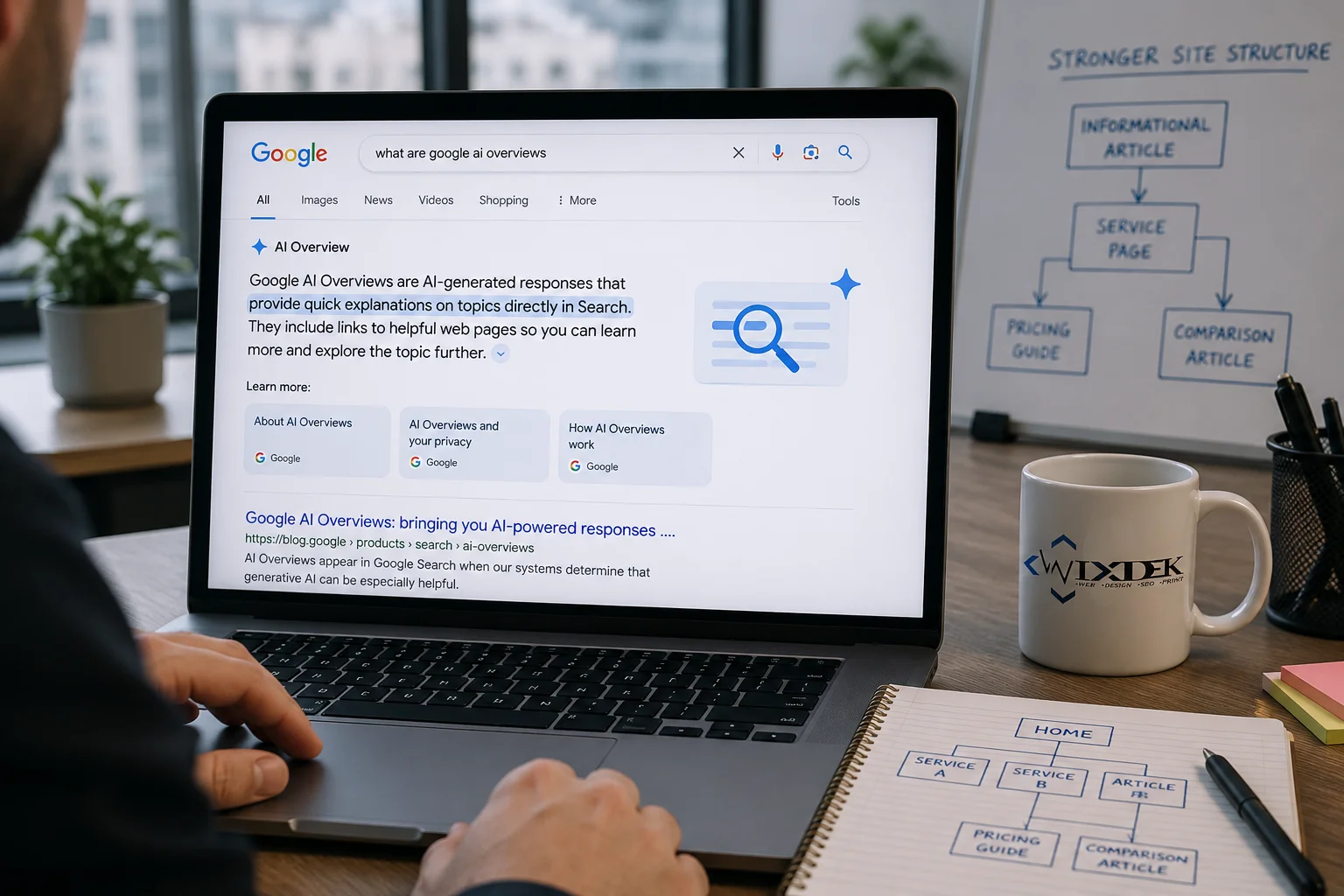
Google AI Overviews are AI-generated summaries that appear within Google Search for selected queries.
They may:
- answer a question directly;
- summarise information from different sources;
- show supporting website links;
- help users explore a topic further.
For example, someone searching for causes of low boiler pressure may see a summary of common explanations alongside links to relevant websites.
Google does not show AI Overviews for every query. Its systems decide when the feature may be useful.
They have been available in the UK since 2024.
Google AI Overviews vs AI Mode
AI Overviews and AI Mode both use generative AI, but they offer different search experiences.
| Feature | Google AI Overviews | Google AI Mode |
| Experience | Summary within Search | Conversational search |
| Main purpose | Answer or explain a query | Explore a topic in depth |
| Follow-up questions | Limited | Core part of experience |
| Supporting links | May appear | May appear |
| UK availability | Introduced in 2024 | Introduced in July 2025 |
This article focuses mainly on Google AI Overviews.
How Google AI Overviews Work
Google’s AI search features use its wider Search systems to identify and present relevant information.
When an AI Overview appears, Google may include links to supporting websites.
Those links provide another route for people to discover content.
Google’s AI features and your website guidance says pages must meet normal Search eligibility requirements.
There are no additional technical requirements specifically for appearing as a supporting link.
What Is an AI Overview Citation?
An AI Overview citation is a supporting website link displayed within the generated answer.
A citation may lead to a page that provides more detail about the topic.
However, Google does not publish the exact formula it uses to select every source.
Good SEO can improve overall search eligibility, but nobody can guarantee that a particular page will appear in Google AI Overviews.
What Google Confirms About AI Overview SEO
There is a lot of advice online about AI search.
Some of it reflects Google’s guidance.
Some of it is speculation.
| Topic | What Google Supports | What Is Not Guaranteed |
| Traditional SEO | Existing best practices remain relevant | Good rankings do not guarantee citations |
| Indexing | Pages must meet normal Search requirements | Indexing alone does not guarantee inclusion |
| Helpful content | Useful, reliable content remains important | No fixed answer length guarantees visibility |
| Structured data | Supported markup can clarify information | Schema does not guarantee AI citations |
| Internal links | Relevant crawlable links remain useful | More links do not guarantee AI visibility |
| Business information | Accuracy supports clarity and trust | No public AI authority score exists |
| Reporting | AI visibility can be measured | Visibility does not prove leads |
Google’s generative AI optimisation guide reinforces the importance of useful content, technical accessibility and established SEO practices. For UK service businesses, the priority remains the same: Build a website that customers and search engines can understand and use.
Can Google AI Overviews Reduce Website Clicks?
They can change click behaviour.
A simple informational query may be answered directly within the search result.
For example:
Why is my boiler losing pressure?
A user may get enough information from an AI-generated answer and decide not to visit another website.
But compare that with:
Emergency boiler repair London
Someone making that search may still need:
- availability;
- service coverage;
- pricing information;
- trust signals;
- contact details.
Commercial searches often require more than a short explanation.
That is why businesses should analyse informational and commercial search intent separately rather than assuming Google AI Overviews affect every search in the same way.
What Google AI Overviews Mean for Service Pages
A service page should remain focused on helping customers decide whether to contact the business.
It does not need to become a long informational article simply because AI search exists.
An emergency locksmith page, for example, should quickly explain:
- the service provided;
- areas covered;
- availability;
- what customers can expect;
- relevant trust factors;
- how to request help.
Those details remain useful whether the customer arrives through an AI Overview, a normal organic listing or another Google feature.
Keep Commercial Intent Clear
Do not turn every service page into a general guide.
A commercial-cleaning page should explain the service and how to request a quote.
A detailed article about cleaning schedules or costs can live separately.
That supporting article can then link naturally to the commercial service.
The goal is a clearer customer journey, not more words.
Supporting Content Still Matters
Informational content can reach customers before they are ready to enquire.
Google AI Overviews create another possible discovery route for that content.
But a guide should remain useful even if Google never selects it as an AI source.
Commercial Cleaning Example
A cleaning company might publish:
- How often should an office be deep cleaned?
- What does commercial cleaning include?
- How much does office cleaning cost?
Each guide answers a real customer question.
When relevant, it can link to the commercial-cleaning service.
Pest Control Example
Someone searching for signs of rats in a loft may initially need information rather than a quote.
A useful guide can explain common warning signs and when professional inspection may be appropriate.
It can then link to the appropriate pest-control service.
Roofing Example
A roofing company may publish a guide explaining whether storm damage can be repaired or requires replacement.
Readers who need professional help can then move to the roof-repair page.
These pages have value even when they do not appear in Google AI Overviews.
Do Schema, GEO or Brand Mentions Guarantee AI Visibility?
No.
These topics are widely discussed, but they need to be separated from confirmed Google requirements.
Structured Data
Structured data can help Google understand supported information.
For service businesses, that may include valid business details.
However, Google does not require special AI Overview schema.
LocalBusiness or other supported markup should reflect information already visible on the site.
FAQ Content
FAQs can answer genuine customer questions.
But adding dozens of FAQs does not guarantee inclusion in Google AI Overviews.
Use FAQs when customers genuinely need the information.
GEO
GEO stands for Generative Engine Optimisation.
It is an industry term used for strategies aimed at improving visibility within generative search experiences.
Google does not require a separate GEO system for AI Overview inclusion.
Its published guidance continues to support established SEO principles.
Our guide on SEO, AEO and GEO explains how these terms overlap.
Brand Mentions
Google has not published a formula saying that a particular number of brand mentions guarantees AI citations.
Strong business identity and reputation can still help customers trust a company.
But unsupported claims about an AI authority score should not drive your SEO budget.
Technical SEO Still Matters
AI-powered search still depends on accessible content.
Google says a page must be indexed and eligible to appear with a snippet before it can qualify as a supporting source.
That makes normal technical SEO important.
Review:
- accidental noindex tags;
- crawling restrictions;
- broken pages;
- incorrect canonical signals;
- inaccessible content.
Googlebot remains the crawler used for Google’s Search AI features.
Standard Search controls remain important.
Local SEO Still Matters for UK Service Businesses
Accurate local information remains essential.
A service business should clearly communicate:
- business name;
- phone number;
- opening hours;
- services;
- genuine coverage areas.
Mobile businesses such as locksmiths and plumbers may need a different Google Business Profile setup from businesses that welcome customers at a physical premises.
Google’s Business Profile guidelines explain these requirements.
Accurate local information supports customers and local SEO.
It should not be presented as a guaranteed Google AI Overviews ranking factor.
How to Track Google AI Overviews in 2026
Google Search Console introduced dedicated generative AI performance reporting in June 2026.
Google reported broader worldwide availability by August 2026.
These reports provide more visibility into supported generative search features, including Google AI Overviews and AI Mode.
What Can You Review?
The reporting can include information such as:
- impressions over time;
- pages receiving AI exposure;
- countries;
- devices;
- date ranges.
Google’s generative AI performance report documentation explains the available metrics.
What Does the Report Not Tell You?
AI visibility does not automatically tell you:
- whether the visitor became a lead;
- whether the lead was qualified;
- whether the customer booked;
- how much revenue was generated.
That means Search Console should not be your only measurement source.
Measure Enquiries Too
A UK service business should also track:
- connected phone calls;
- completed enquiry forms;
- bookings;
- qualified leads.
Google recommends reviewing Search Console and Analytics together to understand both search visibility and website behaviour.
Google AI Overviews Examples for UK Service Businesses
These examples show how different search intents may affect page strategy.
They are illustrative, not live search-result observations.
Plumbing
| Informational Search | Commercial Search |
| Why is my boiler losing pressure? | Emergency boiler repair London |
| Needs an explanation | Needs a provider |
| Guide may be useful | Service page is important |
| AI Overview may appear | AI Overview should not be assumed |
A plumbing company can answer common questions through supporting content while keeping its emergency service page focused on availability and contact.
Commercial Cleaning
A commercial-cleaning company may publish guides about cleaning frequency or costs.
Its commercial page should remain focused on:
- available services;
- property suitability;
- quotation options.
The informational and commercial pages serve different stages of the buying journey.
Pest Control
A customer may first search for signs of rats.
Later, they may look for a local pest-control provider.
The guide and service page should answer those different needs and link naturally where useful.
What UK Service Businesses Should Do Now
You do not need to rebuild your SEO strategy around Google AI Overviews.
Focus on seven priorities.
1. Make Important Pages Accessible
Ensure Google can crawl and index your main services and useful guides.
2. Match Search Intent
Keep service pages commercial.
Use guides, pricing pages and comparisons for deeper informational needs.
3. Improve Content Quality
Remove filler.
Update old information.
Answer genuine customer questions.
Use first-hand knowledge and original examples where possible.
4. Strengthen Internal Links
Connect guides with relevant services, pricing pages and decision-support content.
5. Keep Business Information Accurate
Maintain consistent services, contact information and genuine coverage areas.
6. Use Structured Data Correctly
Apply supported markup only when it accurately reflects visible content.
7. Measure Visibility and Enquiries Together
Track Google AI Overviews exposure alongside wider organic performance and customer enquiries.
Do not chase AI visibility at the expense of commercial results.
Common Google AI Overviews Myths
| Claim | Reality |
| Traditional SEO is dead | Existing SEO practices still apply |
| Every business needs GEO tags | Google does not require them |
| Schema guarantees AI citations | It does not |
| Every page needs dozens of FAQs | Useful answers matter more |
| A fixed answer length improves inclusion | Google publishes no required word count |
| More brand mentions guarantee citations | No public formula supports this |
| AI visibility guarantees enquiries | Business outcomes need separate measurement |
The biggest risk is replacing useful SEO work with tactics that sound advanced but have little evidence behind them.
How Wixdek Approaches Google AI Overviews
At Wixdek, AI search starts with the website’s existing SEO foundation.
We review:
- priority service pages;
- technical accessibility;
- search intent;
- supporting content;
- internal linking;
- local information.
Where relevant reporting exists, Google AI Overviews visibility can be reviewed alongside wider search performance and customer enquiries.
The aim is to identify genuine opportunities rather than promise guaranteed citations.
Our guide on how to audit AI search visibility across Google, ChatGPT and Copilot explores wider AI-search measurement.
Our guide to entity SEO for service businesses explains how clear business identity and consistent information fit into the wider strategy.
What Google AI Overviews Mean for Future SEO
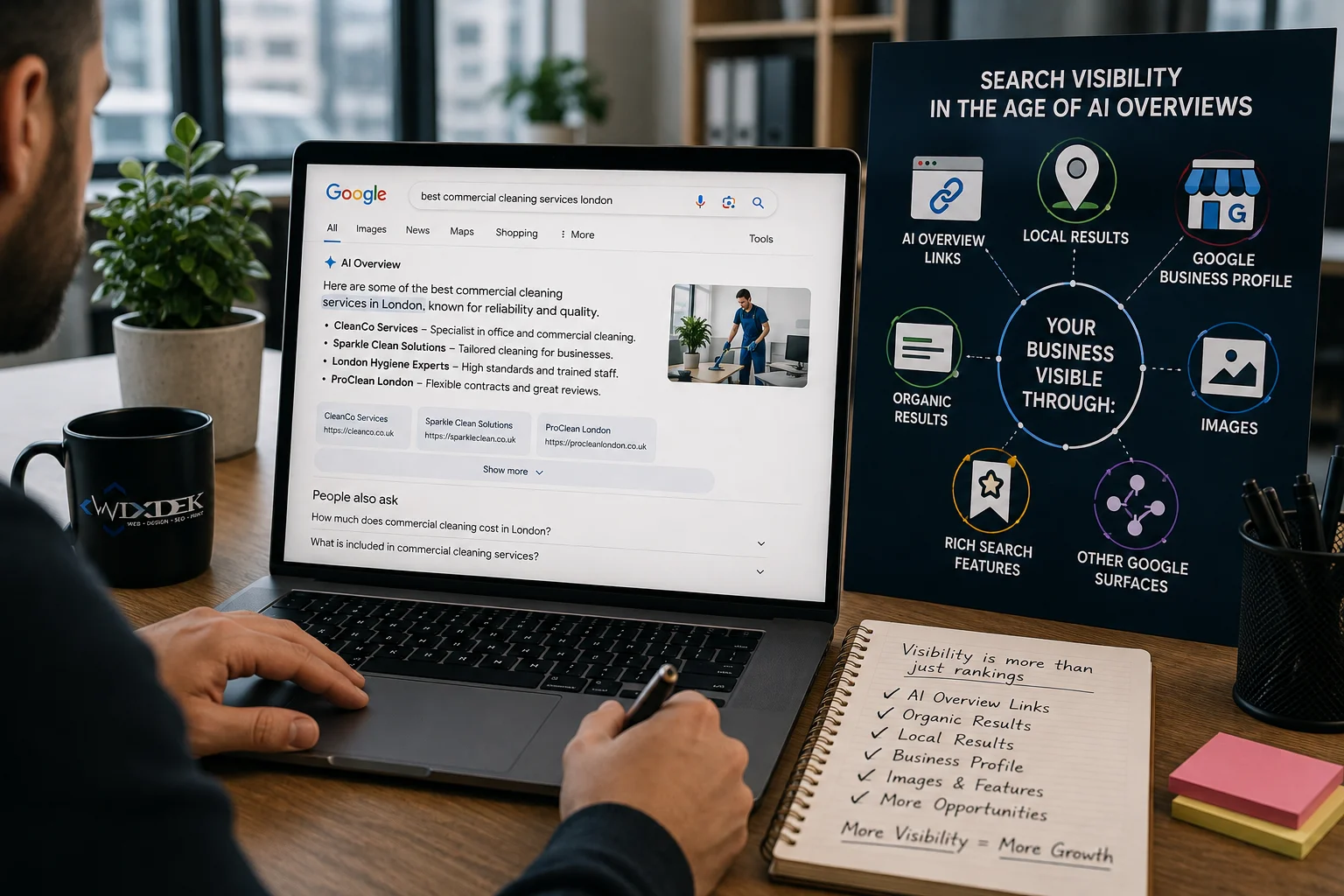
Search visibility is becoming less dependent on one traditional organic position.
A customer may discover a company through:
- an AI-generated answer;
- a supporting source;
- Google Maps;
- a local result;
- a normal service-page listing.
They may also make several searches before contacting a business.
For UK service companies, this makes clear information, useful content and strong customer journeys increasingly important.
But AI visibility is still only part of the search journey.
A website must ultimately attract the right customer and make contacting the business easy.
Improve Your Visibility Across Google AI Overviews and Search
Google AI Overviews have changed how some searches are displayed, but they have not removed the value of SEO.
Technical accessibility, search intent, useful content, internal links and accurate business information still matter.
If your business relies on Google for enquiries, Wixdek can review how your website performs across traditional and AI-powered search.
Our SEO services in London cover technical SEO, content strategy, internal linking, local visibility and conversion-focused improvements.
Request an SEO Opportunity Review to identify where your website needs stronger content, clearer structure or better measurement.
Frequently Asked Questions
What Are Google AI Overviews?
Google AI Overviews are AI-generated summaries that can appear within Google Search for selected queries. They may include supporting links to websites.
Are Google AI Overviews Available in the UK?
Yes. Google AI Overviews were introduced in the UK in 2024.
Do I Need Special SEO for Google AI Overviews?
No.
Google says existing SEO best practices remain relevant. There is no separate technical requirement for Google AI Overviews.
Can My Business Appear in Google AI Overviews?
Potentially.
A page must meet normal Google Search eligibility requirements, but eligibility does not guarantee inclusion.
Does Schema Guarantee Google AI Overviews Visibility?
No.
Supported structured data can help Google understand information but does not guarantee AI citations.
Can Google AI Overviews Reduce Website Traffic?
They can affect click behaviour, particularly for informational queries.
Commercial searches may behave differently.
Can I Track Google AI Overviews in Search Console?
Google provides dedicated generative AI reporting for supported Search features.
Use it alongside wider Search Console and conversion data.
Do Google AI Overviews Generate Leads?
They may contribute to discovery, but visibility alone does not prove lead generation.
Track calls, forms, bookings and sales separately.
Should I Rewrite Service Pages for AI Search?
Not solely for AI.
Keep commercial pages focused on customer needs, service information and conversion intent.
Is GEO Required for Google AI Overviews?
No.
GEO is an industry term rather than a separate Google requirement.
Are Brand Mentions a Confirmed AI Overview Ranking Factor?
Google has not published a simple brand-mention formula that guarantees inclusion.
Should I Publish More Blogs for Google AI Overviews?
Only when the content answers a genuine customer need. Do not create unnecessary pages simply to chase AI visibility.