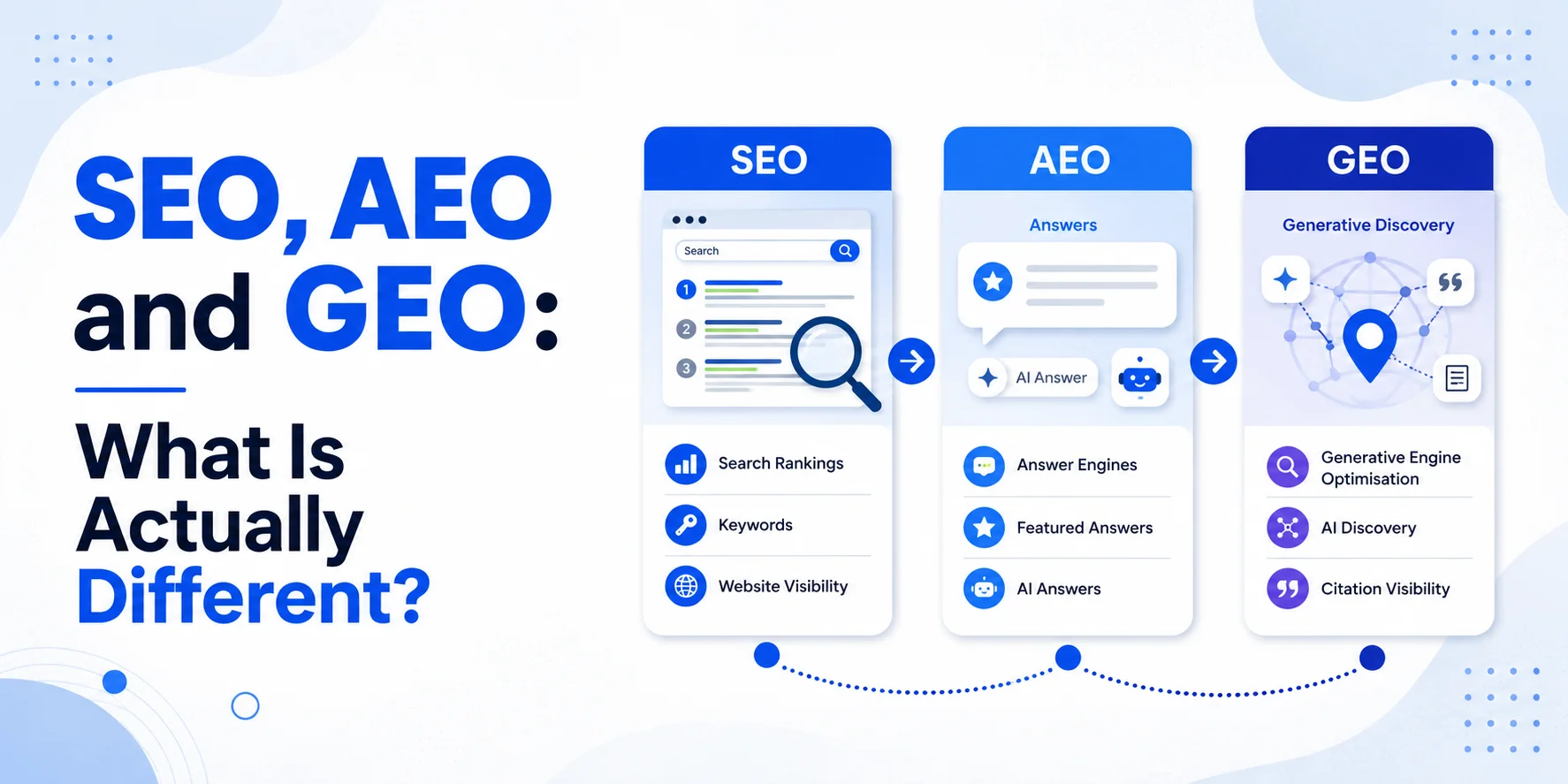
SEO, AEO and GEO now appear frequently in marketing conversations. Some agencies even sell them as three separate services.
But does a UK service business really need three different strategies?
The answer is usually no.
The SEO vs AEO vs GEO difference is mainly about focus:
- SEO improves organic search discovery.
- AEO focuses on clear answers for answer-led search experiences.
- GEO focuses on visibility within generative AI platforms.
They overlap because useful content, technical accessibility, clear business information and trustworthy evidence matter across search experiences.
This guide compares SEO vs AEO vs GEO, explains where they differ and shows how UK service businesses can use them without paying for three versions of the same work.
SEO vs AEO vs GEO: Quick Comparison
| Area | SEO | AEO | GEO |
| Full name | Search Engine Optimisation | Answer Engine Optimisation | Generative Engine Optimisation |
| Main focus | Organic search discovery | Clear answers | Generative AI visibility |
| Typical platforms | Google, Bing, local search | Answer-led search and assistants | Google AI features, ChatGPT, Copilot |
| Content emphasis | Search intent and useful pages | Direct explanations | Reliable source information |
| Technical needs | Crawling and indexing | Platform-dependent | Platform-dependent |
| Main measurements | Rankings, clicks, conversions | Answer visibility | Citations, mentions, AI referrals |
| Guaranteed results | No | No | No |
The simplest way to understand SEO vs AEO vs GEO is this:
SEO is the broad foundation. AEO and GEO add extra attention to newer ways people discover information.
What Is SEO?
SEO stands for Search Engine Optimisation.
It improves a website so search engines can understand it and customers can find useful pages.
For a London service business, SEO may include:
- technical SEO;
- service pages;
- local optimisation;
- keyword research;
- content;
- internal linking;
- authority building;
- conversion tracking.
For example, an emergency plumber needs a page explaining services, coverage and contact options.
Google must be able to access that page, and customers must be able to understand it.
That is standard SEO.
Wixdek’s SEO services in London cover these foundations alongside content and performance measurement.
What Is AEO?
AEO stands for Answer Engine Optimisation.
It is an industry term for making information clear and useful in direct-answer experiences.
AEO often emphasises:
- concise explanations;
- factual accuracy;
- clear structure;
- useful answers to specific questions.
For example:
How quickly should a leaking roof be repaired?
A useful article can answer that question directly, then explain damage, urgency and when professional inspection may be appropriate.
AEO does not mean every heading must become a question or every paragraph must be shortened artificially.
What Is GEO?
GEO stands for Generative Engine Optimisation.
It describes efforts to improve or measure visibility within generative AI experiences such as:
- Google AI Overviews;
- Google AI Mode;
- ChatGPT Search;
- Microsoft Copilot.
A GEO review may examine:
- brand mentions;
- source citations;
- referral traffic;
- accuracy of AI-generated descriptions;
- platform access.
However, there is no universal GEO ranking system shared by Google, OpenAI and Microsoft.
Our AI search visibility audit guide explains how to compare these platforms without inventing ranking positions.

SEO vs AEO vs GEO: The Main Differences
The SEO vs AEO vs GEO comparison becomes clearer when you look at what each approach measures and optimises.
1. Search Experience
SEO covers organic discovery across search engines.
AEO gives extra attention to experiences that answer questions directly.
GEO looks at AI-generated responses that may combine information from several sources.
These experiences often overlap.
2. Content Presentation
SEO content should match search intent.
AEO favours clear answers where direct explanation helps the reader.
GEO considers whether reliable information can be discovered and referenced by generative systems.
One strong page can support all three.
3. Technical Access
Search engines need access to eligible content.
Google’s AI features use its existing Search infrastructure.
ChatGPT Search has separate publisher controls, including OAI-SearchBot.
These platform differences matter, but they do not require three different websites.
4. Visibility
SEO commonly measures:
- rankings;
- impressions;
- clicks;
- landing-page performance.
AEO may examine direct-answer visibility.
GEO may examine:
- citations;
- brand mentions;
- recommendations;
- AI referral traffic.
These measurements are not interchangeable.
5. Business Results
Whatever you call the strategy, commercial outcomes still matter.
A citation with no useful visitors is not automatically valuable.
A page ranking first for irrelevant searches may also provide little business value.
The SEO vs AEO vs GEO decision should always connect visibility with customer behaviour.
What Google Says About SEO vs AEO vs GEO
Google’s 2026 guidance makes an important distinction.
It recognises AEO and GEO as industry terminology, but optimisation for Google’s generative Search features remains part of normal SEO.
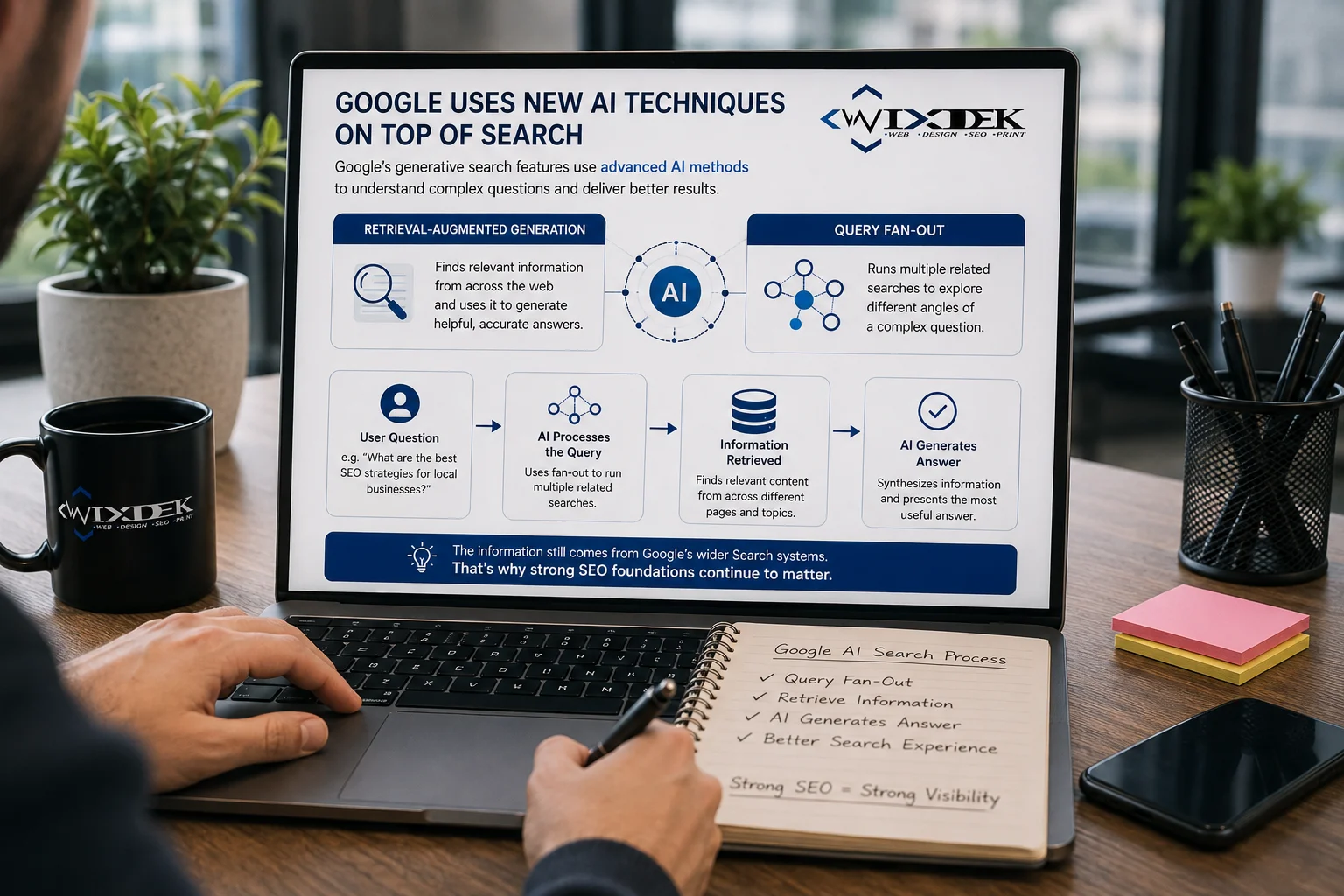
Google AI Overviews and AI Mode use existing Search systems alongside generative techniques.
Google’s generative AI optimisation guidance continues to recommend:
- useful content;
- technical accessibility;
- clear information;
- established SEO practices.
You do not need a separate AI website or special generative-search markup.
This is why the SEO vs AEO vs GEO discussion should focus on changing search experiences rather than pretending the SEO foundation has disappeared.
How ChatGPT and Copilot Differ From Google
Google is not the only search or discovery platform.
ChatGPT and Copilot can also surface websites, but their systems and reporting differ.
ChatGPT Search
ChatGPT Search can retrieve web information and provide source links.
OpenAI recommends allowing OAI-SearchBot when you want eligible public content to be discoverable.
Hosting or CDN restrictions may also affect access.
OpenAI also explains that search placement cannot be guaranteed.
Read the official OpenAI publisher guidance for details.
Microsoft Copilot
Microsoft Copilot can use web information and provide citations.
Bing Webmaster Tools includes AI visibility reporting for supported Microsoft experiences.
Microsoft has introduced reporting features such as:
- Intents;
- Topics;
- Citation Share;
- Compare.
Citation Share is an observational metric, not a traditional ranking score.
Microsoft explains these tools in its AI visibility reporting announcement.
Why Results Differ
The same website may appear in Google but not be cited by ChatGPT.
Copilot may use another source for a similar question.
Results can vary by:
- prompt;
- location;
- available sources;
- platform systems;
- platform updates.
That is a major practical difference in SEO vs AEO vs GEO measurement.
What SEO, AEO and GEO Have in Common
The useful foundations overlap heavily.
A website still needs:
- clear purpose;
- reliable information;
- accessible pages;
- useful content;
- logical structure;
- relevant internal links;
- accurate business details.
Real experience, original data and credible evidence can strengthen content regardless of how someone discovers it.
That is why businesses rarely need separate content versions for SEO, AEO and GEO.
SEO vs AEO vs GEO: Common Myths
AI search has created plenty of advice that sounds more certain than the evidence supports.
Myth 1: Every Website Needs llms.txt
Google does not use llms.txt as a special requirement for Search visibility.
It does not provide a guaranteed AI Overview advantage.
Other platforms may use different controls.
Myth 2: Special AI Schema Guarantees Citations
Google does not require special GEO schema.
Supported structured data may still help describe content, but it does not guarantee AI visibility.
Myth 3: AI Only Understands Short Content
There is no universal requirement to turn every article into tiny paragraphs.
Use short answers where they improve readability.
Use longer explanations when the topic needs them.
Myth 4: Every Heading Must Match an AI Prompt
Question headings can work well when they reflect real customer needs.
Creating a separate page for every possible prompt can lead to repetitive, low-value content.
Myth 5: Brand Mentions Guarantee Visibility
Genuine reputation signals can support trust.
There is no published formula saying a certain number of mentions guarantees AI citations.
Myth 6: AEO Requires Hundreds of FAQs
A useful FAQ answers genuine customer questions.
Quantity alone provides no advantage.
Myth 7: GEO Guarantees ChatGPT Recommendations
No agency can guarantee a first-place ChatGPT recommendation.
A responsible GEO review should report observable citations and mentions without inventing rankings.
SEO vs AEO vs GEO Examples for UK Service Businesses
The SEO vs AEO vs GEO difference is easier to understand through search intent.
Emergency Plumbing
| Customer Search | Intent | Relevant Approach |
| Emergency plumber Camden | Hire a service | SEO + Local SEO |
| Why is my boiler losing pressure? | Understand a problem | SEO + AEO-style clarity |
| Which London plumbers handle urgent boiler repairs? | Compare providers | SEO + GEO visibility review |
The business still needs:
- strong service pages;
- accurate coverage;
- useful guides;
- clear contact options.
AI visibility may create another discovery route, but it does not replace those basics.
Commercial Cleaning
A commercial-cleaning business may have a main service page explaining:
- services;
- suitable premises;
- quotation process.
Supporting content may answer questions about:
- cleaning frequency;
- costs;
- service inclusions.
That content can support SEO, direct-answer experiences and AI discovery without being rewritten three times.
Wixdek
For Wixdek:
- SEO may target SEO services London;
- AEO-style content may answer questions about pricing, audits and timelines;
- GEO monitoring may examine whether AI platforms cite or mention Wixdek.
Again, the underlying website remains connected.
How to Measure SEO vs AEO vs GEO
Different channels need different measurements.
| Search Area | Useful Measurements |
| Traditional SEO | Rankings, impressions, clicks, landing pages |
| Local SEO | Maps visibility, profile actions, local enquiries |
| AEO | Direct-answer visibility where observable |
| Google generative search | AI impressions and exposed pages |
| ChatGPT Search | Mentions, citations, referral traffic |
| Microsoft Copilot | Citations and grounding queries |
| Business outcomes | Calls, forms, bookings, leads, sales |
The SEO vs AEO vs GEO comparison becomes useful only when measurement matches the platform.
Google Generative Search Reporting
Google introduced dedicated generative AI performance reporting in 2026.
The reports provide information about visibility within supported AI Search features such as AI Overviews and AI Mode.
Businesses can review dimensions including:
- pages;
- countries;
- devices;
- dates.
However, generative visibility alone does not provide a complete picture of enquiries or revenue.
Compare it with Analytics and conversion data.
Microsoft AI Reporting
Bing Webmaster Tools provides AI Performance reporting for supported Microsoft experiences.
Its reporting can help identify:
- cited pages;
- citation trends;
- grounding queries;
- topic patterns.
Citation counts should not be treated as traditional rankings.
Measuring ChatGPT Visibility
For ChatGPT, businesses can monitor:
- selected prompts;
- brand mentions;
- citations;
- source links;
- identifiable referral visits.
Repeat checks over time.
A single answer should not be treated as permanent visibility.
Our guide on auditing AI search visibility across Google, ChatGPT and Copilot explains the process in more detail.
A Seven-Step SEO vs AEO vs GEO Framework
UK service businesses can use one connected framework.
Step 1: Fix the SEO Foundation
Review:
- crawling;
- indexing;
- technical problems;
- site structure;
- internal links.
Make sure important service pages are accessible.
Step 2: Map Search Intent
Separate:
- informational searches;
- service searches;
- local searches;
- pricing queries;
- comparisons.
Give each important intent a suitable page.
Step 3: Improve Useful Content
Answer customer questions clearly.
Remove filler.
Update weak pages.
Add genuine expertise, evidence or examples.
Step 4: Keep Business Information Accurate
Check:
- services;
- contact details;
- locations;
- service areas;
- brand identity.
Consistency matters across platforms.
Step 5: Check Platform Access
Confirm Google can crawl important pages.
Check OAI-SearchBot where ChatGPT Search matters.
Use Bing Webmaster Tools for Microsoft reporting.
Step 6: Measure Search and AI Visibility
Track traditional search performance alongside:
- AI citations;
- mentions;
- supporting links;
- AI referral visits.
Step 7: Connect Visibility With Enquiries
Measure:
- connected calls;
- completed forms;
- bookings;
- qualified leads;
- sales.
This keeps SEO vs AEO vs GEO investment tied to actual business results.
Which Strategy Should Your Business Prioritise?
| Situation | Priority |
| Important pages are not indexed | Technical SEO |
| Local pages receive few enquiries | SEO + Local SEO |
| Helpful guides give weak answers | SEO with AEO emphasis |
| You want to measure AI mentions | GEO audit |
| AI citations produce little value | Review relevance and customer journey |
| Several issues exist | Combined strategy |
Most service businesses do not need three separate retainers.
Start with the main website problems.
Add AEO or GEO work when there is a clear reason.
SEO vs AEO vs GEO: One Connected Strategy
SEO should remain the foundation for organic discovery.
AEO can improve the clarity of answers.
GEO can help businesses measure and improve visibility across generative AI platforms.
The strongest SEO vs AEO vs GEO strategy combines these ideas instead of treating them as three disconnected campaigns.
The goal is not to collect the most citations.
It is to help relevant customers:
discover → understand → evaluate → contact
your business.
How Wixdek Approaches SEO vs AEO vs GEO
Wixdek starts with technical SEO, search intent, commercial pages and useful supporting content.
Where appropriate, we also review:
- AI platform access;
- citations;
- brand mentions;
- source accuracy;
- referral traffic.
This prevents businesses from paying for three versions of the same optimisation work.
Our guide on making service content easier for search engines and AI systems explains how clear business information and useful content support different discovery experiences.
For a wider review, our AI search visibility audit examines observable mentions, citations and source accuracy.
Explore our SEO services in London or AEO and GEO optimisation services for more information.
Request an SEO and AI Search Review to identify which approach your business actually needs.
Frequently Asked Questions
What Is SEO vs AEO vs GEO?
SEO vs AEO vs GEO compares three related approaches to search visibility.
SEO focuses on organic discovery, AEO on clear answers, and GEO on generative AI visibility.
What Is the Difference Between SEO, AEO and GEO?
SEO covers the broader organic search strategy.
AEO focuses more heavily on answer-led content.
GEO examines visibility, citations and mentions within generative AI experiences.
Is GEO Replacing SEO?
No.
Generative search still depends heavily on accessible, useful website content and established search systems.
Is AEO the Same as SEO?
They overlap.
AEO simply puts more emphasis on providing clear, direct answers.
Do I Need llms.txt for GEO?
Not as a universal requirement.
Google does not use llms.txt as a special Search visibility signal.
Is Special Schema Required for GEO?
No.
Google does not require special AI Overview or GEO schema.
Use supported structured data when it accurately represents page content.
Can GEO Guarantee ChatGPT Recommendations?
No.
ChatGPT Search placement and responses can vary.
Can SEO vs AEO vs GEO Visibility Be Measured?
Yes, but the metrics differ by platform.
Traditional SEO uses rankings, impressions and clicks.
Generative AI measurement may include citations, mentions, AI impressions and referral traffic.
Should Service Businesses Build Separate GEO Pages?
Usually not.
Create a new page only when it serves a genuine customer or search need.
Is Answer-First Writing Useful for AEO?
Yes, when it helps readers understand the answer quickly.
There is no universal fixed answer length.
Should I Stop Tracking Google Rankings?
No.
Rankings, organic clicks and conversions remain useful.
AI citations and mentions add another layer of measurement.
Which Should I Prioritise: SEO vs AEO vs GEO?
Start with SEO fundamentals. Add AEO improvements when content needs clearer answers. Add GEO monitoring when AI visibility matters to your business.
The best SEO vs AEO vs GEO strategy is usually one connected search programme rather than three separate campaigns.