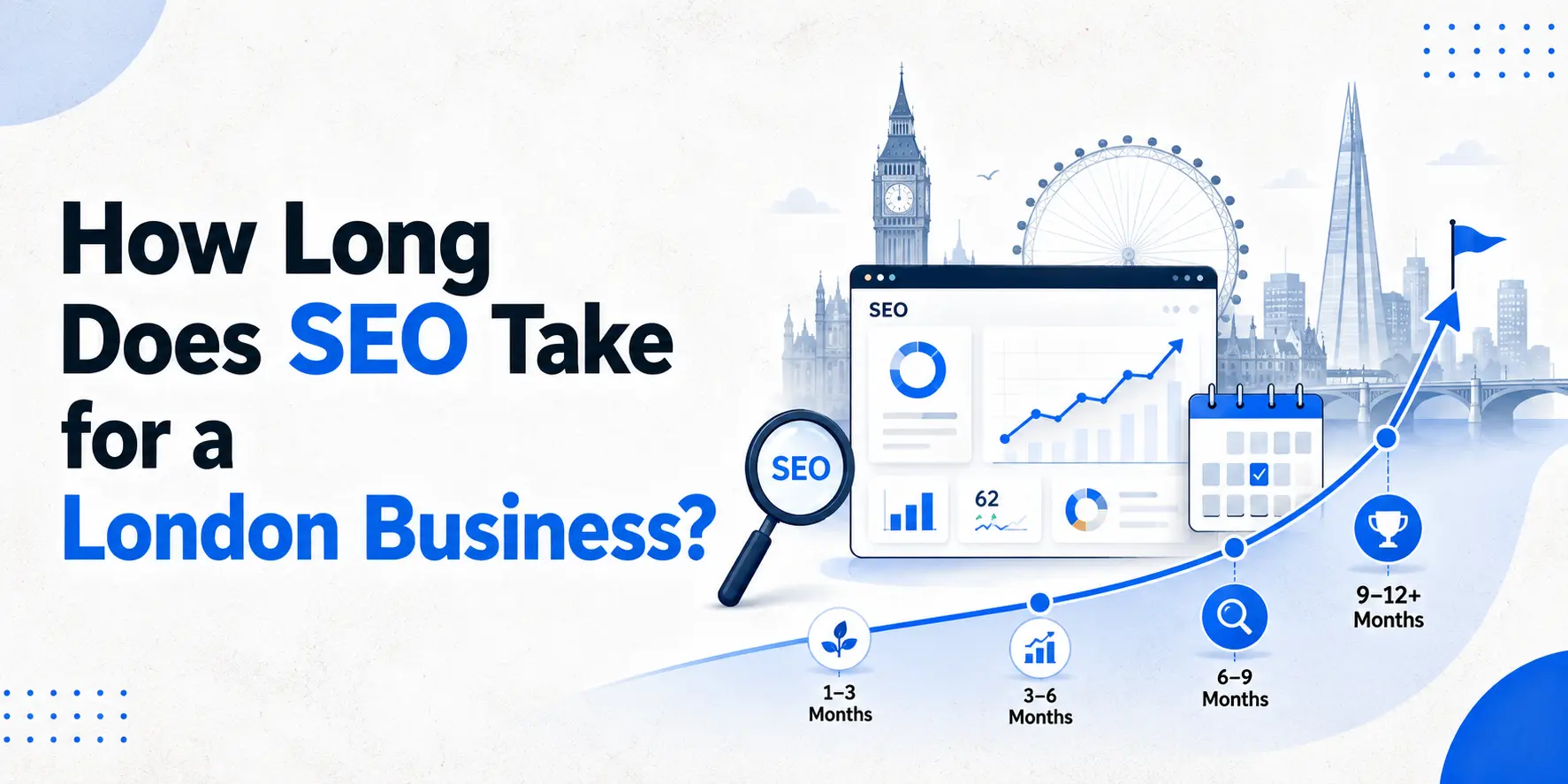
SEO may take three to six months to show clear signs of progress. Steadier traffic and meaningful enquiries may take six to twelve months or longer. These are planning ranges, not promises. A local business targeting one borough may see movement sooner than a national company competing across the UK.
Your SEO timeline depends on:
- Current rankings
- Website condition
- Competition
- Target areas
- Website authority
- Content quality
- Previous SEO work
- Backlink profile
- Approval speed
- Implementation speed
Google explains that some changes may appear within hours, while others can take several months. Not every change will create a visible ranking improvement.
How Long Does SEO Usually Take?
Here is a simple example timeline:
| Period | Main work | Possible progress |
| Month 1 | Audits, tracking, research, and priority fixes | Better measurement and fewer technical problems |
| Months 2 to 3 | Content, on-page work, internal links, and implementation | More pages indexed and early visibility changes |
| Months 3 to 6 | Continued content, Local SEO, authority work, and refinement | Clearer impressions, clicks, and keyword trends |
| Months 6 to 12 | Expansion, testing, and conversion work | Stronger traffic and enquiry patterns may develop |
| Beyond 12 months | Wider targeting and continued improvement | More stable growth in competitive markets |
Example SEO timeline, not a ranking promise.
What Happens During the First Month?
The first month should create a clear starting point.
Work may include:
- Business discovery
- Tracking checks
- Technical SEO audit
- Competitor research
- Keyword and search intent mapping
- Content review
- Backlink review
- Priority planning
- Early fixes
- Baseline reporting
You may not see major ranking changes during this stage.
That doesn’t mean nothing is happening. The team is finding problems, recording the starting position, and deciding what needs attention first.
Read our guide to what monthly SEO services should include to see what a professional campaign should deliver.
What Happens During Months Two and Three?
Months two and three usually move from research into implementation.
Work may include:
- Improving service pages
- Publishing useful content
- Fixing crawl and indexing problems
- Updating internal links
- Improving website structure
- Optimising Google Business Profile
- Starting outreach
- Reviewing Search Console data
- Testing call and enquiry tracking
Early signs may include:
- More pages indexed
- More non-brand impressions
- Wider keyword coverage
- Movement for lower-competition searches
- Better coverage of services and locations
These signs don’t guarantee that enquiries will rise straight away. Read what happens in the first 90 days of SEO for the complete process.

How Do Different SEO Timelines Compare?
Technical SEO, Local SEO, and competitive national SEO don’t move at the same speed.
| SEO area | Early work | When progress may become clearer | Main factors |
| Technical SEO | Fixing redirects, indexing, broken links, and metadata | Some changes may be processed quickly, while complex work takes longer | Website size, development access, crawling, and testing |
| Local SEO | Profile work, citations, reviews, local pages, and tracking | Early movement may appear within three to six months | Relevance, distance, prominence, reviews, and local competition |
| Competitive national SEO | Technical work, commercial pages, content, links, and digital PR | Clearer trends may take six to twelve months or longer | Competition, authority, content gaps, budget, and implementation |
How Long Do Technical SEO Fixes Take?
Technical work should be separated into quick fixes and complex projects.
Smaller Technical Fixes
These changes can often be completed within days or weeks:
- Redirect corrections
- Broken-link fixes
- Metadata updates
- Internal-link changes
- Schema corrections
- Sitemap updates
- Removing accidental indexing blocks
Google must still recrawl the affected URLs. The change may not appear in search results straight away.
Complex Technical Work
These projects can take several weeks or months:
- Website migrations
- JavaScript rendering problems
- Core Web Vitals work
- Ecommerce crawl problems
- Website architecture changes
- Duplicate URL cleanup
- Changes across thousands of pages
A migration, for example, may require:
- URL mapping
- Redirect planning
- Tracking checks
- Pre-launch testing
- Post-launch crawling
- Indexation monitoring
Technical fixes can remove barriers, but they do not guarantee immediate ranking growth.
How Long Does Local SEO Take?
A Local SEO campaign may show early movement within three to six months.
The timeline depends on:
- Google Business Profile condition
- Business location
- Customer proximity
- Review strength
- Citation accuracy
- Local landing pages
- Website authority
- Service relevance
- Local competition

Months One and Two
Early work may include:
- Correcting Google Business Profile information
- Reviewing categories and services
- Checking citations
- Improving local service pages
- Setting up call tracking
- Reviewing local competitors
Months Three to Six
The campaign may focus on:
- Publishing useful local pages
- Building relevant local links
- Improving review activity
- Updating profile information
- Strengthening internal links
- Reviewing calls and profile actions
Some businesses may begin to see wider local visibility during this period.
After Six Months
The team should review:
- Google Business Profile actions
- Local keyword coverage
- Calls and forms
- Location-page performance
- Review growth
- Areas where visibility remains weak
Google states that local results are mainly based on relevance, distance, and prominence. Businesses cannot pay Google for a better local position.
A plumber targeting one part of Barnet may move differently from a company targeting all of Greater London.
How Long Does Competitive National SEO Take?
National SEO normally takes longer because the business competes with established websites across a wider area.
| Period | Main work | Possible progress |
| Months 1 to 3 | Technical audit, competitor research, tracking, and content mapping | Better setup, fewer barriers, and early visibility |
| Months 3 to 6 | Commercial pages, content hubs, internal links, and authority work | Wider impressions and early keyword movement |
| Months 6 to 12 | Continued content, digital PR, technical work, and conversion improvements | More consistent traffic and commercial visibility |
| Months 9 to 18+ | Authority growth, expansion, testing, and refinement | Stronger trends in competitive national markets |
Legal, finance, property, SaaS, ecommerce, and other crowded markets may need a longer campaign.
National SEO often involves:
- Large competitor gaps
- Strong backlink profiles
- Many commercial keywords
- Wider content plans
- Digital PR
- Technical development
- Conversion testing
- Regular strategy reviews
A new website cannot always close those gaps within a few months.
Why Do SEO Timelines Differ?
SEO timelines change because every website starts from a different position.
A campaign may take longer when:
- The website has serious technical problems
- Competitors have stronger content and links
- Several services or locations need new pages
- Previous SEO work needs cleaning up
- Content or technical changes are approved slowly
- The available budget limits monthly implementation
A focused local campaign may show movement sooner than a new website competing across the UK. The important point is not whether every keyword improves quickly. It is whether useful work is being completed and the wider performance trend is moving in the right direction. The engagement model can also affect implementation speed. Compare an SEO retainer with a one-off SEO project before choosing support.
A Real Wixdek Local SEO Timeline
This anonymised example reflects work published from a real Wixdek campaign. Timelines vary by website, competition, resources, and implementation speed.
Business Type
A London electrician offering emergency, domestic, and commercial electrical services.
Starting Position
The business relied heavily on paid advertising. Organic traffic existed, but it did not produce steady calls.
Before the campaign:
- Most enquiries came from Google Ads
- Organic enquiries were inconsistent
- Mobile conversion was weak
- Important service pages had a high bounce rate
- Emergency and local search intent was not being captured well
Main Challenge
The website needed to turn existing visibility into ready-to-call enquiries. The campaign also had to reduce reliance on paid advertising in a competitive London market.
Work Completed Over Four Months
Wixdek:
- Improved eight priority service pages
- Focused pages on emergency, local, and service-specific intent
- Improved mobile navigation and contact paths
- Strengthened local service-area signals
- Added better internal links between related services
- Separated organic calls from paid enquiries
- Reviewed performance by service type
The work required SEO strategy, technical support, on-page content, Local SEO, conversion tracking, and reporting.
How Progress Was Measured
Wixdek measured:
- Organic enquiries
- Organic phone calls
- Mobile conversion rate
- Service-page bounce rate
- Reliance on paid advertising
- Local visibility across important service searches
Within the documented four-month period, Wixdek’s published case study reports that organic enquiries increased from 21 to 44 per month and organic calls rose from 13 to 31 per month. Mobile conversion also improved, while reliance on paid advertising fell.
Important Context
This was a competitive emergency-service market with a mobile-heavy audience and strong Local Pack competitors. The four-month result should not be treated as a standard promise for every electrician or local business.
A Real Wixdek Competitive SEO Timeline
This example covers a competitive London chauffeur market rather than a national SEO campaign.
Business Type
A London chauffeur company targeting airport transfers, executive travel, and corporate bookings.
Starting Position
The website had:
- Low organic traffic
- Very few phone enquiries
- Weak local SEO signals
- Limited keyword coverage
- Slow website performance
- Important keywords sitting around page three
Work Completed Over Five Months
Wixdek completed:
- Chauffeur keyword research
- New service landing pages
- Google Business Profile optimisation
- Technical SEO improvements
- Local citation building
- Wider service and location targeting
How Progress Was Measured
The campaign tracked:
- Monthly website traffic
- Phone enquiries
- Visibility for important chauffeur searches
- Airport-transfer and corporate-travel enquiries
Wixdek’s published case study reports that monthly website traffic increased from 240 to 2,300 and phone enquiries increased from 5 to 32 during the documented five-month campaign. Important terms also moved from page three into the top five results.
Why This Timeline Was Realistic
The chauffeur market in London is crowded, and the website needed technical, content, Local SEO, and citation work. The campaign also needed time for new pages to be crawled, assessed, and improved.
This example should not be described as proof that every competitive campaign will achieve the same result within five months.
How Can You Measure Progress Before Rankings Improve?
Don’t judge an SEO campaign through one keyword.
Early progress may include:
- More important pages indexed
- Fewer crawl errors
- More non-brand impressions
- Wider keyword coverage
- Better click-through rates
- More Google Business Profile actions
- More relevant calls or forms
- More accurate tracking
Google states that some changes may appear within hours, while others may take several months. A page may gain impressions before it gains clicks. Traffic may also increase before conversion work turns more visitors into enquiries.
When Should You Question an SEO Campaign?
SEO takes time, but that should not become an excuse for doing nothing.
Question the campaign when:
-
- No baseline was recorded
- No meaningful work was completed
- The same report appears each month
- You only receive ranking screenshots
- Priorities are never explained
- Technical recommendations remain unfinished
- Content has no clear search intent
- Links come from poor or unrelated websites
- Calls and enquiries aren’t tracked
- Every delay is blamed on Google
Google advises businesses to avoid any SEO provider that guarantees first place.
A good agency should still show what was completed, what changed, and what happens next.
Example SEO Timeline
Audit → Implementation → Content Development → Authority Building → Measurement → Refinement
Example SEO timeline, not a ranking promise.
The campaign does not always move in a straight line. Reporting may show that the team needs to return to technical work, improve a page, change content priorities, or strengthen authority.
Get a Realistic SEO Timeline
Wixdek can review your website, competition, target locations, technical condition, and current visibility before explaining a realistic campaign timeline.
Explore our SEO services in London or speak with an SEO consultant in London.
Request an SEO Timeline Review
Frequently Asked Questions
How long does SEO take to work?
SEO may show early progress within three to six months. Stronger traffic and enquiry patterns may take six to twelve months or longer.
Can SEO work within one month?
Some technical and indexing changes may appear within one month. Major commercial growth is less likely during the setup stage.
How quickly can Local SEO work?
Local campaigns may show early movement within three to six months. Location, competition, reviews, relevance, and website authority affect the timeline.
Why does national SEO take longer?
National campaigns compete with more established websites and often need wider content, stronger authority, technical work, and ongoing refinement.
Does a larger budget make SEO faster?
A larger budget can fund more work and quicker implementation. It cannot guarantee rankings, traffic, or leads.
Should rankings improve every month?
No. Rankings can rise, fall, or remain stable. Review wider trends such as impressions, clicks, calls, forms, bookings, and sales.
When should I question my SEO agency?
Question the campaign when no useful work is completed, no baseline exists, reports lack context, or performance is not connected with leads.
Can anyone guarantee an SEO timeline?
No. A provider can explain likely stages but cannot guarantee a fixed ranking date.