Publishing more blogs does not automatically make your SEO stronger. You can have 100 articles and still struggle to rank the service pages that actually bring enquiries. The problem is often not the amount of content. It is the way the content fits together. A good topic cluster strategy gives each page a clear job. Your main commercial page focuses on the service. Supporting articles answer smaller questions around that service.
Internal links connect those pages where they help the reader. The result is a content structure where blogs support your commercial pages instead of competing with them. Google recommends creating helpful, reliable content for people and organising a website in a logical way so users and search engines can understand how pages relate to each other. Read Google’s people-first content guidance.
This guide explains how Wixdek approaches SEO topic clusters for service businesses and how to build them without creating unnecessary pages.
What Is a Topic Cluster?
A topic cluster is a group of closely related pages built around one main subject. There is normally a central page and several supporting pages. For a service business, the central page will often be a commercial service page. The supporting pages answer related questions.
For example, a roofing company may have a main page for:
- Commercial Roofing Services
- Supporting content may cover:
- How Much Does Commercial Roof Repair Cost?
- Signs a Commercial Roof Needs Repair
- Roof Repair or Roof Replacement?
- How Long Does Commercial Roof Repair Take?
These pages talk about the same broad subject. But they do not have the same purpose. That difference matters.
What Is a Pillar Page?
A pillar page is the main page around a broad topic. For a service business, this may be a core service page. Examples include:
- Commercial Cleaning London
- Emergency Plumbing London
- Technical SEO Services
- Commercial Roofing Services
- Pest Control London
The pillar page should explain the main service clearly. It should help potential customers understand what you offer, who the service is for and what they should do next. The page should not try to answer every possible informational question. That is where supporting content becomes useful.
What Is Supporting Cluster Content?
Supporting content covers narrower questions connected with the pillar. Imagine your pillar page is:
- Commercial Cleaning London
- Useful cluster pages could cover:
- How Often Should an Office Be Professionally Cleaned?
- What Is Included in Commercial Cleaning?
- Commercial Cleaning Costs Explained
- Office Deep Cleaning Checklist
- In-House Cleaner vs Commercial Cleaning Company
Each page has its own purpose. Together, they create a useful content cluster around the commercial service.
Pillar Pages and Topic Clusters Need Different Jobs
This is where many content strategies go wrong. Businesses choose a high-value keyword and create lots of pages around small variations of that same phrase.
For example:
- commercial cleaning London
- commercial cleaners London
- commercial cleaning company London
- professional commercial cleaning London
- best commercial cleaners London
If all five pages sell the same service to the same customer, you probably do not have a useful topic cluster. You may simply have five competing commercial pages. A better SEO content cluster strategy separates pages by intent.
Start With Search Intent
Before creating a cluster, ask what the person searching actually wants. A commercial search may need a service page.
- A question may need a blog.
- A cost query may need a pricing guide.
- A comparison query may need a comparison page.
The page type should follow the user need. For example:
| Search query | Main intent | Suitable page |
| commercial cleaning London | Commercial | Service page |
| commercial cleaning Westminster | Local commercial | Location page |
| how often should an office be cleaned | Informational | Blog |
| commercial cleaning cost London | Commercial investigation | Pricing guide |
| in-house cleaner vs cleaning company | Commercial investigation | Comparison page |
They all relate to commercial cleaning. But they should not all target the same page purpose. This separation protects the commercial page from unnecessary competition.
Step 1: Choose the Commercial Page First
Do not start by brainstorming 50 blog titles. Start with the page that matters to the business.
Ask:
- Which service are we trying to support?
- For a London roofing company, that might be:
- Commercial Roofing Services London
- That becomes the main commercial page for the cluster.
- Now define its purpose.
It should target people looking for a commercial roofing provider. It may explain services, roof types, process, areas covered, experience, common problems and the next step. Once that job is clear, supporting topics become much easier to choose.
Step 2: Define What the Pillar Should Own
Decide which search intent belongs to the commercial page.
For example, the commercial roofing page may own searches around:
- commercial roofing services
- commercial roofers London
- commercial roofing company
- commercial roof repair services
- These phrases are not identical.
- But they may share the same broad commercial need.
You do not necessarily need separate pages for every variation. This is where keyword mapping protects your website from unnecessary overlap.
Step 3: Find Questions Around the Service
Now look at what customers need to know before, during and after choosing the service. For commercial roofing, those questions may include cost, damage, repair, replacement, maintenance, materials and timing. You can find useful questions through customer conversations, sales teams, Search Console, keyword research tools and existing website data. The goal is not to collect every keyword imaginable.
Choose questions that matter to the customer. Google’s current guidance warns against producing large numbers of pages simply to target every possible query variation. Large-scale, low-value content created mainly to manipulate rankings can fall under its scaled content abuse policy. Read Google’s spam policies.
Step 4: Give Every Supporting Page One Clear Purpose
Every cluster page should earn its place.
Imagine these three proposed articles:
- Commercial Roof Repair Cost
- How Much Does Commercial Roof Repair Cost?
- Average Commercial Roofing Repair Prices
- Do you really need all three?
- Probably not if they answer the same question.
- One strong pricing guide may be enough.
- Now compare:
- Commercial Roof Repair Cost
- and:
- Repair or Replace a Commercial Roof?
- Those have different purposes.
- One answers a price question.
- The other helps somebody make a decision.
- Both may deserve separate pages.
Step 5: Separate Commercial and Informational Intent
Your blogs should not become weaker versions of the commercial page.
Imagine you have:
- Commercial Roofing Services London
- Then you publish:
- Best Commercial Roofing Services in London
- The blog is also written like a sales page.
- It talks about the service, locations, benefits and quotes.
Now you have two pages trying to attract similar customers. That is not a strong cluster.
A better supporting article could be:
- 7 Signs Your Commercial Roof Needs Repair
- Now the purpose is clear.
- The blog helps somebody understand a problem.
When professional roofing support becomes relevant, it can guide the reader towards the commercial roofing page. The blog supports the service. It does not try to replace it.
Step 6: Separate Keywords by Intent
Your keyword map should show which terms belong to which page. For example:
| Page | Main intent | Example keyword theme |
| Commercial Roofing Services | Commercial | commercial roofing services |
| Commercial Roof Repair Costs | Cost research | commercial roof repair cost |
| Signs Your Roof Needs Repair | Informational | signs commercial roof needs repair |
| Repair vs Replacement | Comparison | roof repair vs replacement |
| Commercial Roofing Camden | Local commercial | commercial roofers Camden |
Do not worry if some wording appears across several pages. That is normal. A pricing guide may need to use the words “commercial roofing”. A commercial roofing service page may mention price. The important difference is the main purpose of the page.
Step 7: Build Content Around the Customer Journey
A cluster should follow real customer questions. Someone may start by noticing a problem. Then they research it. Next, they compare options. They may look at price. Finally, they contact a provider. Your content can support these different stages.
For example, someone may first read:
- Signs Your Commercial Roof Needs Repair
- Later, they may need:
- Repair or Replace a Commercial Roof?
- Then:
- Commercial Roof Repair Costs
And when they are ready for professional support, the commercial roofing service page is there. You do not need one page to answer every stage. A useful cluster gives each stage enough space.
Step 8: Connect Supporting Content to the Commercial Page
Internal links are what help turn separate pages into a connected structure. When a blog discusses a problem that your service solves, link naturally to the service page. For example: A guide about office hygiene may mention when professional cleaning is needed. That is a sensible place to link to the office cleaning service. A pricing article may also link to the main service when the reader wants to request a quote.
Google says links help it discover pages and understand relevance. It recommends descriptive, concise anchor text that helps both users and Google understand the destination. Read Google’s internal link guidance.
Do Pillar Pages Need to Link Back to Cluster Content?
They can when the supporting page genuinely helps the customer. Imagine your service page explains commercial roof repairs. Somebody wants detailed information about price. Instead of adding a huge pricing section to the service page, you may link to your detailed cost guide. Another visitor may be unsure whether repair is still sensible. You could guide them to your repair-versus-replacement comparison. This makes the service page more useful without turning it into an enormous guide. The links should exist because the information helps. Not because every cluster needs a perfect pattern.
Supporting Pages Can Link to Each Other Too
Two supporting articles may also be closely related. A guide about signs of roof damage may naturally mention whether repair or replacement is the better option. That can justify a link to the comparison guide. But do not link every cluster article to every other article. The relationship should make sense in the sentence and help the reader. Our guide on internal linking strategy for service websites explains this structure in more detail.
Step 9: Make the Commercial Page the Clear Main Destination
If your cluster supports a service, the commercial page should not feel forgotten. Review the supporting content. Do relevant articles guide people towards the service where appropriate? Does the commercial page receive internal support from the rest of the cluster? Is another blog accidentally behaving like the main service page? If the wrong page starts competing for commercial searches, review search intent before changing anything. Our guide on how to fix keyword cannibalisation without losing rankings explains when pages should be separated, merged, redirected or supported differently.
Step 10: Do Not Build Clusters Around Search Volume Alone
A keyword with high search volume can look tempting. But it may have little connection with the customers your business wants. Imagine an accountant publishes dozens of articles about celebrity tax stories because those topics get search volume. The traffic may grow. But does it help someone looking for the accountant’s services? Maybe not. A useful topic cluster should stay close enough to the business that the reader could reasonably become a customer or value the business’s expertise.
Google’s people-first guidance asks publishers whether they have an existing or intended audience that would find the content useful even if they came directly to the site. Read Google’s helpful content guidance.
Topic Clusters Should Add New Information
Publishing twelve articles that say almost the same thing does not make a topic stronger. Every supporting page should add something useful. That might be:
- a different customer question,
- a real comparison,
- first-hand experience,
- an original checklist,
- a real case study,
- a calculation,
- expert input,
- real business data,
- or a practical process.
Google encourages content that provides original information, research, analysis or useful value beyond simply rewriting what other pages already say. (developers.google.com) This is where information gain matters. Before approving a new cluster article, ask:
What does this page add that our existing pages do not?
If the answer is nothing, you may not need the page. Our future guide on information gain will cover that process in more detail.
Use Real Client Work Where It Adds Value
Service businesses often sit on useful information without realising it. Customer questions, audit findings, project challenges, pricing factors and before-and-after processes can all inspire useful content. For example, an SEO agency does not need another generic article saying technical SEO matters. It may be more useful to explain a real type of indexing problem, how it was diagnosed and how the implementation was checked. That gives the reader something practical. Our future article about turning client work into original research will cover how to do this without exposing confidential information or inventing results.
What Is Topical Authority?
“Topical authority” is a common SEO industry term. It generally describes the idea that a website builds a strong body of useful content around subjects it genuinely understands. But it should not be treated like a public Google score that you can increase by publishing a fixed number of articles. Google does not provide a “topical authority score”. So don’t build 50 thin pages because somebody told you that you need 50 articles to become an authority.
Build enough useful content to serve the audience properly. Sometimes that may mean five strong supporting pages. Sometimes it may mean twenty. The right number depends on the subject and customer needs.
Do You Need 8 to 12 Cluster Articles?
Not necessarily. There is no fixed number. A small specialist service may only have four genuinely useful supporting questions. A complex service may need many more. Forcing twelve articles around every service can quickly create repetition. Google’s current guidance on AI and search specifically warns against creating separate pages for every possible query variation simply to manipulate search visibility. (developers.google.com) Publish the pages the customer needs.
Not the number a template tells you to publish.
Worked Example: London Commercial Cleaning Topic Cluster
Imagine Wixdek is planning a cluster for a London commercial cleaning company. The core commercial page is:
Commercial Cleaning London
Its purpose is to attract businesses looking for professional commercial cleaning. Now we build supporting content around genuine questions.
| Content | Main purpose | Relationship to commercial page |
| Commercial Cleaning London | Sell and explain service | Main commercial page |
| How Often Should an Office Be Cleaned? | Answer frequency question | Supports relevant cleaning service |
| Commercial Cleaning Costs in London | Explain price | Supports buying decision |
| Office Cleaning Checklist | Practical information | Supports office cleaning topic |
| In-House Cleaner vs Cleaning Company | Help compare options | Supports commercial decision |
| What Is Included in Commercial Cleaning? | Explain service scope | Supports service understanding |
| Commercial Cleaning Westminster | Serve local demand | Connects location with relevant service |
Notice that the cluster is not seven versions of “commercial cleaning London”. Each page has a different job. That is the key.
Wixdek Six-Month Topic Cluster Strategy
Here is a practical six-month Wixdek framework for building a service-business topic cluster. This is a planning example rather than a claimed client campaign result.
Month 1: Audit and Map the Existing Website
Do not start publishing yet. First review what already exists. Identify the main commercial pages. Check Search Console queries. Look for overlapping pages. Review existing blogs. Decide what should be kept, improved or consolidated. Then map the main search intent for each important URL. By the end of the first month, the business should know which commercial pages each future cluster will support.
Month 2: Strengthen the Commercial Pages
Before sending more internal support towards a service page, make sure that page deserves it.
Review whether the commercial page clearly explains:
- the service,
- who it helps,
- what problems it solves,
- the process,
- areas served where relevant,
- proof,
- and the next step.
The goal is to build a strong destination before expanding the surrounding cluster.
Month 3: Publish High-Priority Supporting Content
Now create the content that answers the most useful customer questions. Start close to buying intent.
For example, you may publish:
- a pricing guide,
- a comparison page,
- and one important problem-solving article.
- Each page should have its own intent.
Do not create articles simply because a keyword tool generated a long list.
Month 4: Build the Internal Link Structure
Review the cluster as a whole. Supporting content should guide users towards the commercial service where appropriate. The service page can also link to useful pricing, comparison or evidence pages. Check anchor text. Check for orphan pages. Make sure important URLs are reachable through crawlable links. Google recommends a logical site structure and says important pages should receive links from other relevant pages. Read Google’s site structure guidance.
Month 5: Add Experience and Original Value
By this stage, the basic topic may already be covered. Do not publish weaker copies just to keep the content calendar full. Look for ways to add something competitors cannot easily copy.
That could include:
- real project lessons,
- an anonymised customer example,
- an original checklist,
- real FAQs from sales calls,
- expert commentary,
- or internal data that can be published responsibly.
This is where the cluster starts becoming more useful rather than simply becoming bigger.
Month 6: Measure, Improve and Expand Carefully
Review Search Console and analytics data. Google Search Console can show performance by queries and pages, including clicks and impressions. See Google’s Search Console guidance. Ask which supporting pages are gaining useful visibility. Check which commercial pages they support. Look at enquiries where tracking is available. Then decide what comes next. Some pages may need improving.
Some may need stronger internal links. Two articles may overlap and need consolidation. A missing customer question may justify a new page. The next six months should come from evidence, not from publishing for the sake of publishing.
A Six-Month Example in Practice
For a London commercial cleaning company, the plan might look like this:
| Month | Main focus | Example work |
| 1 | Research and mapping | Audit commercial cleaning, office cleaning, locations and existing blogs |
| 2 | Commercial foundation | Improve main commercial cleaning and high-value service pages |
| 3 | Decision content | Publish cost and comparison content |
| 4 | Informational support | Publish useful customer problem guides and improve internal links |
| 5 | Original value | Add case-led insights, FAQs, checklists or first-hand expertise |
| 6 | Review and expansion | Check performance, overlap, lead paths and next content gaps |
This creates a controlled topic cluster strategy. It is much safer than publishing thirty blogs in the first month and hoping something ranks.
How to Stop a Blog Cluster Competing With the Pillar
Keep the intent separation clear.
Suppose your commercial page targets:
- SEO Services London
- Do not create supporting articles such as:
- Best SEO Services London
- Professional SEO Services London
- Affordable SEO Services London
if all three are basically trying to sell the same service. Instead, support the service with questions people have around the buying process.
Examples might include:
- How Much Does SEO Cost in London?
- SEO Agency vs SEO Consultant
- What Should Monthly SEO Services Include?
- How Long Does SEO Take?
- These topics still relate to SEO services.
- But each has a separate intent.
- That is a much healthier commercial page content strategy.
Use Search Console to Check for Overlap
Once your cluster is live, check what Google actually shows. Search Console can tell you which queries bring impressions and clicks to your pages. If an informational blog starts appearing heavily for the main commercial query while your service page disappears, investigate. Do not panic. First compare the page purposes. Check internal links. Look at search intent.
See whether the commercial page itself needs improvement. Then make an evidence-led decision.
Should Every Cluster Page Link to the Commercial Page?
Not as a blind rule. Most supporting content should have a logical relationship with the main topic. But the link should still make sense to the person reading. If a cluster article has no natural reason to mention the service, forcing a commercial link into it can feel awkward. The goal is not to complete an SEO checklist.
The goal is to create useful paths. Google recommends relevant, descriptive link text and links that help people understand the destination.
Should the Commercial Page Link to Every Cluster Article?
No. Link to the resources that genuinely help someone evaluate the service. A visitor may benefit from a pricing guide. Another may need a comparison. Someone else may want a case study. The commercial page does not need a long list of every article you have ever published. Choose useful links.
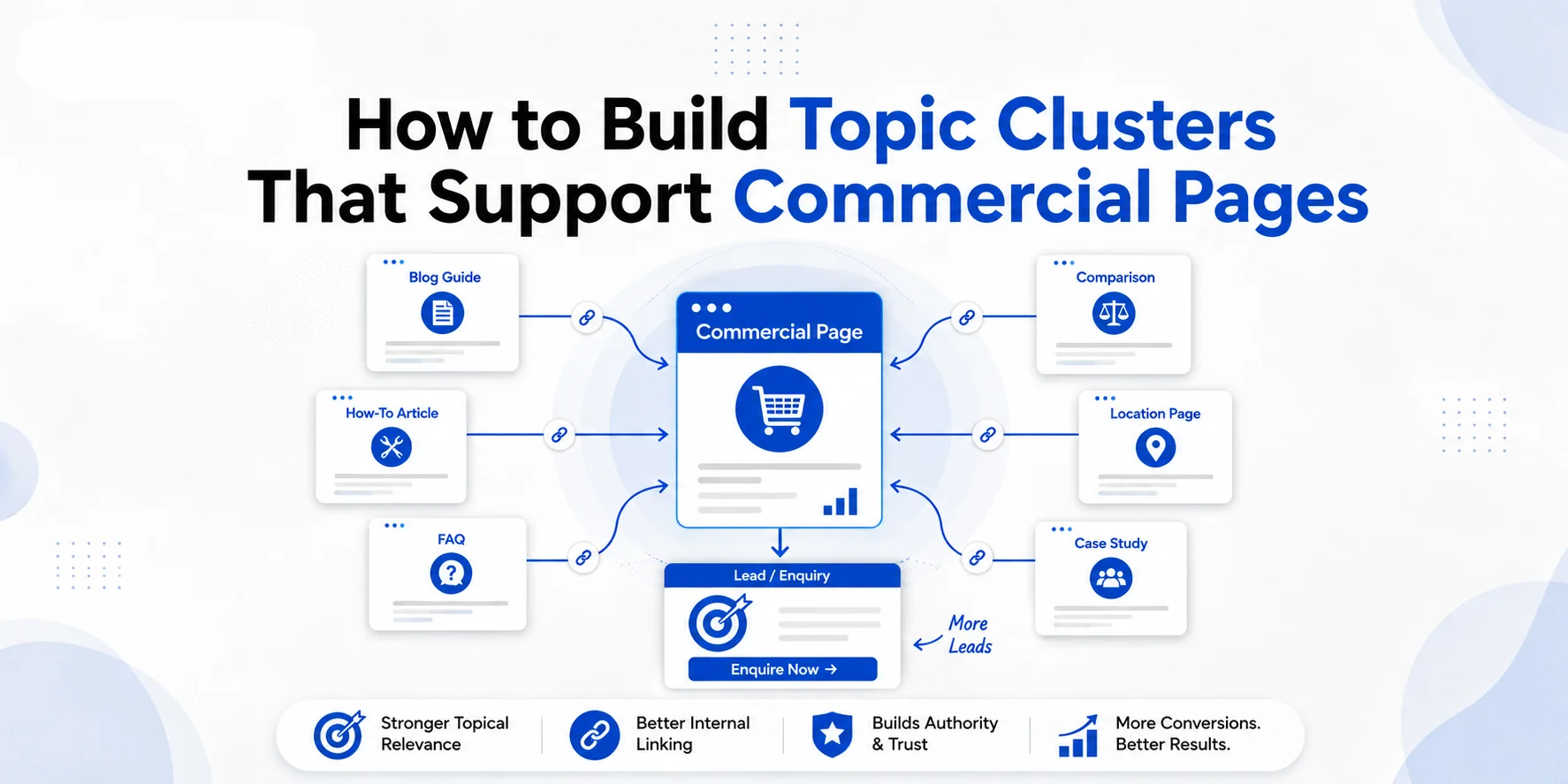
Topic Cluster Diagram for the Blog
Create the original Wixdek graphic with the commercial service page in the centre.
Use surrounding sections for:
- Informational Guides
- Pricing Content
- Comparison Content
- Case Studies and Original Research
- Relevant Location Pages
Show that each section connects naturally with the commercial service page. Also show that related supporting pages may connect with each other where useful. Do not present the design as a rigid structure that every website must follow. Suggested alt text: Topic cluster structure for a service business showing a commercial service page supported by informational, pricing, comparison, location and original research content.
Common Topic Cluster Mistakes
The first mistake is publishing too much content before understanding search intent. Another is creating several pages around tiny keyword variations. Some businesses also make the blog the centre of the cluster while commercial pages receive little support. Another mistake is thinking more content automatically means more topical authority. And one of the easiest ways to create future problems is publishing a new article without checking what is already live.
A topic cluster should reduce confusion. It should not create more of it.
How Wixdek Builds Topic Clusters
At Wixdek, the commercial goal comes first. We identify the service page that needs support. Then we map the customer questions around that service. Each useful query group receives a clear intent. The correct page type is chosen. Existing content is checked before anything new is created. Supporting pages are then connected with the commercial page where the relationship helps users.
As the cluster grows, performance is reviewed through Search Console, analytics and lead data where reliable tracking is available. The goal is not to publish the most content. It is to build a useful body of pages where each URL has a reason to exist.
Build Clusters for Customers, Not Just Keywords
A strong topic cluster should feel natural. The service page explains the main solution. Blogs answer customer questions. Pricing pages explain cost. Comparison pages help people decide. Location pages serve genuine local needs. Original research adds experience and evidence. Internal links connect those pages where they help the customer move forward. Google’s current Search Essentials still centre on helpful, reliable, people-first content, crawlable links and clear content that uses language people understand.
That is a much stronger base than creating dozens of near-identical articles around every keyword variation.
Get Help Building Your SEO Content Strategy
If your website has plenty of content but your main service pages still struggle to gain useful visibility, Wixdek can review how your content fits together. Our SEO services in London cover content strategy, search intent, internal linking, on-page SEO and technical SEO for businesses that want organic search to support real leads. We can help identify which commercial pages should sit at the centre of your strategy, which supporting topics deserve their own pages and where existing content may be overlapping.
Request an SEO Content Strategy Consultation
Frequently Asked Questions
What Is a Topic Cluster in SEO?
A topic cluster is a group of closely related pages built around one main subject. Supporting pages answer smaller questions while a central page covers the core topic or service.
What Is a Pillar Page in SEO?
A pillar page is the main page around a broad topic. For service businesses, it may be a core commercial service page supported by related informational, pricing and comparison content.
How Do Topic Clusters Help Service Pages?
Supporting content can answer customer questions, provide useful context and create natural internal links to relevant service pages. The supporting pages should have their own search intent.
How Many Articles Should a Topic Cluster Have?
There is no fixed number. Create enough useful pages to answer genuine customer needs without producing repetitive or low-value content.
Should Every Topic Cluster Have a Pillar Page?
A clear central page is useful for many clusters, but the structure should follow the website and customer journey rather than a rigid SEO template.
Can Topic Clusters Cause Keyword Cannibalisation?
Yes, if several pages are created around the same search intent. Separating keywords by intent before creating content helps reduce unnecessary competition.
Should Blog Posts Target the Same Keywords as Service Pages?
They can naturally use related wording, but they should normally have a different main intent. The service page should handle commercial searches while supporting blogs answer narrower questions.
What Is the Difference Between a Pillar Page and a Service Page?
A pillar page is a planning term for a central topic page. On a service website, a core service page may act as the commercial pillar when supporting content is built around it.
What Is Topical Authority in SEO?
Topical authority is an SEO industry term for demonstrating useful depth around a subject. It is not a public Google metric or score, so businesses should focus on useful content rather than trying to hit a fixed article count.
Do Internal Links Help Topic Clusters?
Yes. Internal links help users and search engines understand how related pages connect. Google recommends descriptive, crawlable links between relevant pages.
How Do I Know Which Topic Cluster Pages Are Working?
Use Search Console to review queries, pages, clicks and impressions. Combine this with analytics and reliable conversion tracking to see whether content supports useful business outcomes.
How Often Should Topic Clusters Be Reviewed?
Review them when new content is planned, services change, pages begin overlapping or Search Console shows that the wrong URLs are appearing for important queries.