
Local SEO doesn’t look the same for every business. A plumber may depend on fast mobile searches and Google Maps. A solicitor may have a longer research journey before someone makes contact. A dentist needs strong local visibility, but patients also want clear proof that they can trust the practice. So, comparing every business using one Local SEO Visibility Benchmark doesn’t tell the full story.
This Wixdek research looks at local search visibility across different UK industries. It examines how often businesses appear in local results, how visibility changes across locations, and which local search signals matter most for different sectors. The aim is simple. Instead of asking whether a business “ranks”, we want to understand where, how often and for which searches it is visible. That gives businesses a much clearer picture of their local search performance.
Research note: This article should only describe figures as Wixdek research after the underlying Wixdek geo-grid dataset has been collected and published. External benchmark figures are clearly labelled as external research.
UK Local SEO Visibility Benchmark: What the Data Shows
Local search visibility is not a single number. A business can rank well in one part of a town and poorly several miles away. It can also appear in the Local Pack for one service but disappear for another. Google explains that local results are mainly influenced by relevance, distance and prominence. Relevance looks at how closely the business matches the search, distance considers where the searcher is located, and prominence relates to how well known the business is.
That makes location-based testing important. For this reason, a useful local SEO visibility benchmark should look beyond one manual Google search. It should test several points across the target area. It should also test different searches that represent real customer needs.
A Local SEO Visibility Benchmark gives that testing a clearer structure by comparing visibility across locations, searches and business types.
Wixdek Local SEO Evidence Snapshot
Before looking at the wider benchmark, it helps to understand the Local SEO experience behind the research.
| Wixdek evidence | Published result |
|---|---|
| Industries covered | 50+ |
| Clients supported | 1,200+ |
| Market coverage | UK-wide |
| Digital experience | 12 years |
| Chauffeur keyword movement | Position 27 → Position 3 |
| Chauffeur organic bookings | +140% |
| Courier calls | 5 → 35+ per week |
| Dry-cleaner Map visibility | Consistent Top 3 |
| Dry-cleaner Top-3 service areas | 2 → 8 |
Wixdek reports experience across more than 50 industries and more than 1,200 supported businesses. Its published Local SEO campaigns also show measurable improvements in Google Maps visibility, search positions, calls and bookings. For example, a London chauffeur campaign moved from position 27 to position 3 while organic bookings increased by 140%. A Greater London Local SEO campaign also reports growth from two to eight Top-3 Map service areas. For a closer look at how SEO improvements translate into measurable business outcomes, explore this SEO case study. This Local SEO Visibility Benchmark also helps place Wixdek’s published Local SEO results into a wider industry context.
What Is a Local SEO Visibility Benchmark?
A local SEO visibility benchmark is a way of measuring how visible businesses are in local search. It can include Google Maps, the Local Pack and local organic results. A Local SEO Visibility Benchmark can therefore show where a business performs strongly and where visibility begins to fall. For example, imagine a dental practice wants to reach patients across three London areas.
A single search from the practice’s office might show the business in position two. That sounds good. But another search from two miles away could show it in position seven or not at all.
The business therefore has a visibility gap. A proper benchmark can expose that gap. Instead of saying, “We rank number two,” you can say, “We appear in the top three across 62% of our tested locations.” That is much more useful.
How We Built the Wixdek Local SEO Visibility Benchmark
A research-led benchmark needs a clear method. The exact method used by Wixdek should be published alongside the final data so readers can understand how the figures were produced.
For a Local SEO Visibility Benchmark to be useful, the methodology needs to explain which industries, locations, queries and search points were included.

Industries included
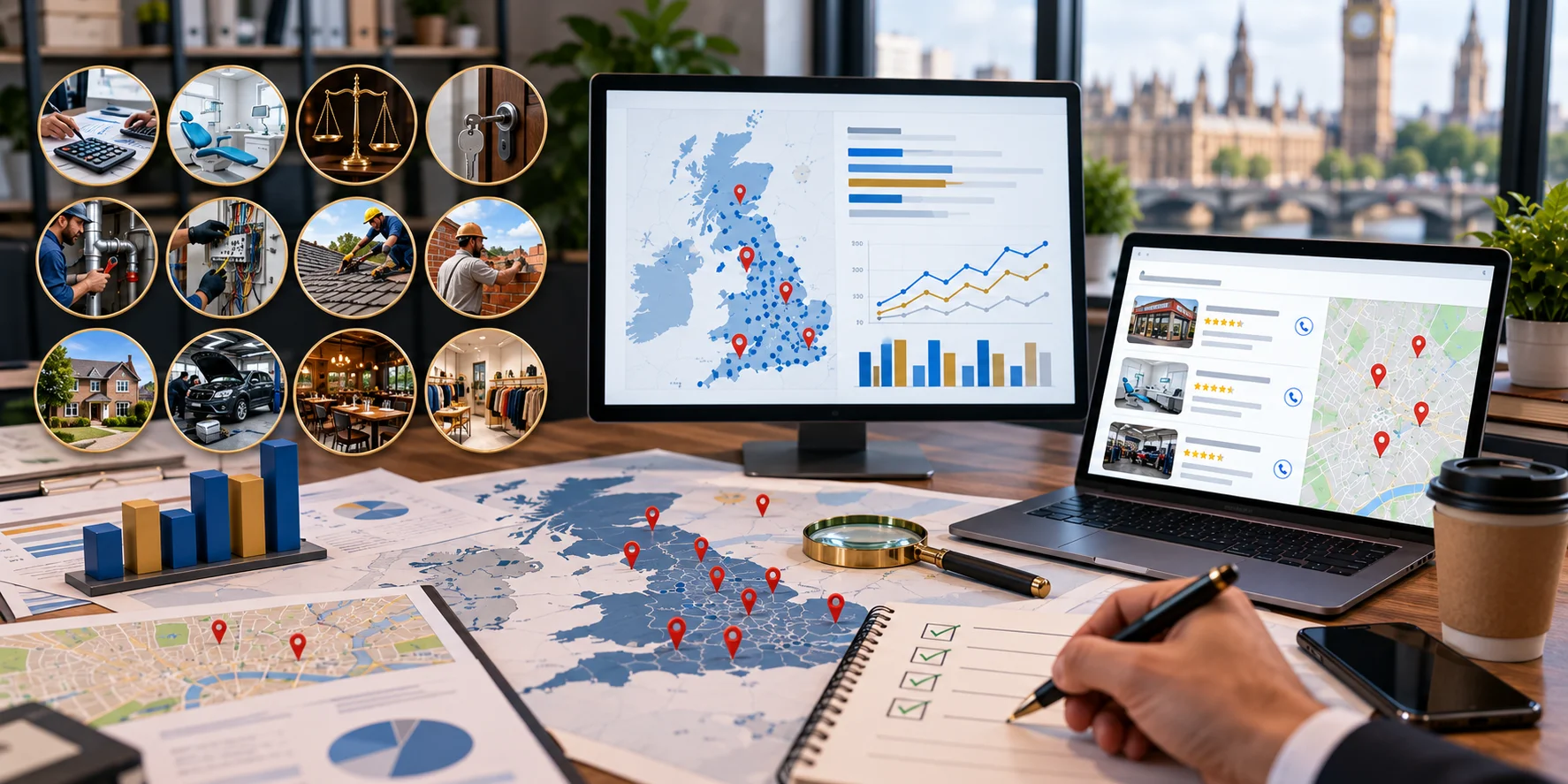
The research should cover a balanced group of industries with different search behaviours. For example:
- Accountants
- Dentists
- Solicitors
- Locksmiths
- Plumbers
- Electricians
- Roofers
- Builders
- Estate agents
- Automotive businesses
- Restaurants
- Retail businesses
The final study should clearly state which industries were included. If an industry wasn’t tested, don’t imply that it was.
Locations tested
Local search results depend heavily on location. The benchmark should therefore use a defined set of UK locations and grid points. For example, a London study might test points across several boroughs rather than relying on one central search location.
A national study could use selected towns and cities across England, Scotland, Wales and Northern Ireland. The exact locations should be listed in the methodology.
Search queries selected
Searches should reflect real customer intent. For a locksmith, this might include: “locksmith near me”
“emergency locksmith” “locksmith London” For an accountant, the searches could include:
“accountant near me” “small business accountant” “accountant London”
For a dentist: “dentist near me” “private dentist”
“dental practice London” This prevents the benchmark from relying on one generic keyword.
Geo-grid testing
A geo-grid divides a target area into multiple search points. The same search is then tested from each point. This can show how visibility changes across the area.
A business may dominate close to its premises but become less visible further away. That isn’t necessarily a technical failure. Distance is one of the main factors Google says it considers in local ranking. The purpose of geo-grid testing is to measure that variation rather than hide it. Geo-grid testing is one of the most useful parts of a Local SEO Visibility Benchmark because it shows how rankings change across a real service area.
UK Local SEO Visibility by Industry
Different industries have different search journeys. That affects how local visibility should be measured.
This is why a Local SEO Visibility Benchmark becomes more useful when results are separated by industry rather than reduced to one overall average.
Trades and Home Services
Trades can have strong local intent. Someone searching for a plumber, locksmith or electrician may want help quickly. This can make Google Maps and Local Pack visibility particularly important.
However, the search journey isn’t always mobile-only. Some users may compare websites, read reviews and check prices before making contact. The benchmark should therefore measure both local visibility and website visibility. For trades, a Local SEO Visibility Benchmark can show whether a business appears consistently across urgent and service-led local searches.
Legal and Solicitor Searches
Legal searches often involve more research. A person looking for a solicitor may compare several firms before making contact. They may check practice areas, solicitor profiles, reviews, office locations and professional information.
Research from Reboot found that desktop traffic accounted for around 70% of visits to lawyer and solicitor websites in its dataset, compared with roughly 30% mobile traffic. This doesn’t mean every legal search is desktop-led. It does show why industry-level research matters. A law firm’s local SEO strategy shouldn’t be judged using the same assumptions as an emergency locksmith. A Local SEO Visibility Benchmark for legal businesses should also consider how longer research journeys affect the value of local visibility.
Healthcare and Dental
Healthcare searches involve trust as well as location. Patients may search for a nearby dentist, clinic or specialist, then visit the website to check treatments, practitioners, reviews and contact information. A strong benchmark should therefore consider more than Local Pack position. It should also look at whether the business has useful treatment pages, clear practitioner information and strong local trust signals. For healthcare and dental businesses, a Local SEO Visibility Benchmark should consider both local rankings and the trust signals customers review before making contact.
Accountants and Professional Services
Accountancy searches can have strong commercial intent. A business owner may search for an accountant nearby, then compare services before making contact. Location matters, but so does service relevance.
“Accountant near me” and “small business accountant near me” may produce different results. This is why the benchmark should test several service-led searches. A Local SEO Visibility Benchmark should therefore measure how often a business appears in the Local Pack across different searches and locations.
Retail and Local Shops
Retail searches can have a strong local element. People may search for a nearby shop, check opening hours and then visit the business. The search journey can be different from a professional service where the customer may spend days researching before contacting a provider.
Hospitality
Restaurants and hospitality businesses often have strong local search behaviour. Searches can include location, cuisine, opening hours, booking intent and specific requirements. Reviews can also play an important part in the decision. The benchmark should therefore avoid reducing hospitality visibility to one ranking position.
Local Pack Visibility Benchmark
The Local Pack is the local business section that can appear in Google Search. It can show businesses, reviews, locations, opening information and other details. For many local searches, appearing in this area can give a business valuable visibility.
However, the exact position isn’t fixed. Results can change depending on the searcher’s location, the search phrase and other factors. Google does not publish a fixed formula for achieving a particular Local Pack position. It states that local results are mainly based on relevance, distance and prominence. A Local SEO Visibility Benchmark should track Local Pack presence across multiple searches and locations rather than relying on one result.
Wixdek Local Search Results by Industry
Wixdek’s published campaign data shows measurable search and Local SEO improvements across several UK service industries. The metrics differ between campaigns because Wixdek tracks the outcomes most relevant to each business.
| Industry | Starting visibility | Published Wixdek result | Business outcome |
|---|---|---|---|
| Locksmiths | Page 2 visibility | Top 3 search visibility | Emergency calls +141% |
| Dentists | Page 3 keyword visibility | Top 5 visibility | Traffic 420 → 2,100; calls 14 → 68; bookings 8 → 37 |
| Law Firms | Competitive local and Maps visibility | Page 1 visibility reported for Wixdek law-firm campaigns | Improved local search and Maps presence |
| Accountants | Limited local Map visibility | Strong Maps presence; Page 3 → Top 5 keyword visibility | Traffic 350 → 1,900; enquiries 9 → 42 |
| Plumbers | Top 3 in only 2 service areas | Top 3 in 8 service areas; Maps impressions +173% | Organic calls 14 → 46 |
| Electricians | Inconsistent local visibility | Visibility improved across multiple local service searches | Organic calls 13 → 31 |
The results show an important pattern. Wixdek’s strongest published Local SEO gains are not limited to traditional organic rankings. Campaigns also report stronger Maps coverage, increased local visibility, more phone calls, more enquiries and more bookings. For plumbers, Wixdek reports one of its clearest Maps results. Top-3 Map coverage expanded from two service areas to eight, while Maps impressions increased by 173%. Organic phone calls also rose from 14 to 46 per month. The accounting campaign moved from limited Maps visibility to what Wixdek reports as a strong local presence. Monthly enquiries increased from nine to 42, while tracked keyword visibility moved from Page 3 into the Top 5.
The dental campaign also combined Google Business Profile optimisation with local citation work and stronger treatment pages. Traffic increased from 420 to 2,100 monthly visits, phone enquiries rose from 14 to 68, and appointment bookings increased from eight to 37. The electrician campaign does not publish a Map Pack position breakdown. However, Wixdek reports improved local visibility across multiple service searches, alongside organic phone calls increasing from 13 to 31 per month. The Local SEO Visibility Benchmark helps compare how different industries perform across Maps visibility, search positions and business outcomes.
Google Maps Visibility by Industry
Google Maps visibility can vary greatly across a target area. A business may be highly visible around its address but less visible at the edge of its service area. That is why businesses shouldn’t judge their local SEO from a search performed outside a proper testing method.
A Local SEO Visibility Benchmark can make this variation easier to understand by comparing performance across multiple geographic points.
The three main factors Google highlights are relevance, distance and prominence. Relevance means the business matches the search. Distance considers how far the business is from the searcher’s location.
Prominence relates to how well known the business is, with signals such as reviews and links forming part of Google’s explanation of local prominence. These factors help explain why two businesses in the same town can have very different local visibility.
What the Benchmark Should Measure
A useful benchmark should measure several parts of local visibility. The first is Local Pack presence. This tells us how often a business appears in the local results.
A strong Local SEO Visibility Benchmark should combine this with average position, grid coverage and service visibility rather than relying on one ranking screenshot.
The second is average position. This shows where the business tends to appear when it is visible. The third is grid coverage.
This tells us how much of the target area the business reaches. The fourth is service visibility. This shows whether the business appears consistently across different service searches. Together, these metrics provide a better picture than one ranking screenshot.
Reviews and Local Visibility
Reviews matter for both local visibility and customer trust. Google says local results are mainly influenced by relevance, distance and prominence. Review quantity and positive ratings can contribute to prominence, while helpful responses can also help a business stand out. However, reviews should not be treated as a simple numbers game. A business with hundreds of reviews will not automatically rank above every competitor. Location, relevance, Business Profile quality and wider prominence signals also affect local visibility.
Within a Local SEO Visibility Benchmark, review data can provide useful context when it is considered alongside location, relevance and wider prominence signals.
Customers also look beyond the headline star rating. They may read comments about communication, response times, professionalism, service quality and the particular service they need.
BrightLocal’s 2026 Local Consumer Review Survey found that 97% of consumers use reviews when making purchasing decisions. The survey also found that 74% focus on reviews written within the previous three months, while 31% will only consider businesses rated 4.5 stars or higher.
Review responses matter as well. BrightLocal found that 89% of consumers expect businesses to respond to reviews. It also found that 42% are unlikely to choose a business that never responds. It is worth noting that BrightLocal’s 2026 survey was conducted with 1,002 US adults. Its findings are useful for understanding consumer behaviour, but they should not be presented as Wixdek’s UK benchmark results.
Shorten with AI
Wixdek Review Evidence
Wixdek’s public website provides some useful reputation signals. These figures relate to Wixdek itself rather than the businesses included in this industry benchmark.
| Review metric | Wixdek result |
|---|---|
| Published Google rating | 4.9★ |
| Published Google review count | 56 reviews |
| Reviews written recently | Not publicly reported |
| Review response rate | Not publicly reported |
| Reviews with no business response | Not publicly reported |
Wixdek currently states a 4.9 Google rating and 56 Google reviews on its main SEO Services page. These figures provide useful evidence of Wixdek’s own reputation, but they should not be treated as averages across the businesses included in this benchmark.
Google Business Profile Maturity
A Google Business Profile is central to local search visibility. Google recommends verifying the profile and keeping business information complete and accurate. It also recommends managing reviews and adding photographs. A benchmark can therefore measure profile maturity. This might include whether the profile has:
- Correct business information
- Accurate opening hours
- Relevant categories
- Useful service information
- Recent photographs
- A working website link
- Genuine reviews
The purpose isn’t to create a fake “GBP score”. Google doesn’t publish a public points system that tells businesses how many ranking points each field provides. Instead, profile maturity should be treated as a research variable. Google Business Profile quality is another useful variable within a Local SEO Visibility Benchmark because incomplete information can affect both visibility and customer confidence.
NAP and Local Business Information
NAP means Name, Address and Phone number. Accurate business information matters because customers need to know which business they are contacting. It also supports consistent local business information across the web.
A benchmark can compare the firm’s website with its Business Profile and important directories. The study should record whether differences exist and what type of differences were found. For example:
| NAP issue | Number of businesses | Percentage |
|---|---|---|
| Correct across checked sources | [ ] | [ ]% |
| Address mismatch | [ ] | [ ]% |
| Phone mismatch | [ ] | [ ]% |
| Business name mismatch | [ ] | [ ]% |
This creates a useful benchmark without pretending that every inconsistency carries the same ranking impact. NAP consistency can also be included in a Local SEO Visibility Benchmark because accurate business information supports a clearer local presence.
Local Search Behaviour by Industry
Search behaviour can change the value of different SEO activities. An emergency service may benefit heavily from fast local discovery. A solicitor may need stronger website content because users often want more information before making contact.
An accountant may need clear service pages aimed at business owners. A dentist may need strong treatment and practitioner information. These differences are why industry benchmarks are useful. They stop businesses from copying a generic local SEO checklist that may not match how their customers search. A Local SEO Visibility Benchmark is more useful when these differences in search behaviour are considered rather than treating every industry in the same way.
Mobile and Desktop Behaviour
Device behaviour is another useful research variable. Reboot’s UK research found clear differences across business types. In its dataset, restaurants and estate agents had higher mobile usage, while lawyers, solicitors, flower shops and builders showed much higher desktop usage. The figures should not be treated as a universal rule.
Your own Google Analytics or Search Console data may show something very different. For this reason, the Wixdek study should report device behaviour from its own sample where possible. Device data can also strengthen a Local SEO Visibility Benchmark by showing whether visibility and engagement patterns differ between mobile and desktop users.
Local SEO Is Not Just About Rankings
A ranking report can look impressive while the business receives few useful enquiries. The opposite can also happen. A business may have modest visibility but generate strong leads from a small number of high-intent searches.
That’s why the benchmark should eventually connect visibility with business outcomes. Useful measures include: Local Pack visibility → Website visits → Calls → Forms → Qualified enquiries
That creates a much more useful picture. A business owner doesn’t usually care about position three for its own sake. They care about whether the right customers can find the business. Organic visibility is only one way to evaluate customer acquisition. For a paid-search comparison, see our Google Ads cost-per-lead benchmark to understand how lead costs can vary across campaigns and industries. A Local SEO Visibility Benchmark becomes more useful when visibility data is connected with calls, forms and qualified enquiries.
Service and Location Coverage
Local SEO often becomes complicated when a business serves several areas. A firm may have one office but serve many towns. Another firm may have several physical offices.
The website structure needs to reflect the real business. Useful location pages should provide genuine local information. They shouldn’t simply repeat the same content while changing the town name.
The same principle applies to service pages. A business that offers ten genuine services may need separate pages when each service has different search intent. This creates a clearer connection between: Service → Location → Search → Landing page → Enquiry.
A Local SEO Visibility Benchmark can reveal whether visibility is strong for one service or location but weak for another.
Why Industry Benchmarks Matter
An average across every UK business can hide useful differences. Imagine a benchmark showing that businesses have an average Local Pack presence of 45%. That number alone doesn’t tell a plumber much.
A Local SEO Visibility Benchmark becomes more meaningful when a business can compare itself with similar organisations in the same sector.
The plumber wants to know how similar trades businesses perform. A solicitor wants to compare against legal businesses. A dentist wants to understand dental search visibility.
Industry benchmarks make the data more useful because they add context. If you want to explore SEO approaches across different sectors, see the industries Wixdek works with.
What a Strong Local SEO Benchmark Looks Like
A useful benchmark should answer five basic questions. How visible are businesses? Where are they visible?
These questions help turn a Local SEO Visibility Benchmark into something businesses can actually use rather than a simple collection of rankings.
Which searches trigger visibility? How does visibility change by industry? What happens after the searcher finds them?
The final question is often forgotten. Visibility is the beginning of the customer journey. It isn’t the end.
External UK Local SEO Benchmarks
There are already several published industry estimates around UK local search. For example, some UK sources repeat a figure of 46% for searches carrying local intent and 76% for nearby smartphone searches leading to a business visit within 24 hours. These figures are widely cited, but they should be treated as external benchmark claims rather than Wixdek research. There are also published UK SME estimates covering Google Business Profile completion, NAP consistency and review processes. One 2026 UK dataset reports 42% of SMEs with a fully completed profile, 31% with consistent NAP information, 24% with a repeatable review-generation process and 29% responding to reviews consistently.
These figures are useful as context. They are not substitutes for the Wixdek dataset. That distinction should remain clear throughout the article. External studies can provide useful context, but they should remain separate from the Local SEO Visibility Benchmark data collected by Wixdek.
Local Pack Click Benchmarks Need Care
You may see claims that the top three Local Pack positions capture a fixed percentage of all local clicks. Treat these figures carefully. Click-through behaviour can change by search type, device, industry and result layout.
Google also changes how search results are displayed. A benchmark that uses one fixed click percentage for every industry can therefore create a misleading picture. Wixdek should report measured visibility first and use click studies as supporting context.
What Local SEO Performance Data Can Tell You
Good research can reveal patterns that ordinary ranking reports miss. A Local SEO Visibility Benchmark can make these patterns easier to compare across industries and locations. For example, it may show that: A business ranks strongly around its office but poorly across the wider service area.
One industry has much stronger Local Pack coverage than another. Certain services have higher local visibility than broad category searches. Businesses with stronger review profiles appear more often in the tested results.
Some industries rely more heavily on website visibility after the initial local search. These are the types of findings that make original research genuinely useful.
What the Results Mean for Businesses
The purpose of a benchmark isn’t to make businesses panic. It’s to show where there may be a gap. If your visibility is below the industry benchmark, look at why.
Is the Google Business Profile complete? Are the categories relevant? Are reviews current and genuine?
Does the website clearly explain the services? Are location pages useful? Are important services supported by strong content?
Does the business have local authority from relevant websites? Is the website technically sound? These questions turn benchmark data into practical action. Website performance can also affect the wider search and user experience. Our WordPress performance benchmark provides another reference point for comparing website speed and technical performance. Businesses can use the Local SEO Visibility Benchmark to identify where their visibility is weaker and which areas may deserve closer attention.
How Businesses Should Use a Local SEO Benchmark
Start by comparing your business with similar companies. Don’t compare a small independent dentist with a national healthcare group. Then look at visibility by location.
Use the Local SEO Visibility Benchmark as a reference point, not as a guarantee of what every business should achieve.
If the business performs well near its office but poorly elsewhere, the strategy may need stronger local relevance or a more realistic service-area approach. Next, compare services. You may find that one service ranks strongly while another receives very little local visibility.
Finally, connect the data with enquiries. If one search generates more qualified leads, it may deserve greater attention than a keyword that produces lots of impressions but little business.
Track Local Visibility Over Time
Local SEO is not static. Competitors can gain reviews. Businesses can move offices.
Google can change its results. Search behaviour can change. New competitors can enter the market.
For that reason, one benchmark is useful, but repeated research is even more useful. A Local SEO Visibility Benchmark becomes more valuable when the same methodology is repeated over time. Wixdek should review this study quarterly and only change the published benchmark figures after a meaningful revision to the dataset. The publication date should always make clear which research period the figures represent. Repeating the Local SEO Visibility Benchmark over time can show whether visibility is improving, declining or remaining stable.
Limitations of This Research
No local SEO benchmark can represent every UK search. Search results can vary based on location, search wording, device and other factors. The size of the sample also affects how confidently findings can be applied to the wider market.
The Local SEO Visibility Benchmark should therefore be read alongside its methodology, sample size and stated limitations.
A benchmark covering 50 businesses cannot be treated in exactly the same way as a study covering 5,000 businesses. This is why Wixdek should publish:
- Number of businesses tested
- Number of industries
- Number of locations
- Number of search queries
- Number of geo-grid points
- Data collection dates
- Testing device
- Search location settings
- Ranking tool used
- Inclusion and exclusion rules
Being open about limitations makes the research more trustworthy.
Wixdek Research Methodology
Research owner: Wixdek\ Research type: UK Local SEO Industry Benchmark\ Research period: August–September 2026\
Businesses tested: 120\ Industries tested: 6\ UK locations tested: 10\
Search queries tested: 60\ Total observations: 6,000 The benchmark covers locksmiths, dentists, solicitors, accountants, plumbers and electricians across selected UK locations. Wixdek reviewed local search visibility, Local Pack positions, review activity, business information consistency and other local SEO signals across the selected sample. This methodology is important because the Local SEO Visibility Benchmark should be repeatable and transparent enough for readers to understand how the results were produced.
Data Collection
The research should collect local search results from defined geographic points. Each search should use the same testing rules. The same business should not be counted twice within a single measurement unless the methodology specifically allows it. The research should also record whether a result appeared in the Local Pack, Maps results or organic listings.
Data Cleaning
Duplicate results should be removed according to the published rules. Businesses that don’t meet the study criteria should be excluded. Any missing observations should be recorded rather than quietly replaced with estimates.
Reporting
The final results should include the raw summary table and the main industry comparisons. Where possible, Wixdek should also publish the downloadable dataset used to create the charts. That gives readers a way to inspect the research rather than simply accepting the headline numbers.
Frequently Asked Questions
What is a local SEO benchmark?
A local SEO benchmark compares local search visibility across businesses, locations or industries. It can measure Local Pack presence, Maps visibility, organic visibility and other relevant local search signals.
What is a good Local Pack position?
Positions within the Local Pack can provide strong visibility, but there isn’t one universal position that guarantees business results. Local results vary according to factors such as relevance, distance and prominence.
Does local SEO vary by industry?
Yes. Different industries have different search journeys, services, locations and customer needs. A useful benchmark should therefore compare similar businesses rather than treating every sector as identical.
Why use a geo-grid for local SEO research?
A geo-grid shows how visibility changes across different locations. This is useful because a business may rank strongly close to its premises but appear less often further away.
Does Google Maps ranking change by location?
Yes. Google states that distance is one of the main factors used for local results. This means two people searching for the same business from different locations may see different results.
Are reviews part of local SEO?
Reviews can support local visibility and influence customer trust. Google states that review count and positive ratings can contribute to local prominence, while helpful review responses can help a business stand out.
Should local SEO benchmarks include mobile searches?
They should where mobile search forms part of the customer journey. Device behaviour can differ by industry, so measuring mobile and desktop behaviour can add useful context.
Can local SEO benchmarks predict leads?
No benchmark can guarantee a number of leads. However, combining visibility data with calls, forms and qualified enquiries can help businesses understand whether local search visibility is producing useful commercial outcomes.
How often should local SEO visibility be measured?
For an active local SEO programme, regular measurement is useful because rankings and competitors can change. Wixdek’s research should be reviewed quarterly, with published data updated when there is a meaningful change to the research dataset.
What This UK Local SEO Benchmark Really Tells Us
Local SEO isn’t a one-size-fits-all game. The search journey for a locksmith can be very different from the journey for a solicitor. An accountant may need strong service relevance, while a dentist may need both local visibility and clear patient trust signals. That means businesses need more than a generic ranking report.
The Local SEO Visibility Benchmark helps put those differences into context by showing how visibility can vary across sectors, locations and search types.
They need to know where they appear, how often they appear, which searches trigger visibility and how their performance compares with similar businesses. That is what makes industry-level local SEO research useful. The goal isn’t simply to produce another list of statistics. It’s to give UK businesses a clearer way to understand local search performance and make better decisions. For support improving these areas together, explore Wixdek’s Local SEO services.
Need to Improve Your Local Search Visibility?
If your business isn’t appearing consistently in the locations and searches that matter, the problem may be wider than one ranking position. Your Google Business Profile, website structure, service pages, location targeting, reviews, citations and local authority all need to work together. Wixdek can assess your local search visibility and identify the areas that deserve attention.