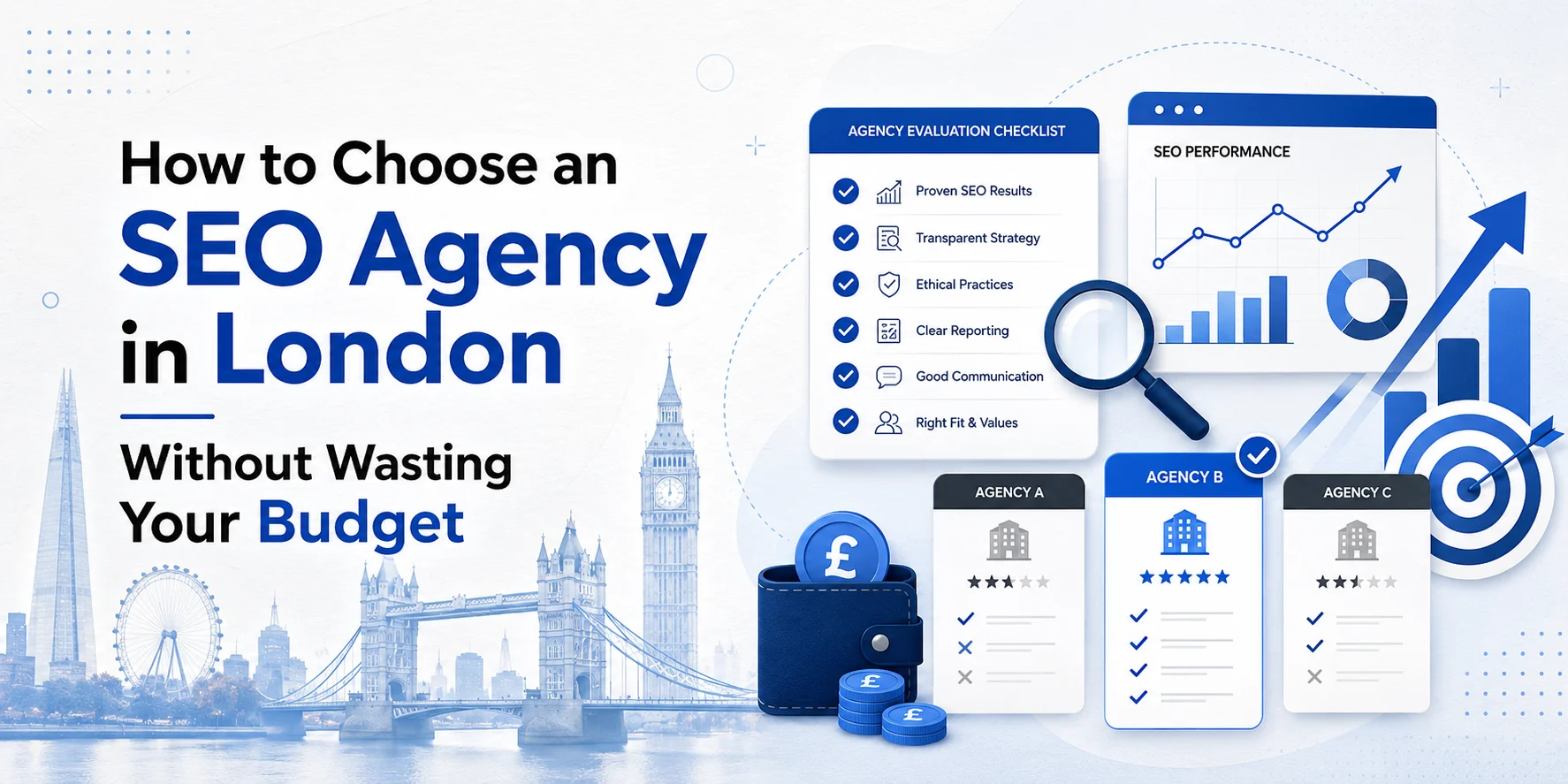
Choosing an SEO agency in London can feel harder than it should. One agency promises page-one rankings. Another talks about backlinks, AI search, technical SEO and hundreds of keywords. A third gives you a low monthly price but doesn’t explain what will actually be done. The problem isn’t a lack of choice. It is knowing which claims you can trust.
A good SEO agency should be able to explain:
- What your website actually needs
- What work will be completed
- Who will complete it
- How long different tasks may take
- How results will be measured
- What you need to provide
- What is included in the price
- How the agreement can end
Google itself warns businesses that no SEO provider can guarantee a number-one Google ranking and says you should be cautious when an agency is secretive about what it plans to do. So leave the too-good-to-be-true promises at the door. Here is how to choose an SEO agency in London based on evidence, transparency and business fit.
What Should You Check Before Hiring an SEO Agency?
Start with eight areas.
| Check | What you need to know |
| Business goals | Does the agency understand what produces value for you? |
| SEO strategy | Can it explain what should happen and why? |
| Team | Who will actually work on your campaign? |
| Evidence | Can its results and case studies be verified? |
| Deliverables | What work will be completed? |
| Reporting | Will leads and conversions be measured? |
| Links | How will authority and backlinks be built? |
| Contract | What are the cost, term, notice and cancellation rules? |
Don’t choose an SEO company because one sales call sounded impressive. Check what happens after you sign.

1. Start With Your Business Goals
Before comparing SEO agencies, decide what you actually need SEO to achieve. That may be:
- More qualified phone calls
- More quote requests
- More bookings
- Ecommerce sales
- Better Local SEO visibility
- More enquiries for priority services
- Expansion into new London areas
- Less reliance on paid advertising
“More traffic” is too broad. A London electrician may care more about emergency electrical calls in the areas they serve. A cleaning company may want more commercial contract enquiries. An ecommerce company may care about category sales and revenue from organic search. The agency should understand this before building the strategy.
Ask This
Which business outcome will this campaign focus on?
If the answer is only “more rankings”, keep asking.

2. Check Whether the Agency Understands Your Starting Point
A reliable agency shouldn’t prescribe a full campaign before understanding the website. Early discovery may include:
- Technical review
- Current rankings
- Search Console performance
- Analytics
- Existing content
- Backlinks
- Local visibility
- Competitors
- Conversion tracking
- Website structure
Your business may not need everything at once. For example, creating ten new service pages makes little sense if the website has serious crawling or tracking problems. Likewise, spending the whole first month fixing minor technical warnings may make little sense if your main service pages barely explain what you sell. Good SEO starts with priorities.
3. Ask What Will Actually Be Delivered
“Full SEO package” tells you very little. Ask what you will actually receive. Possible deliverables may include:
- Technical SEO audit
- Keyword mapping
- Competitor research
- Service-page optimisation
- New content
- Local SEO work
- Google Business Profile improvements
- Internal links
- Technical fixes
- Digital PR or outreach
- Conversion tracking
- Monthly reporting
The proposal should also explain what is not included. For example:
- Is development included?
- Is content writing included?
- How many pages can be worked on?
- Are new landing pages included?
- Is outreach included?
- Are website design changes separate?
- Does the agency implement recommendations or only advise?
A cheaper proposal may become more expensive if you later need several other suppliers to complete the work.
4. Find Out Who Will Actually Work on Your Campaign
The person on the sales call may not be the person doing the SEO. That isn’t automatically a problem. Agencies have different specialists. Your campaign may involve:
- SEO strategist
- Technical SEO specialist
- Content writer
- Developer
- Local SEO specialist
- Outreach specialist
- Reporting specialist
- Account manager
The important part is knowing who owns each task.
Ask:
- Who creates the strategy?
- Who completes technical work?
- Who writes the content?
- Who approves it?
- Who manages outreach?
- Who reviews performance?
- Who will I speak to each month?
You don’t need every specialist in every meeting. You do need clear ownership.
5. Check the Agency’s SEO Case Studies Properly
Case studies are useful, but don’t stop at the headline. A statement such as:
“Traffic increased by 250%.”
needs context.
Ask:
- What was the starting point?
- How long did the campaign run?
- What work was completed?
- Was the growth organic?
- Which pages improved?
- Did enquiries increase?
- Did sales increase?
- Was paid advertising involved?
- What industry was the client in?
- Can the result be verified?
A website going from 20 visits to 70 visits has a large percentage increase, but that doesn’t automatically make it a strong commercial result.
Look for Evidence
Useful evidence may include:
- Search Console screenshots
- Analytics screenshots
- Call-tracking data
- Form enquiries
- Booking data
- Ecommerce results
- Before-and-after visibility
- Real implementation examples
Sensitive client information can be hidden. The important part is that the agency can explain how the work connects with the result.
6. Don’t Judge an Agency on Rankings Alone
It can be useful to see how an SEO company markets its own website. But don’t make this your only test. An agency may target different services, locations or customer acquisition channels. Instead, combine several trust checks:
- Does the website explain its services clearly?
- Are real people or team roles visible?
- Are case studies available?
- Are claims supported?
- Are reviews believable?
- Is the company easy to identify?
- Does its advice match recognised search guidance?
- Can staff explain the work in plain English?
For a UK limited company, you can also check public company information through Companies House. Its free register can show information such as company status, registered office details, filing history and officers. One trust signal is never enough on its own.
7. Be Careful With Guaranteed SEO Rankings
This is one of the clearest SEO agency red flags. Be cautious when you hear:
- “Guaranteed number one on Google”
- “Guaranteed first page”
- “We have a special relationship with Google”
- “We can submit you to Google first”
- “We know the algorithm”
- “We can rank you instantly”
Google specifically warns that nobody can guarantee a number-one ranking and advises businesses to be cautious about SEOs making these claims. Google uses many systems and signals to decide which pages appear for searches, and even following Google’s requirements does not guarantee that a page will be crawled, indexed or served in search results. An agency can commit to its work.
It can’t control Google.
Better Promise
Look for an agency willing to commit to:
- Clear deliverables
- Proper implementation
- Transparent reporting
- Agreed deadlines
- Regular reviews
- Evidence-based decisions
That is much more useful than a ranking guarantee.
8. Ask How the Agency Builds Links
“100 backlinks every month” should trigger more questions.
Ask:
- Where will the links come from?
- Why are those websites relevant?
- Are links paid?
- Is outreach involved?
- Will you see the placements?
- Are private networks being used?
- Does the agency control the linking websites?
- How does it check link quality?
Google’s spam policies specifically cover link schemes designed primarily to manipulate search rankings. A link-building strategy should focus on relevance, quality and legitimate reasons for another website to mention your business. Possible methods may include:
- Digital PR
- Expert contributions
- Useful resources
- Industry publications
- Local partnerships
- Relevant outreach
- Original research
Don’t buy backlink numbers. Understand the method.
9. Check the Reporting Before You Sign
Ask to see an example SEO report before agreeing to the campaign. A useful report may include:
- Work completed
- Search Console clicks
- Impressions
- Important queries
- Priority landing pages
- Calls
- Forms
- Bookings
- Sales where available
- Lead quality
- Problems found
- Next-month priorities
A report full of green arrows can still hide a weak campaign. For example:
40 keywords improved.
Sounds good. But what if none of those keywords generated a useful visitor? Reporting should help you understand business performance, not just make the agency look busy. Read how to read an SEO report without getting distracted before comparing agency reports.
10. Ask How Leads Will Be Measured
This question often separates basic reporting from commercial SEO. Ask how the agency will connect organic search with:
- Calls
- Contact forms
- Quote requests
- Bookings
- Purchases
- Revenue where available
- Qualified leads
Tracking may use tools such as Google Analytics, Search Console, ecommerce data and call tracking. Not every sale can always be tied perfectly to one channel. But the agency should still explain what can be measured and what cannot.
11. Understand SEO Agency Pricing in London
There is no single correct London SEO price. Cost can change based on:
- Competition
- Website size
- Number of services
- Number of locations
- Technical condition
- Content requirements
- Development work
- Ecommerce complexity
- Authority gap
- Internal client resources
Published UK SEO pricing varies widely. For example, The SEO Works currently states that its small-business SEO starts at £1,500 per month, while its broader UK pricing guidance says ongoing SEO across the market can range much more widely depending on scope. That doesn’t mean £1,500 is the “correct” price for every London business. It shows why comparing prices without comparing scope is risky.
Compare What the Budget Buys
Instead of asking only:
How much per month?
Ask:
What will be completed for that amount?
Compare:
| Area | Agency A | Agency B |
| Monthly fee | £ | £ |
| Technical SEO | Included? | Included? |
| Implementation | Included? | Included? |
| Content | How much? | How much? |
| Development | Included? | Included? |
| Local SEO | Included? | Included? |
| Outreach | Included? | Included? |
| Reporting | What metrics? | What metrics? |
| Calls/forms tracked | Yes/No | Yes/No |
| Contract | Terms | Terms |
| Extra costs | £ | £ |
The cheapest proposal can become expensive when everything useful is an extra. The highest proposal isn’t automatically the best either.
12. Watch for the Cheap SEO Trap Without Using Price Alone
Very cheap SEO deserves questions. But price alone does not prove quality. A small local website in a low-competition market may need less work than a London ecommerce site with thousands of URLs. Instead of deciding that anything below one price is bad, look at the maths. If an agency charges a small monthly fee, ask:
- How many hours can realistically be spent?
- Is content included?
- Is technical implementation included?
- Who writes the content?
- How are links earned?
- Is reporting automated?
- What happens when a serious issue appears?
The problem isn’t simply “cheap SEO”. The problem is paying for a package that can’t realistically deliver the work your website needs.
13. Check the SEO Contract Carefully
Don’t wait until you want to leave before reading the agreement. Check:
- Minimum term
- Notice period
- Cancellation process
- Monthly cost
- Setup fees
- Additional costs
- Renewal terms
- Ownership
- Deliverables
- Paused work
- Unfinished tasks
- Content ownership
- Account ownership
- Website access
Ask Who Owns Everything
You should know who owns:
- Your website
- Google Analytics
- Search Console
- Google Business Profile
- Content
- Reports
- Tracking accounts
- Advertising accounts where relevant
Be careful when important business accounts are created in a supplier’s name and cannot easily be transferred.
14. Ask What Happens If Priorities Change
SEO campaigns rarely stay identical for months. Imagine your company suddenly launches a new service in Camden. Or your ecommerce website changes its category structure. Or a developer replaces an important website template. The SEO team may need to change priorities.
Ask:
Can monthly work change when the data or business changes?
A good campaign should have structure without becoming rigid.
15. Ask What Happens When Development Is Needed
This catches many businesses out. An SEO audit may find:
- Redirect problems
- Slow templates
- Structured-data errors
- Internal-link issues
- JavaScript problems
- Tracking errors
- Mobile usability problems
Who fixes them? Possible answers include:
- The SEO agency
- Your developer
- A separate development company
- Shared responsibility
Get the answer before signing. Otherwise, you may pay for an audit and then discover that implementation needs another budget.
16. Check How Content Is Produced and Approved
Ask:
- Who writes the content?
- Is it reviewed by an SEO strategist?
- Does somebody check business facts?
- Can your team request corrections?
- How is search intent checked?
- How do they stop pages competing with each other?
- Who publishes the content?
- How are old pages reviewed?
Avoid agencies that treat content as a numbers game. Publishing 30 thin articles is not automatically better than improving five important pages. Google’s Search Essentials recommend helpful, reliable, people-first content and warn against spam practices such as unnatural keyword stuffing.
17. Ask How They Handle AI Search
SEO agencies now talk about:
- AI Overviews
- ChatGPT
- AEO
- GEO
- AI search optimisation
That doesn’t mean you need a completely separate magic strategy. Ask what the agency will actually change. Useful answers may include:
- Making service information clearer
- Improving entity information
- Strengthening evidence
- Creating useful original content
- Improving technical accessibility
- Monitoring search changes
- Tracking referrals where possible
Be cautious when somebody claims they can guarantee that ChatGPT, Google AI Overviews or another AI system will recommend your company. Ask for the method and evidence.
18. Check Communication and Project Management
Poor communication can make good SEO difficult. Before signing, ask:
- Who is my main contact?
- How often do we meet?
- Where are tasks recorded?
- Where can I see deadlines?
- How are approvals handled?
- How quickly are questions answered?
- How are urgent website issues handled?
SEO campaigns often depend on the client too. Your agency may need:
- Website access
- Business information
- Developer support
- Content approval
- Product details
- Service details
- Lead-quality feedback
Both sides need clear responsibilities.
How Wixdek Defines Scope Before Work Starts
At Wixdek, the aim is to make the SEO scope clear before implementation begins. Depending on the engagement, this may include:
- Business goals
- Priority services
- Target locations
- Website access
- Tracking requirements
- Technical priorities
- Content requirements
- Responsibilities
- Approvals
- Reporting
- Development scope
- Campaign deliverables
Wixdek’s current SEO Services page also promotes clear monthly reporting and no long-term contracts. The exact scope should still be confirmed in the proposal for your individual campaign.
That way, both sides know:
- What are we doing?
- Who is doing it?
- How will we measure it?
- What happens next?
SEO Agency Red Flags Checklist
Be careful if an agency:
- Guarantees number-one rankings
- Refuses to explain its strategy
- Hides where links come from
- Promises huge numbers of backlinks
- Talks only about rankings
- Cannot explain how leads will be measured
- Won’t show examples of reporting
- Has vague monthly deliverables
- Cannot tell you who does the work
- Pushes a contract before reviewing your needs
- Uses the same plan for every business
- Won’t explain extra costs
- Creates important accounts that you cannot access
- Publishes content without business approval
- Cannot explain what happens after the audit
One warning sign may need clarification. Several warning signs together should make you cautious.
SEO Agency Due-Diligence Checklist
Before signing, verify:
Business
- Company details
- Website
- Contact information
- Real team or responsible people
- Relevant experience
Evidence
- Case studies
- Screenshots
- Reviews
- Client examples where permitted
- Clear explanation of the work behind results
Delivery
- SEO strategy
- Monthly deliverables
- Implementation responsibility
- Content production
- Technical support
- Link-building approach
Measurement
- Search Console
- Analytics
- Calls
- Forms
- Bookings
- Sales where possible
- Lead quality
Commercial Terms
- Price
- Scope
- Minimum term
- Cancellation
- Notice
- Extra costs
- Ownership
A Simple SEO Agency Decision Guide
Use this before choosing a provider.
Does the Agency Understand Your Business?
No → Stop and clarify first. Yes → Continue.
Can It Explain the Strategy in Plain English?
No → Ask for a clearer proposal. Yes → Continue.
Are Deliverables Clear?
No → Do not sign yet. Yes → Continue.
Can Results or Experience Be Verified?
No → Ask for evidence. Yes → Continue.
Is Implementation Included?
No → Work out who will do it and what it will cost. Yes → Continue.
Are Leads and Conversions Measured?
No → Fix measurement before judging ROI. Yes → Continue.
Are Contract and Cancellation Terms Clear?
No → Get them in writing. Yes → You can compare the agency properly.
Suggested visual alt text:
SEO agency selection decision guide showing checks for strategy, evidence, implementation, reporting, pricing and contract terms.
Questions SEO Agencies Should Be Able to Answer
Before signing, ask:
- What problems would you investigate first?
- What will you complete each month?
- Who will work on my campaign?
- Is implementation included?
- Who writes and approves content?
- How do you build links?
- How will you measure calls or enquiries?
- What happens when priorities change?
- What costs extra?
- How does cancellation work?
- Who owns the content and accounts?
- What should I expect during the first 90 days?
If these basic questions create uncomfortable silences, that tells you something. For a deeper comparison, use the SEO agency selection scorecard before you sign.
Agency, Consultant or One-Off Project?
You may not need an agency at all. An SEO consultant may suit you when:
- You already have writers
- You have a developer
- Your marketing team can implement recommendations
- You mainly need strategy or audits
An SEO agency may suit you when:
- You need several specialists
- Implementation must be managed for you
- You need ongoing content
- You need Local SEO
- Technical work continues
- Reporting and lead tracking need regular attention
A one-off project may suit you when:
- The problem is clearly defined
- The work has a clear end point
- Your internal team can implement the recommendations
Read SEO retainer vs one-off SEO project if you’re deciding which support model offers better value.
What Should Happen After You Choose an Agency?
Signing should not be the end of the buying process. The agency should move into a clear onboarding stage.This normally means confirming:
- Access
- Goals
- Tracking
- Priority services
- Locations
- Responsibilities
- Reporting
- Immediate technical problems
- First actions
Your first few months should produce clear campaign outputs rather than vague promises.
Choose an SEO Agency Based on Evidence, Not Noise
The best SEO agency for your business isn’t automatically:
- The cheapest
- The most expensive
- The agency ranking first for one search
- The company with the biggest backlink claim
- The agency promising the fastest result
Look for fit. A good SEO provider should understand your business, explain its work, show evidence, implement useful changes and report on outcomes that matter. You should know what you’re paying for. You should know who is doing the work. And you should know what happens if the campaign needs to change. That is a much safer way to choose an SEO agency in London.
Review Your SEO Proposal With Wixdek
If you’re comparing SEO providers and aren’t sure whether a proposal gives you enough detail, Wixdek can help you understand what your website actually needs. Our SEO services in London cover ongoing strategy and implementation for businesses that need wider campaign support. If you already have an internal team and need independent strategy, you can also speak with an SEO consultant in London.
We’ll focus on the website, competition, resources and goals before explaining what should happen first.
Request an SEO Consultation
Frequently Asked Questions
How do I choose an SEO agency in London?
Compare strategy, evidence, team expertise, deliverables, implementation, reporting, link-building methods, pricing and contract terms. Don’t choose on rankings promises alone.
What are the biggest SEO agency red flags?
Guaranteed rankings, secretive link building, vague monthly work, poor reporting, unclear ownership and an unwillingness to explain the strategy are strong warning signs.
What questions should I ask an SEO agency?
Ask what it will do, who does the work, how links are earned, what is included, how leads are measured and how the agreement can end.
Can an SEO agency guarantee number-one rankings?
No. Google states that nobody can guarantee a number-one ranking. Agencies can commit to work and processes, but they cannot control Google’s results.
How much should SEO cost in London?
There is no single correct price. Cost depends on competition, scope, website condition, content, development, locations and the specialists required.
Should I choose the cheapest SEO agency?
Not automatically. Compare what is included, who implements the work, how much specialist time is available and which costs may appear later.
Should an SEO agency provide case studies?
Case studies are useful evidence. Look for starting conditions, work completed, timeframe and measurable outcomes rather than headline percentages alone.
Should I sign a long SEO contract?
Read the commercial terms before signing. Check the minimum period, notice requirements, cancellation process, ownership and unfinished work.
How can I check whether an SEO company is genuine?
Review its company details, team, website, case studies, reviews and contact information. UK company information can also be checked through Companies House where applicable.
Should an SEO agency report on leads?
Where tracking allows it, yes. Calls, forms, bookings, purchases and lead quality can provide better commercial context than rankings alone.
Is an SEO agency better than an SEO consultant?
It depends on your resources. An agency may suit businesses needing wider implementation, while a consultant may suit teams that can complete recommendations internally.
How long should I give an SEO agency?
SEO timelines depend on the website and competition. More important early checks are whether tracking, audits, priorities and agreed implementation are actually being completed.