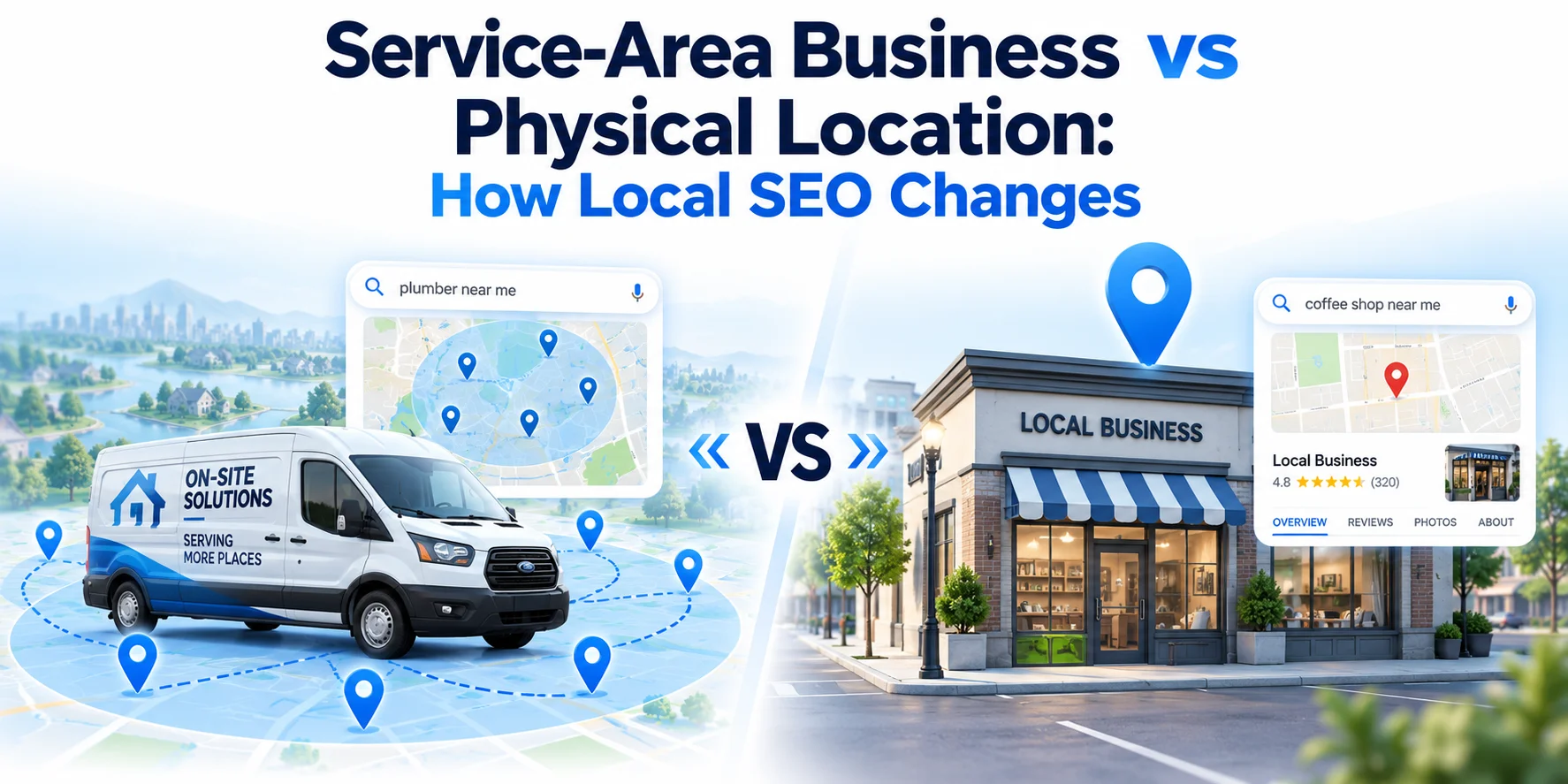
If your business travels to customers, your local SEO setup can look very different from a shop, office or clinic with a public address. A service-area business serves customers at their location rather than welcoming them at a fixed premises. A physical location business has a real place where customers can visit. This difference affects your Google Business Profile, website structure, local keywords and location strategy. Get the setup wrong and you could confuse customers or create unnecessary local SEO problems.
What Is a Service-Area Business?
A service-area business, often called an SAB, travels to customers to provide its services. Common examples include plumbers, electricians, locksmiths, mobile mechanics, cleaners and some trades. Customers normally don’t visit the business address. Instead, the business travels to their home, workplace or another agreed location. Google says service-area businesses should use a service area when they visit customers directly. If customers don’t visit the business address, that address should be removed from the public Business Profile. For example, a mobile locksmith serving Camden, Ealing and Croydon doesn’t need a shop in each borough. The business needs to show where it genuinely provides its service.
What Is a Physical Location Business?
A physical location business has premises where customers can visit. Examples include dental practices, restaurants, salons, retail shops, clinics and accountancy offices. The real business address can be displayed on the Google Business Profile, helping customers find the premises and request directions. The important point is that the address must represent a genuine customer-facing location. Google advises businesses to provide accurate business information and represent the business as it exists in the real world.
Service-Area Business vs Physical Location
The difference is fairly simple. A physical location tells customers where they can visit the business. A service-area business tells customers where the business can provide its services.
| Area | Physical Location | Service-Area Business |
| Customers visit the business | Yes | Usually no |
| Public address | Normally shown | Hidden when customers don’t visit |
| Service areas | Can be added | Important part of the setup |
| Main local focus | Premises and relevance | Service coverage and relevance |
| Website strategy | Location and service pages | Service and genuine location pages |
Neither model is automatically better for local SEO. The right setup depends on how your business actually operates.
How Google Business Profile Settings Change
Physical Location
If customers visit your premises, use the real business address on your Google Business Profile. For example, a dental practice in Richmond can show its clinic address and provide customers with directions. If the business also travels to customers, it may qualify as a hybrid business and can use both its physical address and service area.
Service-Area Business
If customers don’t visit your address, don’t present that address as a customer-facing location. Instead, set the areas where you genuinely provide your service. Google currently allows service areas to be set using cities, postcodes or other areas, with up to 20 service areas. Google also advises businesses to keep their overall service area realistic and accurate. You can review the current requirements in the official Google Business Profile service-area guidance.
Two Real-World Configuration Examples
Example 1: Mobile Locksmith
Imagine a locksmith based in London who travels to customers. Customers don’t visit the business address. The appropriate setup would be:
- Business model: Service-area business
- Address: Hidden from customers
- Service areas: Genuine areas served
- Website: Service pages plus useful location pages where appropriate
The business shouldn’t create fake offices in every borough.
Example 2: Dental Practice
Now consider a dental practice with a real clinic in Richmond. Patients visit the premises for treatment. The setup would be:
- Business model: Physical location
- Address: Public
Location: Real clinic address - Website: Service pages plus useful location information
If the practice also provides eligible services away from the clinic, its profile may need to reflect that additional service area. The important thing is accuracy, not choosing whichever setup appears to rank better.
How Proximity Affects Local Search
Proximity matters in local search, but it isn’t the only consideration. A physical business has a clear address that Google can use when assessing distance. A service-area business doesn’t have the same customer-facing map location. Its visibility therefore relies on a wider mix of signals, including relevance, business information, website content and genuine service coverage. This is why adding another London borough to a website doesn’t automatically make the business rank there. Local SEO isn’t a postcode lottery where adding more locations guarantees more visibility.

Don’t Create Fake Locations
This is one of the biggest mistakes service businesses can make. If a mobile electrician serves Croydon, there is no reason to pretend the company has an office there. Don’t use a virtual office simply to create another Google location. Don’t create location pages that claim you have premises when you don’t. Google’s guidelines state that service-area businesses should have one profile for the area they serve, subject to its location and eligibility rules. Your local SEO should describe the real business, not a made-up version designed to capture rankings.
How Your Website Strategy Changes
Your website should support the way your business operates.
For Physical Location Businesses
A genuine location business can build around its real premises. The website might include service pages, location information, contact details, directions and useful information for local customers. The business address should also remain consistent across important business listings.
For Service-Area Businesses
An SAB should lead with its actual services and then show where those services are available. For example, a mobile locksmith could have pages covering auto locksmith services, emergency locksmith services and car key replacement. Selected location pages can then explain how those services are provided in important areas. A location page should offer genuine value. Simply replacing “Camden” with “Croydon” across dozens of pages isn’t a useful local SEO strategy. This is where local SEO strategy and optimisation needs to connect services, locations and customer intent.
Should You Create Location Pages?
Sometimes, yes. But more pages don’t automatically mean better rankings. A location page makes sense when the area has real commercial value and the business can provide useful information about serving customers there. Good local keyword research can help you identify which services and locations customers are actually searching for.
For example, an emergency locksmith serving Hackney could explain its service coverage, common customer problems, available services and how customers can request help. A page that only changes the borough name gives customers very little value and may create thin or repetitive content.
Keep Your Local Citations Accurate
Your local business information should also be consistent across relevant directories and platforms. This includes your business name, address where applicable, phone number and website. An old address can be particularly confusing for a physical business that has moved.
If your business details have changed, take time to find and fix incorrect local citations across important directories and platforms. Incorrect service information can also create problems for a service-area business.
Before creating more local pages or listings, review your existing business information and local SEO optimisation to make sure the wider setup is accurate. There is little point adding new local signals while existing information is wrong.
How Customer Reviews Fit In
Reviews are another important part of your local presence. Understanding how customer reviews affect local visibility can help you see why genuine customer feedback matters for both trust and local SEO.
Reviews also help potential customers understand what other people experienced with the business. They can provide useful context about the services customers actually use. A plumber, for example, may receive reviews mentioning boiler repairs, emergency call-outs or leak repairs.
Businesses should focus on genuine customer feedback rather than trying to manufacture reviews or add keywords artificially. The goal is simple. Give customers a clear picture of the real service they can expect.
A Simple Decision Tree
Use these questions to identify the right business model. Can customers visit your business at the listed address? If yes, a physical location may be appropriate. If no, and your team travels to customers, a service-area business may be appropriate. If customers visit your premises and you also travel to them, you may operate as a hybrid business. Don’t copy the setup of a competitor just because it appears successful. Your profile should match your actual business model.

Common Mistakes to Avoid
Showing an Address Customers Never Visit
A mobile business shouldn’t present a residential or other non-customer-facing address as a shopfront.
Listing Areas You Don’t Serve
Don’t add every London borough simply because you want rankings there.
Creating Duplicate Location Pages
A page for every postcode isn’t automatically a local SEO strategy. Each page needs a genuine purpose and useful information.
Changing Business Details Without Checking Everything
When addresses, service areas or other business details change, review your website and important listings too.
How Wixdek Approaches Local SEO
At Wixdek, we start with the real business model. We review the services, customer journey, operating areas, Google Business Profile and website before deciding what local structure makes sense. For a physical business, that may mean strengthening the real location and its services. For a service-area business, it may mean improving service-led pages and creating selected location pages around genuine demand. The aim isn’t to create more locations for the sake of rankings. The aim is to make the business easier for customers and search engines to understand. If technical problems are affecting your website, our Technical SEO services can also help identify issues with crawling, indexing and page performance.
Final Thoughts
A service-area business and a physical location business can both perform well in local search, but they need different approaches. A physical business can build local relevance around its genuine premises. A service-area business needs to clearly communicate its services and genuine coverage without creating misleading locations. The best approach starts with the real business model. Your Google Business Profile, website, local keywords and business listings should then support the same story. If you’re unsure whether your current setup is right, a focused review can help you find the gaps before you make unnecessary changes.
Frequently Asked Questions
Can a service-area business show its address on Google?
If customers don’t visit the address, Google says the address should be removed from the Business Profile and the business should use its service area instead.
Can a service-area business rank across different London boroughs?
Yes, but adding borough names doesn’t guarantee rankings. The business needs genuine coverage and relevant local signals.
Should I create a page for every area I serve?
No. Create pages where there is genuine demand and enough useful information to make each page worthwhile.
Can a business have both a physical location and service areas?
Yes. A business that serves customers at its premises and also travels to customers may qualify as a hybrid business.
Does having a physical address guarantee better local rankings?
No. Proximity is only part of local search. Relevance, business information and other local signals also matter.
Ready to Review Your Local SEO Setup?
Not sure whether your business should use a physical location or service-area setup? Request a Local SEO Review and find out what needs attention before making changes.