Getting more PPC leads is not always the answer.
Sometimes the account already gets traffic, spends money and reports conversions.
The real problem is that too many enquiries are commercially useless.
That was the issue in this Greater London emergency-locksmith PPC Case Study.
The account was attracting searches around:
- DIY lock fixes;
- key cutting;
- locksmith jobs;
- training;
- tools;
- low-urgency research.
Emergency users were mixed with people who were never likely to become customers.
Wixdek rebuilt the campaign around emergency intent, local coverage and qualified calls.
The published results were:
- qualified emergency calls increased from 28 to 96 per month;
- cost per qualified call fell from £42 to £26;
- wasted spend fell by 41%;
- irrelevant impressions fell by 38%;
- CTR increased from 4.1% to 7.3%.
This PPC Case Study shows how reducing wasted spend can improve lead quality and volume at the same time.
The Client
The business provides emergency locksmith services across Greater London.
Its revenue depends on urgent call-outs such as:
- lockouts;
- lost keys;
- urgent access;
- lock faults.
For this business, a lead is valuable only when the person genuinely needs a locksmith and is within a serviceable location.
Someone searching for locksmith training has almost no commercial value.
Someone locked outside a property nearby may become an immediate job.
That difference shaped the entire campaign rebuild.
The Starting Problem
The campaign was generating traffic, but too much of that traffic had weak commercial intent.
Ads were appearing for searches involving:
- DIY advice;
- cheap key cutting;
- locksmith employment;
- training;
- tools;
- equipment;
- low-urgency research.
Emergency and non-emergency intent were mixed together.
That meant genuine urgent customers were competing for budget with people who were unlikely to become paying jobs.
Why the Account Was Wasting Money
The main problem was not simply high CPC.
It was where the money was going.
For an emergency-service account, one question matters:
Is this person likely to need the service now?
If the answer is no, the click may create traffic without creating revenue.
In this PPC Case Study, the existing structure caused three problems:
- irrelevant searches consumed budget;
- emergency customers competed with weaker traffic;
- reporting looked healthier than the real call quality.
The PPC Case Study Goal
The rebuild did not start with:
“How can we get more clicks?”
The goals were:
- increase qualified emergency calls;
- reduce wasted spend;
- lower cost per qualified call;
- improve strong time-of-day coverage;
- keep visibility within serviceable areas.
The PPC Case Study goal was better campaign control.
Not more activity.

Step 1: Remove Low-Value Search Intent
The first job was cutting searches unlikely to become emergency jobs.
These included themes around:
- DIY;
- jobs;
- training;
- courses;
- tools;
- equipment;
- cheap non-urgent services.
The campaign also stopped treating searches such as:
locked out locksmith near me
and:
how to change a door lock yourself
as though they had the same value.
Both involve locksmith language.
Only one shows clear emergency buying intent.
Search-Term Reviews Exposed the Waste
Keyword lists alone were not enough.
The actual Search terms report showed what people were typing before clicking.
That made it possible to identify repeated low-value themes and exclude them more confidently.
The lesson from this PPC Case Study is simple:
optimise from real search behaviour, not just the keyword list you originally built.
More Than 1,200 Negative Keywords Were Added
The published case reports that more than 1,200 negative keywords were added during the first phase.
They covered themes such as:
- DIY;
- jobs;
- training;
- tools;
- courses;
- other unsuitable searches.
Within the first month, irrelevant impressions fell by 38%.
That meant less exposure to searches that did not fit the emergency service.
Negative Keywords Were Not the Whole Fix
It would be easy to look at the result and conclude:
“Just add more negative keywords.”
That would be wrong.
The improvement came from several changes working together:
- search intent was cleaned;
- emergency and non-emergency services were separated;
- location targeting was tightened;
- schedules were reviewed;
- ads were rewritten;
- call tracking improved;
- lead quality was reviewed regularly.
The negatives were one part of the rebuild.
Match Type Was a Control, Not a Shortcut
The lesson is not:
“Broad match is bad.”
Broad, phrase and exact match can all waste money when the campaign lacks control.
The better question is:
What searches did this match type actually produce?
Match types were therefore judged against:
- intent;
- cost;
- call quality;
- geography;
- commercial outcome.
Data decided what deserved budget.
Step 2: Separate Emergency and Non-Emergency Intent
Emergency and lower-urgency services were split.
That gave the account more control over:
- budget;
- messaging;
- landing-page journey;
- bidding;
- reporting.
Someone locked outside needs a very different experience from someone casually researching lock replacement.
The PPC Case Study campaign structure now reflected that difference.
Step 3: Tighten Location Targeting
For an emergency locksmith, geography directly affects profitability.
A strong enquiry outside the real dispatch area can still be worthless.
Targeting was tightened around locations the team could realistically serve.
In this PPC Case Study, tighter location targeting helped reduce calls that sounded relevant but could never become jobs.
The campaign stopped treating every Greater London search as equally valuable.
Step 4: Match Spend to Useful Time Periods
Emergency demand changes through the day.
The published case used scheduling and bid adjustments around stronger emergency periods.
The principle is more important than the exact schedule:
Spend more where useful demand exists and the business can respond.
Advertising during weak or unsupported periods can create wasted clicks and missed calls.
Step 5: Rewrite Ads Around Emergency Intent
The targeting changed.
The messaging needed to change too.
Ads were rewritten around:
- emergency intent;
- local relevance;
- clear service wording.
Generic filler and price bait were removed.
CTR increased from:
4.1% to 7.3%
That is roughly a 78% relative increase.
But CTR was not treated as the final business result.
It was evidence that the ads matched the search intent more closely.
Why CTR Alone Was Not Enough
A high CTR can still produce bad leads.
The real question was:
Did better ad relevance create better calls?
In this PPC Case Study, downstream call-quality metrics also improved.
That makes the CTR increase more meaningful.
Step 6: Make Calls the Main Conversion Signal
Phone calls were the key conversion path.
This PPC Case Study therefore moved towards call-first measurement rather than treating every small website interaction as equal.
The journey became:
Search → Ad → Call → Qualified Emergency Opportunity
That matched how customers actually bought the service.
Call-First Ads Reduced Friction
Emergency customers often want to speak to someone immediately.
The campaign used a call-first approach where appropriate to reduce unnecessary steps between:
- search;
- advert;
- phone call;
- service.
The shorter path better matched emergency intent.
Call Quality Was Reviewed
A long call is not automatically valuable.
Someone can spend ten minutes asking about a locksmith vacancy.
A customer can say:
“I’m locked out in Chelsea. Can you come now?”
in less than a minute and become a real job.
That is why call duration alone was not enough.
Calls were reviewed by relevance and outcome.
The published PPC Case Study reports that call relevance improved by more than 60%.
Before and After Results
| Metric | Before | After | Change |
| Qualified emergency calls/month | 28 | 96 | +243% |
| Cost per qualified call | £42 | £26 | -38% |
| Wasted spend | High | Reduced | -41% |
| CTR | 4.1% | 7.3% | Strong improvement |
| Irrelevant impressions | High | Reduced | -38% |
| Call relevance | Lower | Improved | +60%+ |
Qualified emergency calls increased roughly 3.4×.
That is the strongest commercial result in the case.
What Happened to Total Spend?
The published Wixdek case does not provide exact monthly before-and-after spend.
So this article should not invent it.
The verified results are enough:
- wasted spend fell 41%;
- cost per qualified call fell from £42 to £26;
- qualified emergency calls increased from 28 to 96.
Those figures demonstrate a clear improvement in efficiency without unsupported claims.
Cost per Qualified Call Fell 38%
Before:
£42
After:
£26
That is about a 38% reduction.
This metric is stronger than cheaper clicks because it measures the cost of an enquiry that has already passed a quality check.
Qualified CPL Matters More Than Raw CPL
Imagine:
Campaign A
- 100 raw leads;
- 20 qualified;
- £20 raw CPL.
Campaign B
- 60 raw leads;
- 45 qualified;
- £30 raw CPL.
Campaign A looks cheaper.
Campaign B produces far more useful opportunities.
This PPC Case Study shows why lead quality should sit alongside conversion volume.
The Result Was Not Just More Calls
Qualified emergency calls increased from 28 to 96 per month.
But the stronger outcome was the combination of:
- more qualified calls;
- lower qualified-call cost;
- less wasted spend;
- cleaner search intent;
- stronger call relevance.
Volume and efficiency improved together.
Why This PPC Case Study Worked
The account was rebuilt around how the business actually makes money.
For an emergency locksmith, that means:
- the right problem;
- the right location;
- the right time;
- the right call.
Traffic failing those tests has less value.
Once those conditions shaped the campaign, budget became easier to control.
Poor Intent Control Is Expensive
The lesson is not:
“Never use broad match.”
The better lesson is:
“Poor intent control is expensive.”
An account can waste money with broad, phrase or exact keywords.
The useful question is always:
What did this search produce?
Budget Followed Commercial Value
The campaign stopped treating every click equally.
More budget was focused around:
- genuine emergency intent;
- useful locations;
- stronger time windows;
- job-ready calls.
Lower-value activity lost priority.
That is what reducing wasted spend actually means.
It is not simply spending less.
It is spending less on weak opportunities.
Landing Pages Still Matter
Even a well-targeted campaign can waste money if the landing page creates friction.
Emergency users need:
- clear service wording;
- visible phone CTA;
- fast mobile experience;
- trust;
- local relevance.
The campaign and landing-page journey need to support each other.
What Was Reviewed Weekly
Optimisation focused on:
- search terms;
- irrelevant impressions;
- call quality;
- cost per qualified call;
- location performance;
- time-of-day performance;
- CTR;
- service intent.
In this PPC Case Study, frequent review helped stop weak patterns before they consumed too much budget.
Why Search-Term Review Matters
Search behaviour changes.
New irrelevant queries appear.
New valuable queries appear.
A negative-keyword list created once and forgotten will eventually become outdated.
Ongoing search-term review is part of PPC management, not a one-time cleanup.
What Other Businesses Should Not Copy Blindly
A PPC Case Study is evidence.
It is not a universal template.
Another business should not automatically copy:
- 1,200 negative keywords;
- the same location radius;
- the same schedule;
- the same CPL target;
- the same call settings.
Those decisions belonged to this account.
The transferable method is:
- identify waste;
- rebuild around customer intent;
- track the real conversion;
- review lead quality;
- move budget towards stronger outcomes.
Could Broad Match Still Work?
Potentially.
Broad match can be useful when:
- search terms stay commercially relevant;
- conversion tracking is strong;
- bidding receives good signals;
- lead quality is monitored.
If it repeatedly creates weak searches, tighter control is needed.
The data should decide.
Better Tracking Improved Optimisation
Conversion tracking does more than create reports.
It also influences what automated systems learn from.
If every call or button click is treated as equally valuable, optimisation may chase easy actions rather than good customers.
The closer conversion data gets to actual job quality, the more useful the optimisation becomes.
What This PPC Case Study Proves
This case supports several conclusions:
- reducing waste does not necessarily reduce lead volume;
- stronger search intent can increase qualified leads;
- qualified CPL matters more than raw CPL;
- search terms need ongoing review;
- location and scheduling should match operational reality;
- call tracking should measure useful opportunities.
What It Does Not Prove
This case does not prove that:
- every locksmith will get the same result;
- every account needs 1,200 negatives;
- exact match always beats broad match;
- every London business can cut CPL by 38%.
Those results belong to this specific campaign.
The method is the transferable part.
The Stop, Rebuild, Measure Framework
Stop
Remove searches, locations and time periods that consume spend without enough commercial value.
Rebuild
Structure campaigns around real service intent, geography, urgency and conversion path.
Measure
Track qualified calls or leads rather than clicks and raw conversions.
Then repeat.
That is the central lesson from this PPC Case Study.
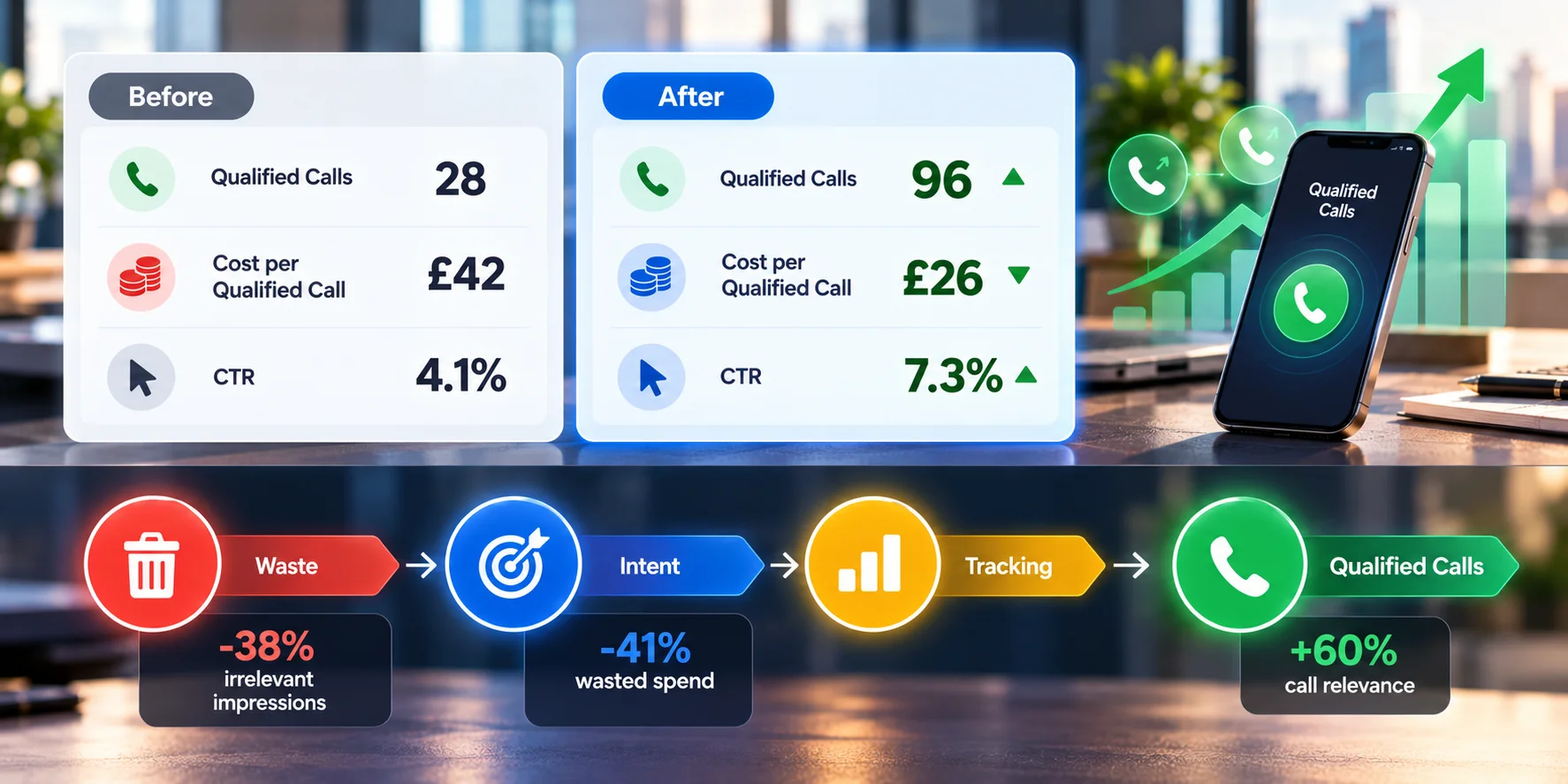
Before-and-After Visual
A useful original chart for this page should show:
| Metric | Before | After |
| Qualified Calls | 28 | 96 |
| Cost per Qualified Call | £42 | £26 |
| CTR | 4.1% | 7.3% |
A second visual can show:
Waste → Intent → Tracking → Qualified Calls
with:
- -38% irrelevant impressions
- -41% wasted spend
- +60% call relevance
These visuals communicate the case more effectively than generic PPC stock imagery.
Evidence Screenshots to Add
Where client confidentiality allows, use real screenshots showing:
- before-and-after performance;
- search-term exclusions;
- conversion actions;
- call-quality reporting;
- campaign structure.
Do not expose:
- client names;
- customer information;
- phone numbers;
- account IDs;
- private search data.
Evidence should prove the result without exposing confidential information.
Why This Matters for London PPC
London clicks can become expensive quickly when targeting is loose.
The answer is not always lower bids.
Sometimes the account needs:
- cleaner intent;
- better structure;
- stronger tracking;
- tighter qualification;
- smarter budget allocation.
This PPC Case Study shows that reducing waste and increasing qualified lead volume can happen together.
How Wixdek Approaches PPC Audits
At Wixdek, we do not start with:
“How do we get more traffic?”
We start with:
- Where is the budget going?
- Which searches trigger ads?
- Which leads are useful?
- Which locations work?
- Which calls become jobs?
- What should stop?
- What deserves more budget?
That is how a PPC audit moves from activity to business performance.
Need Help Reducing Wasted PPC Spend?
If your campaigns generate clicks but sales still complains about lead quality, raising the budget may make the problem worse.
Wixdek can review:
- search terms;
- keyword structure;
- locations;
- schedules;
- conversion tracking;
- call quality;
- landing pages.
Our PPC agency in London service focuses on qualified enquiries and measurable business outcomes.
If this PPC Case Study feels similar to your account, the first step is not necessarily more spend.
It is finding where the existing spend is leaking.
Frequently Asked Questions
What was the main result of this PPC Case Study?
Qualified emergency calls increased from 28 to 96 per month, while cost per qualified call fell from £42 to £26.
How much did wasted PPC spend fall?
The published result reports a 41% reduction in wasted spend.
How much did qualified calls increase?
Qualified calls increased by roughly 243%, or about 3.4×.
What happened to cost per qualified call?
It fell from £42 to £26, a reduction of around 38%.
What happened to irrelevant impressions?
They fell by 38% in the first month.
What happened to CTR?
CTR increased from 4.1% to 7.3%.
How many negative keywords were added?
More than 1,200 were added during the first phase.
Did negative keywords create the whole improvement?
No.
Campaign structure, locations, scheduling, ad messaging, tracking and ongoing lead-quality review also changed.
Should every PPC account add 1,200 negatives?
No.
Negative keywords should come from the actual search behaviour and commercial needs of the account.
Should businesses stop using broad match?
Not automatically.
Broad match can still work when tracking, bidding and search-term control are strong.
How was lead quality measured?
Calls were reviewed by relevance and outcome rather than raw call count alone.
What happened to call relevance?
The published case reports an improvement of more than 60%.
Why were emergency services separated?
Emergency and non-emergency searches have different urgency, value and conversion journeys.
Why did location targeting matter?
A relevant emergency lead outside the real service area can still be commercially useless.
Why did time of day matter?
Budget works better when it aligns with periods where useful demand appears and the business can respond.
Is lower CPC the main success metric?
No.
Cost per qualified lead and qualified-lead volume provide stronger commercial evidence.
Can another business expect the same result?
No.
Results depend on market conditions, competition, account history, tracking and business model.
What is the main lesson from this PPC Case Study?
Stop paying for weak activity, rebuild around real customer intent and measure qualified outcomes.