Microsoft Ads vs Google Ads is not really a question of choosing one platform forever.
For most UK businesses, Google offers the larger pool of search demand.
Microsoft usually offers less volume, but that smaller audience can still be valuable if it adds profitable customers at a sensible cost.
The more useful question is:
When does Microsoft Advertising add profitable demand that Google Ads is not already capturing?
That matters because adding a second platform is only useful if it improves the business result.
Copying campaigns into another dashboard is not automatically growth.
Microsoft Ads vs Google Ads: The Main Difference
In a Microsoft Ads vs Google Ads comparison, both platforms let businesses advertise to people searching for products or services.
The biggest practical difference is reach.
Google usually provides the larger search audience.
Microsoft Advertising can serve Search ads across Bing and partner properties, giving advertisers access to additional search demand.
That audience is smaller.
Smaller does not mean useless.
Is Google Ads Better Than Microsoft Ads?
For businesses weighing Microsoft Ads vs Google Ads from scratch, Google is usually the stronger first platform because it offers more search volume.
That can matter when the business needs:
- broad local demand;
- large keyword volume;
- faster testing;
- more consumer reach.
Microsoft can become more useful once Google is already working and the business has enough budget to test another source of demand.
Think of Microsoft as Incremental Reach
The wrong question is:
“Can Microsoft beat Google?”
The better question is:
“Can Microsoft add profitable customers after Google is already working?”
Imagine Google Ads produces:
- 100 qualified leads;
- £80 cost per qualified lead.
Microsoft then produces:
- 15 additional qualified leads;
- £62 cost per qualified lead.
Google is still the larger platform.
Microsoft simply adds useful extra demand.
That is the most practical way to think about Microsoft Ads vs Google Ads.
What Does Incremental Mean?
Incremental leads are leads you would not reasonably have received from your existing campaign mix anyway.
That is important because some people may use both Google and Bing before converting.
Do not assume every Microsoft conversion is completely new demand.
Review:
- total qualified leads;
- total spend;
- customer volume;
- channel overlap;
- acquisition cost;
- commercial outcomes.
The goal is to see whether adding Microsoft improves the overall result.
Microsoft Ads vs Google Ads Example
The figures below are illustrative.
| Metric | Google Ads | Microsoft Ads |
|---|---|---|
| Spend | £8,000 | £1,500 |
| Clicks | 2,000 | 500 |
| Average CPC | £4.00 | £3.00 |
| Leads | 100 | 24 |
| Qualified Leads | 65 | 18 |
| Cost per Qualified Lead | £123 | £83 |
Microsoft looks cheaper.
That does not mean Google should lose all its budget.
Google still produces far more qualified leads.
Microsoft is useful because it adds efficient volume.
Microsoft Ads Is Not Always Cheaper
In Microsoft Ads vs Google Ads cost comparisons, Microsoft can have lower CPCs in some auctions because competition may be lighter.
That is not a universal rule.
A niche B2B keyword may still be expensive.
A broad consumer term may still convert badly.
Do not assume:
“Microsoft is always cheaper.”
A better rule is:
Test Microsoft against your own Google benchmark.
Compare Qualified Outcomes, Not CPC Alone
Suppose:
- Google CPC = £5;
- Microsoft CPC = £3.
Microsoft looks better.
Now compare:
- Google qualified-lead rate = 45%;
- Microsoft qualified-lead rate = 20%.
The cheaper click may create worse economics.
Compare the full funnel:
Spend → Lead → Qualified Lead → Customer
CPC is only the first step.
Microsoft Can Reach Different Audiences
Audience targeting is another factor in Microsoft Ads vs Google Ads decisions, especially for some businesses.
One notable difference is LinkedIn profile targeting.
Advertisers may be able to use professional attributes such as:
- company;
- industry;
- job function.
That can be particularly interesting for B2B campaigns.

Why LinkedIn Targeting Matters
Imagine a software company wants to reach:
- finance directors;
- operations managers;
- IT decision-makers;
- specific industries.
Google can reach these users through search intent.
Microsoft can add professional audience information as another layer.
That does not replace keyword intent.
It can provide extra audience context.
Example: B2B Software
Imagine a SaaS business runs Google Search for:
business workflow software
Google produces strong volume.
The business then tests the same core themes on Microsoft and adds LinkedIn professional targeting.
It reviews whether specific industries or job functions produce stronger opportunities.
If those users convert better, Microsoft adds useful insight and potentially useful incremental demand.
Microsoft Ads Is Not Only Bing
A common mistake is treating Microsoft Advertising as:
Bing only
Search ads can also appear across partner properties depending on campaign settings.
That expands reach.
It also means partner traffic should be reviewed rather than assuming every placement performs the same way.
Google Still Has the Larger Demand Pool
For most UK businesses, Google’s biggest advantage is scale.
If somebody needs:
- a plumber;
- solicitor;
- chauffeur;
- accountant;
- product;
Google will usually provide more search volume.
That is why businesses with limited budgets often start with Google.
Once Google is profitable, Microsoft can become a useful second source of demand.
When Should a UK Business Test Microsoft Ads?
A Microsoft Ads vs Google Ads test is usually worth considering when:
- Google campaigns are stable;
- conversion tracking works;
- landing pages are strong;
- lead quality is understood;
- the business has spare acquisition capacity;
- enough budget exists for a meaningful test.
If those foundations are weak, adding another platform may simply create a second messy account.
When Should You Wait?
Do not rush into Microsoft if:
- Google tracking is broken;
- lead quality is unknown;
- campaign structure is poor;
- budget is already too thin;
- landing pages are weak;
- sales cannot identify good leads;
- the business cannot handle more enquiries.
Fix the core platform first.
Then expand.
Start With Google When Scale Matters
Google is usually the better first choice when the business needs broad search reach.
That often includes:
- local services;
- high-volume ecommerce;
- broad product categories;
- markets with strong search demand.
A business with a small budget may learn more by concentrating spend on one well-built platform than splitting it between two weakly funded accounts.
Microsoft Works Better as a Second Platform
Once Google is stable, test Microsoft with a controlled budget.
Start with:
- high-intent campaigns;
- proven landing pages;
- reliable conversion actions;
- strong service or product categories.
That gives the second platform a better starting point.
Microsoft Can Import Google Ads Campaigns
Microsoft Advertising includes a Google Ads import tool.
This can save setup time.
But it should not be treated as a one-click strategy.
Imported campaigns still need review.
Do Not Import and Walk Away
After import, check:
- budgets;
- bids;
- targeting;
- negative keywords;
- campaign status;
- conversion tracking;
- quality settings.
Google and Microsoft are not identical platforms.
The import is the starting point.
Not the finished campaign.
Check Location Targeting After Import
Location settings may behave differently across platforms.
For a local business, that matters.
A London locksmith should not assume:
“The import copied everything, so geography must be correct.”
Check it manually.
Review Negative Keywords Too
Negative keyword behaviour can differ after import.
Do not assume every Google exclusion will behave exactly the same way in Microsoft Advertising.
Review the imported negative list carefully.
Do Not Copy Budgets One-for-One
Suppose Google spends:
£200 per day
That does not mean Microsoft should also start at:
£200 per day
The Microsoft search pool may be much smaller, so Microsoft Ads vs Google Ads budgets need not match.
Use a test budget large enough to collect useful data but small enough to control risk.
There is no universal percentage.
Example Microsoft Test Budget
Imagine Google spends:
£10,000 per month
and generates:
80 qualified leads
The business could test Microsoft with:
£1,000–£1,500
across the strongest imported campaigns.
Then measure:
- search volume;
- CPC;
- qualified-lead rate;
- cost per qualified lead;
- customer outcomes.
If Microsoft only spends £600 because demand is smaller, do not force extra spend.
Use the Same Conversion Definitions
A Microsoft Ads vs Google Ads comparison becomes meaningless if each platform counts different things.
For example:
- Form submitted;
- Qualified lead;
- Booked consultation.
Microsoft
- Form submitted;
- Qualified lead;
- Booked consultation.
Use consistent commercial definitions wherever possible.
Microsoft Uses UET for Tracking
Microsoft Advertising uses Universal Event Tracking, or UET.
That helps measure website activity and build audiences.
Google conversion tracking does not automatically become Microsoft conversion tracking.
The Microsoft setup still needs to be configured correctly.
Imported Campaigns Need Microsoft Conversion Goals
The ads may import.
The tracking still needs its own setup.
Check:
- UET;
- conversion goals;
- forms;
- phone calls;
- purchase values;
- qualified outcomes.
A Microsoft Ads vs Google Ads evaluation should use the same business logic.
Example: Local Service Business
Imagine a London accountant runs Google Ads for:
- limited company accountant;
- business accountant;
- corporation tax accountant.
Google produces:
40 qualified leads per month
Microsoft then adds:
8 qualified leads
The volume is much smaller.
But if those eight leads are profitable and would otherwise have been missed, Microsoft has done its job.
Example: B2B Professional Service
Imagine a commercial consultancy targets:
- operations consultancy;
- business process consulting;
- enterprise workflow consultancy.
Search volume is limited.
Microsoft may become interesting because professional audience signals can add another layer to B2B demand.
Five strong opportunities can be more valuable than 100 weak clicks.
Example: Ecommerce
An ecommerce business may use Google as the main Search and Shopping platform.
Microsoft can then be tested for additional product traffic.
Compare:
- revenue;
- margin;
- new customers;
- ROAS;
- profit.
A cheaper click means very little if it sells poor-margin products.
Avoid Audience Stereotypes
You may hear that Microsoft users are:
- older;
- wealthier;
- more professional;
- more desktop-focused.
Do not build the whole strategy around stereotypes.
Instead:
- test the platform;
- review your own data;
- compare customer quality;
- analyse device and audience performance.
Let the account show who converts.
LinkedIn Targeting Is a Real Difference
Microsoft’s LinkedIn profile targeting can be useful for:
- B2B software;
- professional services;
- corporate training;
- consultancy;
- commercial suppliers.
Use it as an audience layer.
Not as a magic filter.
Google Has Broader Scale
Google’s advertising ecosystem gives businesses access to a very large audience across multiple campaign types.
Microsoft also offers several ad products.
But the Microsoft Ads vs Google Ads decision should be based on opportunity rather than feature counting.
Scale and Efficiency Are Different
Imagine Microsoft produces:
- £40 cost per qualified lead;
- 5 qualified leads per month.
Google produces:
- £65 cost per qualified lead;
- 80 qualified leads.
In this Microsoft Ads vs Google Ads example, Microsoft is more efficient.
Google is still more important for scale.
A smart business can use both.
Ask Two Separate Questions
When comparing Microsoft Ads vs Google Ads, ask:
Which platform is more efficient?
and:
Which platform can produce enough volume?
The answers may be different.
That is fine.
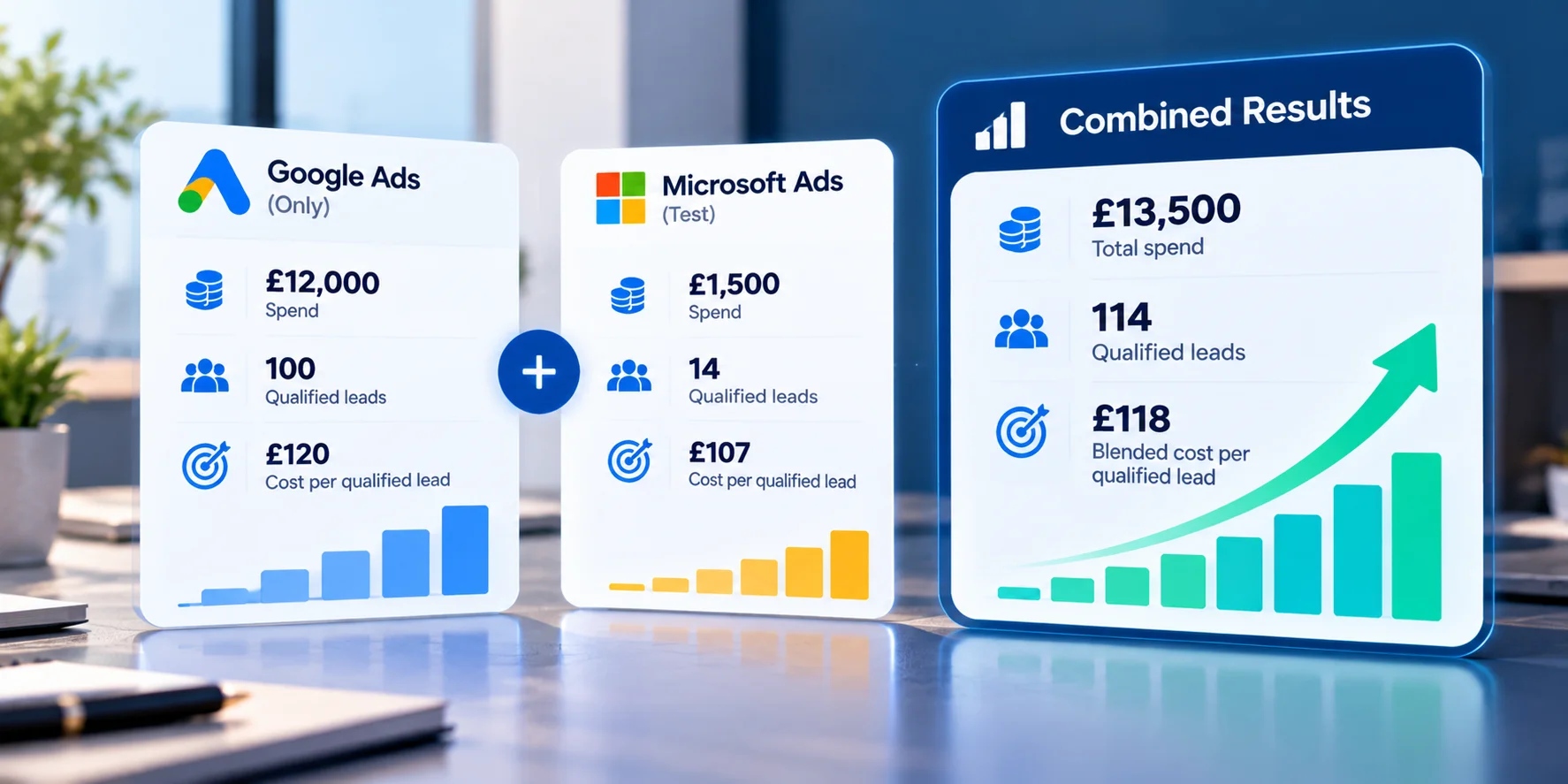
Incremental Lead Example
Google Only
- Spend: £12,000
- Qualified leads: 100
- Cost per qualified lead: £120
After Microsoft Test
- Google spend: £12,000
- Google qualified leads: 100
- Microsoft spend: £1,500
- Microsoft qualified leads: 14
- Combined leads: 114
- Combined spend: £13,500
- Blended cost per qualified lead: about £118
Microsoft adds 14 leads while slightly improving blended efficiency.
That is a useful incremental outcome.
Bad Expansion Example
Now imagine:
- Google qualified leads: 100
- Microsoft spend: £2,000
- Microsoft qualified leads: 4
- Microsoft cost per qualified lead: £500
If those leads have no higher value, Microsoft is probably not helping.
Do not keep spending simply because:
“We should be on Bing too.”
Imported Campaigns Need Their Own Search-Term Review
Do not assume search behaviour will be identical.
After launch, review:
- search terms;
- negatives;
- locations;
- devices;
- audiences;
- partner traffic;
- lead quality.
The imported campaign should become a Microsoft campaign.
Not remain a Google campaign in a different dashboard.
Brand Campaigns Need Separate Reporting
Brand campaigns often convert well because users already know the business.
That does not automatically prove incremental acquisition.
Keep brand and non-brand performance separate when comparing the two platforms.
Look for New-Customer Outcomes
A second platform becomes more useful when it creates:
- new qualified leads;
- new customers;
- new revenue.
For lead generation, CRM data can help.
For ecommerce, purchase and new-customer data can help.
That makes Microsoft Ads vs Google Ads incremental analysis stronger.
CPC Differences Can Mislead
Suppose:
- Google CPC = £6;
- Microsoft CPC = £3.50.
Microsoft looks better.
Now add:
- Google conversion rate = 10%;
- Microsoft conversion rate = 4%.
The cheaper click may produce a higher acquisition cost.
Follow the whole funnel.
Microsoft Ads vs Google Ads Dashboard
| Metric | Microsoft | |
|---|---|---|
| Spend | £ | £ |
| Clicks | ||
| Average CPC | £ | £ |
| Leads | ||
| Qualified Leads | ||
| Qualification Rate | % | % |
| Cost per Qualified Lead | £ | £ |
| Customers | ||
| Customer Acquisition Cost | £ | £ |
| Revenue | £ | £ |
For B2B, also consider:
- pipeline value;
- opportunities;
- close rate.
The deeper the measurement, the better the decision.
Do Not Compare Different Attribution Rules Blindly
Google and Microsoft may use different attribution settings or conversion windows.
Before deciding the Microsoft Ads vs Google Ads winner, understand:
- what counts as a conversion;
- which date receives credit;
- attribution model;
- offline conversion use;
- call tracking setup.
Our Google Ads Conversion Tracking Checklist can help validate the Google side before comparison.
Fix Tracking Before Expanding
If Google conversions are already unreliable, importing the campaign into Microsoft simply spreads the problem.
Fix tracking first.
Then expand.
The same applies to campaign structure.
Our Google Ads Search Campaign Structure guide explains how to organise Search before copying it elsewhere.
Do Not Import a Messy Google Account
If the Google account has:
- poor keywords;
- weak negatives;
- wrong locations;
- duplicate conversions;
- random budgets;
- bad naming;
Microsoft may inherit much of that mess.
Clean the source account first.
Performance Max Is Not the Main Reason to Choose Microsoft
Microsoft also offers automated campaign formats.
That does not mean the business needs Microsoft simply for another version of PMax. The stronger question remains: Does Microsoft provide useful incremental demand for this business?
Read our guide on performance max for service businesses.
When Microsoft Ads Deserves a Test
Microsoft may be worth testing when:
- Google is already profitable;
- the business has spare capacity;
- B2B audiences matter;
- desktop traffic performs well;
- Search structure is strong;
- tracking is mature;
- another source of qualified demand is needed.
The important word is:
test.
When Google Alone May Be Enough
Google may be enough for now when:
- budget is limited;
- Microsoft search demand is tiny;
- Google still has profitable room to scale;
- tracking is weak;
- sales capacity is full;
- the business struggles to manage one platform.
Do not expand channels just to look sophisticated.
Controlled Microsoft Ads Test
Step 1: Choose Proven Google Campaigns
Pick campaigns with:
- strong search intent;
- reliable tracking;
- good landing pages;
- acceptable lead quality.
Step 2: Import Them
Use Microsoft’s import tool.
Step 3: Review Settings
Check:
- budget;
- bids;
- location;
- negatives;
- scheduling;
- tracking;
- campaign status.
Step 4: Test Microsoft-Specific Features
Where relevant, test:
- LinkedIn profile targeting;
- Microsoft audience options;
- network settings.
Step 5: Gather Enough Data
Do not judge the platform after a handful of clicks.
Step 6: Compare Qualified Outcomes
Use:
- cost per qualified lead;
- customer acquisition cost;
- revenue;
- profit.
Step 7: Scale Only if It Adds Value
Do not force spend.
Four-Layer Microsoft Ads vs Google Ads Framework
1. Reach
Does Microsoft access additional useful demand?
2. Efficiency
What does the traffic cost?
3. Quality
Do the leads or customers fit the business?
4. Incrementality
Did the business gain additional profitable outcomes?
The fourth question is the most important.
Example: London B2B Firm
Imagine:
Google produces:
35 qualified leads
Microsoft produces:
7 qualified leads
Microsoft volume is much smaller.
But if five of those seven come from larger businesses and two become high-value clients, Microsoft may deserve more budget.
It did not beat Google on volume.
It added valuable demand.
Example: Local Consumer Business
A local emergency service may find strong Google demand but very little Microsoft volume.
If Microsoft’s few leads are expensive, the business may be better putting the money back into Google.
Not every business needs both platforms.
Should You Cut Google Budget to Fund Microsoft?
Sometimes.
But do not automatically cut a profitable Google campaign to fund an unproven channel.
If possible, use an expansion budget first.
If total spend is fixed, move money from:
- weak Google campaigns;
- low-priority tests;
- unprofitable areas
before cutting strong performers.
Avoid Arbitrary 10% or 20% Rules
Advice such as:
“Put 10% of Google spend into Microsoft.”
is easy to remember.
It is not a universal strategy.
Budget should reflect:
- search volume;
- CPC;
- conversion rate;
- required sample size;
- business risk.
There is no magic percentage.
How Long Should a Microsoft Test Run?
There is no fixed number of days.
A high-volume campaign may generate useful data quickly.
A niche B2B campaign may need much longer.
A Microsoft Ads vs Google Ads test needs enough data to compare:
- CPC;
- conversion rate;
- lead quality;
- customer outcomes.
Do not stop after a few poor days.
Use the Same Landing Pages Initially
Using the same proven landing pages can make the Microsoft Ads vs Google Ads test cleaner.
If you change:
- platform;
- landing page;
- offer;
- form;
- tracking
all at once, you will not know what caused the difference.
Start with the same conversion journey.
Then optimise platform-specific issues later.
Keep Platform Reporting Separate
Review:
- Google independently;
- Microsoft independently;
- combined performance.
This gives you three useful views.
You can see whether Microsoft works on its own and whether it improves the wider acquisition mix.
Low Volume Can Still Be Valuable
A platform does not need hundreds of leads to justify itself.
If a business sells £20,000 contracts, three strong opportunities may be commercially meaningful.
Judge volume relative to customer value.
Google May Still Be the Better Place for the Next £1
Suppose Microsoft performs well.
But Google still has plenty of profitable untapped demand.
Where should the next £1 go?
Whichever platform is expected to create more useful business value.
That may still be Google.
A second platform is not automatically the next best investment.
Campaign Fundamentals Still Matter
Whether you use Google, Microsoft or both, campaigns still need:
- clear intent;
- organised keywords;
- strong ads;
- useful negatives;
- relevant landing pages;
- reliable tracking.
A Microsoft Ads vs Google Ads decision does not rescue weak campaign fundamentals.
How Wixdek Approaches Microsoft Ads vs Google Ads
At Wixdek, we would not compare platforms by asking:
“Which one has cheaper clicks?”
We would ask:
- Which platform creates qualified customers?
- How much incremental volume appears?
- Does Microsoft reach a useful audience?
- What happens after the lead?
- Are B2B audience tools helpful?
- What is the blended acquisition result?
That gives a much stronger Microsoft Ads vs Google Ads comparison.
Need Help Comparing Microsoft Ads vs Google Ads?
If Google Ads is already working but you are unsure whether Microsoft can add useful UK leads, use a controlled expansion test.
Wixdek can review:
- your Google account;
- campaigns worth importing;
- tracking;
- Microsoft-specific settings;
- lead quality;
- qualified outcomes across both platforms.
Our PPC agency in London service focuses on acquisition decisions based on real customer value rather than platform preference.
The goal is not to advertise everywhere.
It is to add Microsoft only when the Microsoft Ads vs Google Ads comparison shows that it creates useful incremental business.
Frequently Asked Questions
Is Microsoft Ads better than Google Ads?
Not generally.
Google usually offers more search volume, while Microsoft can add useful incremental reach.
What is the main Microsoft Ads vs Google Ads difference?
Google generally offers greater scale.
Microsoft usually has less search volume but can provide additional demand and useful B2B audience options.
Should UK businesses start with Microsoft Ads or Google Ads?
Most businesses with limited budgets should usually establish Google first, then test Microsoft as an additional channel.
Is Microsoft Ads cheaper than Google Ads?
Sometimes.
But lower CPC does not automatically mean lower acquisition cost.
Compare qualified leads and customers.
Does Microsoft Ads only run on Bing?
No.
Search ads can also appear on Microsoft partner properties depending on campaign settings.
Can Google Ads campaigns be imported into Microsoft Ads?
Yes.
But imported campaigns should still be reviewed carefully after import.
Should I copy my Google budget into Microsoft?
No.
The search volume and auction environment may be very different.
What should I check after importing campaigns?
Review:
- budgets;
- bids;
- location targeting;
- negative keywords;
- schedules;
- tracking;
- campaign status.
Does Microsoft support LinkedIn targeting?
Yes.
LinkedIn profile targeting can provide professional audience signals such as company, industry and job function.
Is LinkedIn targeting useful for B2B?
It can be.
But lead and sales outcomes should still decide whether it is valuable.
Should Microsoft Ads vs Google Ads use the same landing pages?
Using the same proven landing page initially can make platform comparisons cleaner.
How much budget should Microsoft get?
There is no universal percentage.
Use enough budget to gather useful data without weakening profitable Google campaigns unnecessarily.
Is 10% of Google spend a good Microsoft test?
It can be in some accounts.
It is not a rule.
Use search volume, CPC, conversion rate and required sample size instead.
How do I know whether Microsoft adds incremental leads?
Compare total qualified leads, customers and commercial outcomes before and after the test.
Can Microsoft Ads work for local businesses?
Yes.
But available search volume may be much smaller than Google’s.
Can Microsoft Ads work for B2B?
Yes.
B2B advertisers may find Microsoft particularly interesting because of professional audience targeting.
Can ecommerce businesses use Microsoft Ads?
Yes.
Compare revenue, margin, new customers and profitability rather than CPC alone.
Should Microsoft Ads vs Google Ads be compared by conversion rate?
Conversion rate is useful.
Cost per qualified lead, customer acquisition cost and revenue are stronger decision metrics.
Should Microsoft be kept if volume is low?
Only if the available volume creates enough commercial value to justify the spend and management.
When should a Microsoft Ads test stop?
Stop or reduce it when enough data shows the channel is not creating useful incremental outcomes at an acceptable cost.