Getting more PPC leads looks good until the sales team says:
“Most of these are not useful.”
Google Ads may show a healthy conversion rate and low cost per lead while the real enquiries are:
- outside the service area;
- looking for the wrong service;
- too small for the business;
- job seekers;
- students;
- spam;
- low-budget prospects;
- people who never respond.
The usual reaction is to tighten everything.
Pause broad match. Add more negatives. Reduce locations. Make the form longer. Those changes can improve ppc lead quality. They can also remove valuable demand.
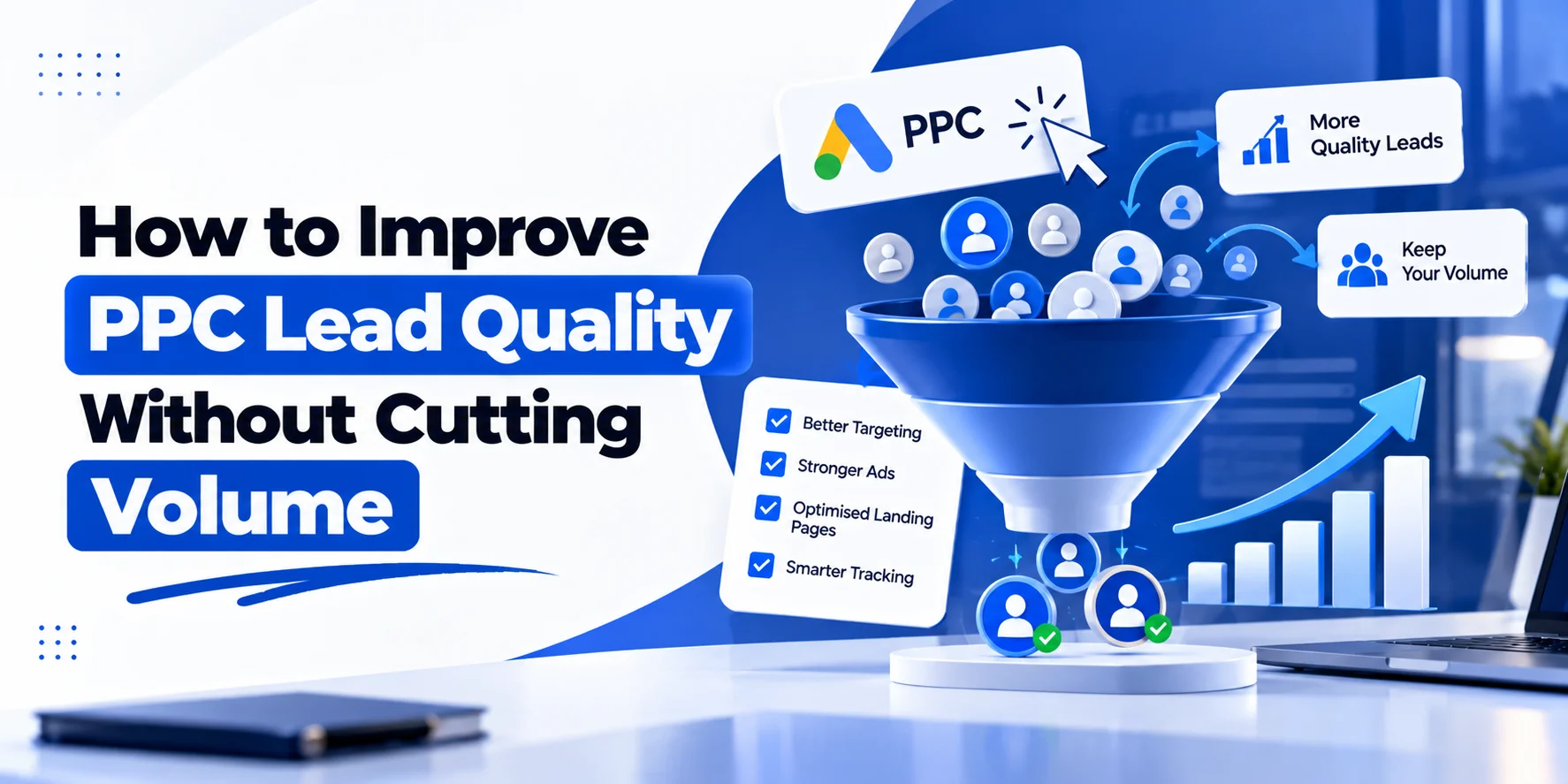
The better goal is to Improve PPC Lead Quality while keeping enough volume to grow. That requires a feedback loop between targeting, ads, landing pages, forms, sales and customer outcomes.
Why PPC Lead Quality Goes Wrong
Poor lead quality usually comes from several parts of the funnel.
Problems may include:
- broad search intent;
- weak ad qualification;
- unclear landing pages;
- forms with no filtering;
- incorrect conversion goals;
- poor sales feedback.
Marketing may see:
40 conversions
while sales sees:
8 useful opportunities
If Google Ads learns from all 40 equally, it may keep finding more people who behave like the weak leads.
That is why better measurement is central when you want to Improve PPC Lead Quality.
Define a Good Lead First
Before changing campaigns, agree on what a qualified lead actually means.
Imagine a London builder.
A strong lead may need to:
- be within the service area;
- want an extension or large renovation;
- have a realistic budget;
- own a suitable property;
- plan to start within a reasonable timeframe.
A form submission that fails most of those checks is still technically a conversion.
Commercially, it may be worth very little.
Define qualification with sales first.
Then optimise PPC around that definition.
Raw Leads and Qualified Leads Are Different
Consider:
| Campaign | Leads | CPL | Qualified Leads | Cost per Qualified Lead |
| Campaign A | 50 | £35 | 10 | £175 |
| Campaign B | 30 | £55 | 22 | £75 |
Campaign A looks better on raw CPL.
Campaign B produces more useful opportunities.
This is why cheap leads can become expensive.
To Improve PPC Lead Quality, judge campaigns against business outcomes rather than the easiest conversion Google can find.
Build a Marketing-to-Sales Feedback Loop
A better PPC process looks like:
Search → Ad → Landing Page → Lead → Sales Qualification → Customer Outcome → PPC Feedback
Weak accounts often stop at:
Search → Ad → Form
That leaves Google Ads blind to what happened afterwards.
A strong process brings sales outcomes back into campaign decisions.
Capture the PPC Source
When a lead enters the business, keep enough information to understand where it came from.
Useful fields may include:
- campaign;
- ad group;
- keyword or search context;
- landing page;
- click identifier;
- device;
- form or call source.
You do not need every possible field.
You need enough to connect later sales outcomes with the marketing source.
Record Lead Quality in the CRM
Do not mark every enquiry simply as:
Lead
Use clearer stages such as:
- New;
- Qualified;
- Not qualified;
- Quote sent;
- Appointment booked;
- Customer won;
- Customer lost.
Also record why weak leads were rejected.
Examples:
- wrong service;
- outside area;
- low budget;
- job seeker;
- spam;
- duplicate;
- not ready;
- unable to contact.
That turns vague complaints into useful PPC data.
Feed Better Outcomes Back Into Google Ads
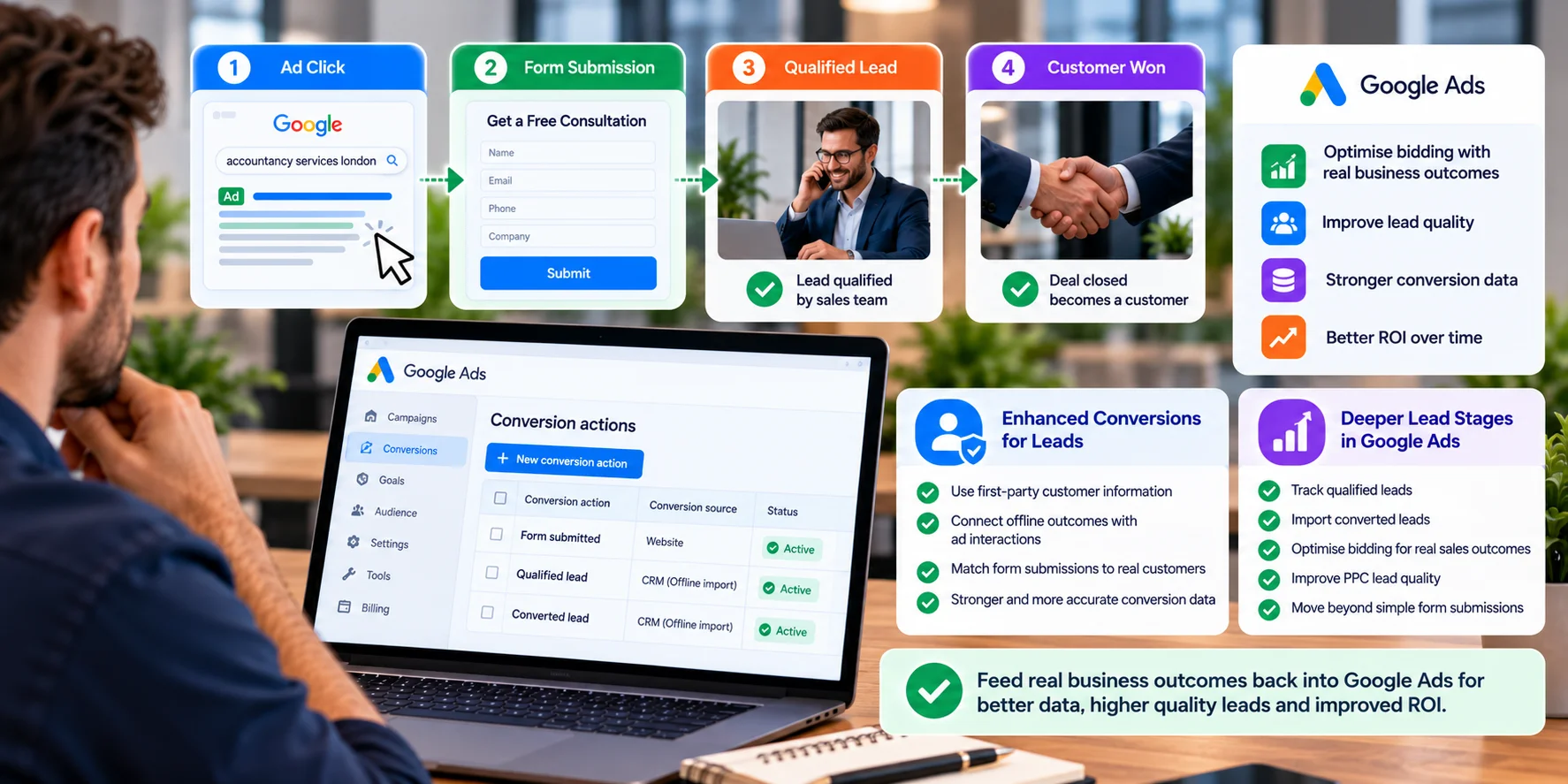
Google Ads supports deeper lead stages such as qualified leads and converted leads.
Google’s qualified and converted lead guidance explains how advertisers can connect online enquiries with later sales outcomes.
Instead of teaching Google only:
Form submitted
you can move towards stronger signals such as:
Qualified lead
or:
Customer won
where the setup supports it.
That can help Improve PPC Lead Quality because bidding receives a signal closer to the real business result.
Enhanced Conversions for Leads
Google’s enhanced conversions for leads guidance explains how first-party customer information can help connect later offline outcomes with earlier ad interactions.
For example:
- Someone clicks an advert.
- They submit a form.
- Sales qualifies them.
- They become a customer later.
Where implemented correctly, that final outcome can be connected back to the original ad interaction.
This gives PPC stronger data than raw form submissions alone.
Do Not Train Smart Bidding on Bad Leads
Smart Bidding optimises towards the signals you provide.
If every form submission is a primary conversion, Google may simply find more people likely to submit forms.
It does not automatically know which leads your sales team actually wants.
Imagine:
- 20 strong leads come from commercial searches;
- 40 poor leads come from cheaper general searches.
If all 60 have equal value, the cheaper traffic may look more attractive to the algorithm.
Poor measurement can therefore train Google to chase poor leads.
Make Conversion Goals Match the Business Goal
A lead-generation account might track:
- form start;
- phone click;
- form submitted;
- qualified lead;
- customer won.
These actions are not equally valuable.
Use the strongest available commercial outcome for optimisation where data quality and volume support it.
Do not make every measurable action a primary conversion.
Use Conversion Values Carefully
Value-based bidding can make sense when different outcomes genuinely have different values.
For example:
- basic enquiry = lower value;
- qualified lead = higher value;
- customer won = actual sale value.
Do not invent arbitrary numbers simply to use Target ROAS or Maximise Conversion Value.
Bad values create bad optimisation.
Use Search Terms to Improve PPC Lead Quality
Sales feedback tells you what happened.
Search terms help explain why.
Imagine an accountant targets:
business accountant
The search terms show:
- accountant jobs London;
- accounting course;
- free accounting advice;
- accountant salary UK;
- small business accountant London;
- limited company accountant.
Some searches have strong commercial intent.
Others were unlikely to become customers.
Use this data to Improve PPC Lead Quality at the traffic level.
Use Negative Keywords Carefully
Negative keywords are useful.
Aggressive exclusions can also remove good demand.
Suppose a builder receives poor leads from:
cheap extension
Adding:
cheap
as a negative may seem sensible.
But a good prospect may still start with:
cheap extension builders near me
before learning what a realistic project costs.
Review:
- search patterns;
- spend;
- CRM rejection reasons;
- qualified leads;
- customers.
Negatives should follow evidence.
Search-Term Example: Locksmith
| Search Term | Leads | Qualified | Result |
| emergency locksmith Chelsea | 8 | 7 | Strong |
| locksmith near me | 10 | 6 | Mixed |
| locksmith jobs London | 6 | 0 | Exclude |
| locksmith training | 4 | 0 | Exclude |
| uPVC lock repair | 7 | 6 | Strong |
Jobs and training are obvious exclusions.
Locksmith near me still produces useful business.
Blocking it completely could reduce valuable volume.
That is the difference between filtering and over-filtering.
Separate Keyword Problems From Landing-Page Problems
Sometimes the search term is fine.
The page is the problem.
Imagine someone searches:
commercial roofer London
The advert is relevant.
The landing page says:
Roofing for Homes and Businesses
Now residential users may also feel encouraged to enquire.
The keyword may be fine.
The landing-page positioning may be too broad.
Our PPC Landing Page Checklist explains how message match and qualification can improve ppc lead quality before the form.
Use Ad Copy to Qualify Before the Click
You pay after the click.
That means advert wording can help poor-fit users self-select out.
Compare:
Landscaping Services London | Free Quote
with:
Premium Garden Design London | Projects From £15k
The second advert may receive fewer clicks.
That can be useful if low-budget users were never likely to become customers.
The goal is not maximum CTR.
It is attracting plausible buyers.
Useful Ad Qualifiers
Depending on the business, useful qualifiers may include:
- commercial only;
- projects from £X;
- minimum hire period;
- London businesses;
- limited companies;
- B2B only;
- same-day emergency service.
Use only qualifiers that genuinely affect whether someone can buy.
Do Not Over-Qualify Ads
Qualification can go too far.
An advert saying:
Extensions Over £50k Only | London Homeowners | Start Within 60 Days
may exclude good customers who have not decided their exact budget or timing.
Use enough information to remove obvious bad fits.
Do not turn the advert into an application form.
Use Forms to Improve PPC Lead Quality
Forms can help sales identify better prospects.
For high-value services, useful fields may include:
- service required;
- postcode;
- budget;
- timeframe;
- property type;
- company size.
This adds some friction.
Useful friction is not automatically bad.
Useful Friction vs Bad Friction
Useful friction helps determine fit.
Bad friction creates work without helping qualification.
A commercial construction company may genuinely need:
- project value;
- location.
It probably does not need:
- fax number;
- full postal address;
- twenty project questions
before the first conversation.
Every required field should have a purpose.
Form Example: Accountant
An accountant wants limited-company clients but receives personal-tax enquiries.
Instead of asking only:
- Name;
- Email;
- Message,
add:
Business Type
Options:
- Limited company;
- Sole trader;
- Partnership;
- Other.
One useful field can improve qualification considerably.
Form Example: Builder
An extension builder may ask:
- postcode;
- property type;
- approximate budget;
- expected start date.
These fields can filter tiny repair jobs without creating an unnecessarily long form.
Form Example: Chauffeur Business
Useful questions may include:
- journey type;
- pickup;
- destination;
- date;
- passengers;
- vehicle preference.
These help both qualification and operations.
Unrelated questions only create friction.
Landing-Page UX Still Matters
Improving qualification does not mean making the page difficult.
Common UX problems include:
- unclear CTA;
- poor mobile layout;
- confusing navigation;
- weak proof;
- form errors;
- intrusive popups.
Good prospects should still find it easy to enquire.
Landing-Page Speed Still Matters
A strong form is useless if mobile visitors leave before the page loads.
Our How Landing Page Speed Affects PPC Cost and Conversion guide explains how performance can affect paid traffic.
Qualification should come from commercial fit.
Not from user patience.
Use Audience Data With Commercial Context
Do not rely on vague assumptions about ideal customers.
Useful customer characteristics may include:
- service type;
- company size;
- location;
- purchase value;
- industry;
- repeat status;
- lifetime value.
That is stronger than unsupported personas.
PPC should learn from actual customer patterns.
Location Quality Can Differ
Lead quality may change by area.
Suppose campaigns target:
- London;
- Reading;
- Milton Keynes.
Do not compare only lead volume.
Compare:
- qualified-lead rate;
- close rate;
- customer value;
- acquisition cost.
Cheap forms do not automatically mean profitable customers.
Device Quality Can Differ
Mobile may generate more calls.
Desktop may produce larger form enquiries.
There is no universal answer.
Where enough data exists, compare:
- lead volume;
- qualified rate;
- sales;
- customer value
by device.
Time of Day Can Affect Lead Quality
Late-night traffic may generate:
- urgent real enquiries;
- spam;
- job seekers;
- low-intent forms.
Do not automatically switch campaigns off.
Check the real customer outcomes first.
Marketing and Sales Need the Same Definitions
Marketing may define a lead as:
Form submitted
Sales may define a lead as:
Someone we would quote
Management may care about:
Paying customer
These are different stages.
Name them clearly:
- Conversion;
- Marketing-qualified lead;
- Sales-qualified lead;
- Opportunity;
- Customer.
Shared definitions make it much easier to Improve PPC Lead Quality.
Build a Lead-Quality Reason List
When sales rejects an enquiry, record why.
Keep the categories simple.
Examples:
- Wrong service;
- Outside location;
- Budget too low;
- Job seeker;
- Spam;
- Duplicate;
- Not ready;
- Unable to contact.
Then instead of saying:
“PPC leads are bad.”
you can say:
“31% of rejected PPC leads were outside our service area.”
That gives marketing a specific problem to fix.
Match the Fix to the Problem
Different lead problems require different fixes.
Job Seekers
Review:
- negative keywords;
- ad copy;
- landing-page wording.
Low Budgets
Review:
- minimum pricing;
- ad qualification;
- form budget field.
Wrong Locations
Review:
- location targeting;
- service-area wording;
- postcode field.
Wrong Services
Review:
- keyword structure;
- ad copy;
- landing-page message.
Relevant Leads but Nobody Answers
That may be a sales-process problem rather than a PPC problem.
Do not use one solution for every lead-quality issue.
Missed Calls Can Look Like Poor PPC
Suppose Google Ads produces 40 relevant phone enquiries.
The business answers 22.
Sales later says PPC created very few customers.
The traffic may be fine.
The missed-call rate may be the real problem.
Marketing cannot close a call nobody answers.
Sales Follow-Up Matters
A good enquiry can become a “bad lead” if nobody replies for three days.
When reviewing rejected leads, ask:
- Was the lead contacted?
- How quickly?
- How many attempts were made?
- Was qualification consistent?
Do not train Google Ads on poor internal follow-up as if advertising caused it.
Avoid Optimising Only for Cheap CPL
Imagine:
Campaign A
- Spend: £2,000
- Leads: 100
- Qualified: 10
- Customers: 2
CPL:
£20
Customer acquisition cost:
£1,000
Campaign B
- Spend: £2,000
- Leads: 40
- Qualified: 25
- Customers: 10
CPL:
£50
Customer acquisition cost:
£200
Campaign B has the worse CPL.
It has far better economics.
That is why a low CPL is not enough when you want to Improve PPC Lead Quality.
Use Cost per Qualified Lead
When revenue takes longer to appear, cost per qualified lead can be a useful middle metric.
Formula:
PPC spend ÷ qualified leads
It is not the final KPI.
But it is usually more useful than raw CPL when lead quality varies.
Customer Acquisition Cost Goes Further
Once customers can be connected back to campaigns:
PPC spend ÷ customers = customer acquisition cost
Then compare CAC with:
- average order value;
- gross profit;
- repeat value;
- lifetime value.
That turns PPC optimisation into a business discussion.
Do Not Change Bidding Too Early
Poor lead quality often causes marketers to jump straight to another bidding strategy.
That can be premature.
Before switching, ask:
- Are conversion actions correct?
- Are qualified outcomes imported?
- Are values credible?
- Is tracking clean?
- Is there enough reliable data?
Changing bidding before fixing measurement can simply automate the wrong signal faster.
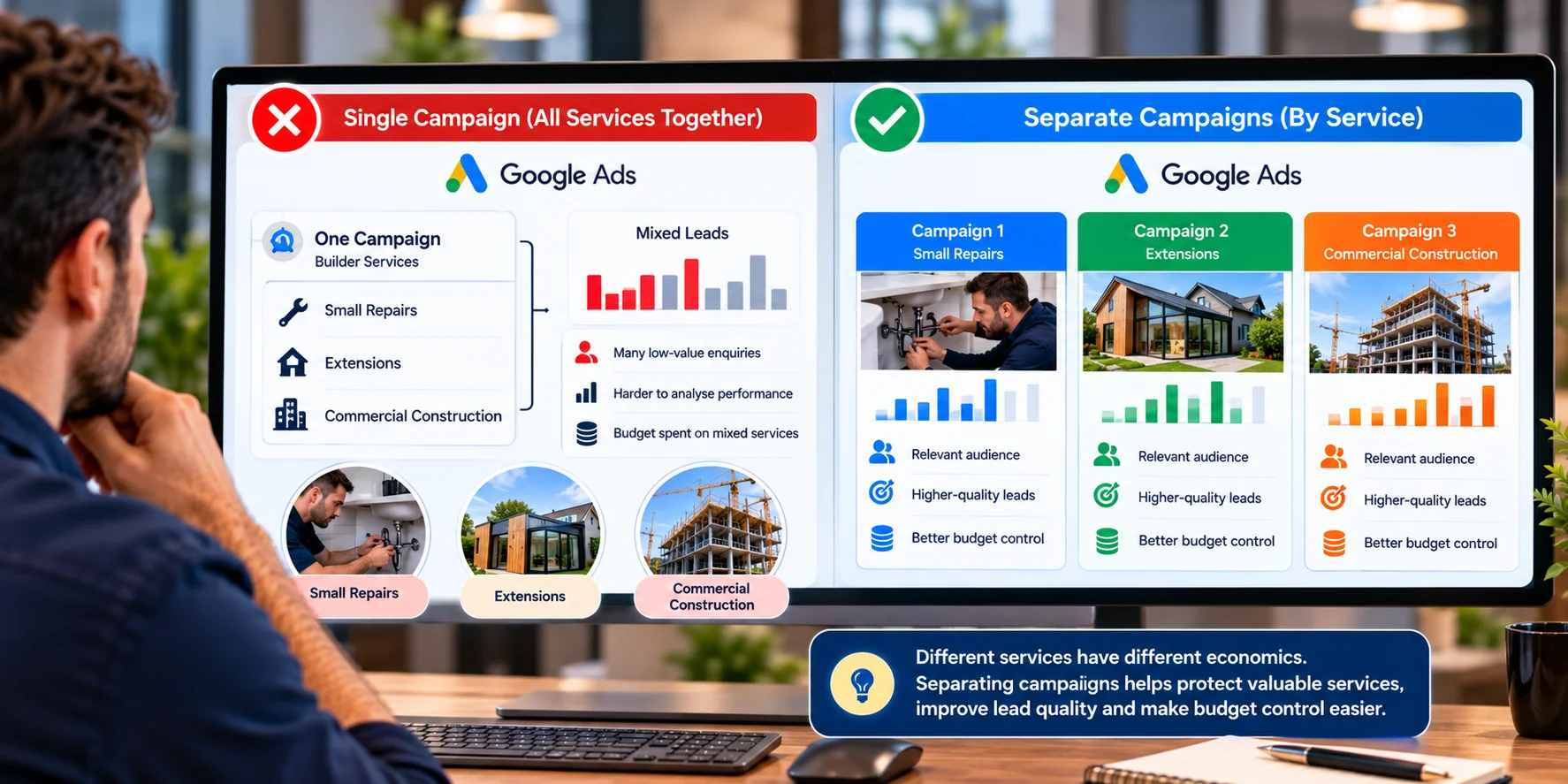
Campaign Structure Can Protect Valuable Services
Different services may have different economics.
A builder may advertise:
- small repairs;
- extensions;
- commercial construction.
If all three sit in one campaign, cheaper low-value conversions may distort performance.
Separating them can make lead-quality analysis and budget control easier.
Do Not Kill Broad Match Automatically
Broad match can produce poor queries.
It can also find valuable demand.
Before pausing it, review:
- search terms;
- qualified leads;
- customer outcomes;
- negative keywords;
- bidding;
- campaign maturity.
If broad match produces profitable customers alongside some noise, improve control around it rather than removing all reach.
Do Not Over-Narrow Locations
The same applies to geography.
If London performs best, that does not mean every surrounding area should be removed.
Some locations may still produce profitable customers.
Cut waste.
Keep useful reach.
How to Improve PPC Lead Quality Without Cutting Volume
Work through the funnel in order.
1. Remove Obvious Irrelevant Traffic
Exclude repeated job, training, DIY and wrong-service intent when the evidence is clear.
2. Improve the Advert
Make the service, audience and important requirements obvious.
3. Improve the Landing Page
Strengthen message match, proof, service boundaries and mobile UX.
4. Add Useful Form Qualification
Ask only for information sales genuinely needs.
5. Record Sales Outcomes
Track which leads were qualified, rejected, quoted and won.
6. Feed Better Outcomes Back
Use qualified and converted lead data where possible.
7. Adjust Bidding After Measurement Improves
Use value-based optimisation only when the underlying data is trustworthy.
This process can Improve PPC Lead Quality without unnecessarily closing the funnel.
The Improve PPC Lead Quality Framework
Use five stages.
Stage 1: Attract
Are keywords and ads attracting plausible prospects?
Stage 2: Filter
Does the ad and landing page make customer fit clear?
Stage 3: Qualify
Does the form or call process collect useful commercial information?
Stage 4: Validate
Does sales record whether the enquiry was genuinely valuable?
Stage 5: Feed Back
Does the outcome return to marketing and Google Ads?
Then the cycle repeats.
This feedback loop is what many lead-generation accounts are missing.
Example: London Accountant
Search:
limited company accountant London
Advert:
Accountants for UK Limited Companies
Landing page:
Explains company accounts, Corporation Tax, VAT and ongoing support.
Form:
Asks business type and turnover range.
Sales:
Marks the enquiry as qualified or unsuitable.
Google Ads:
Receives the qualified-lead outcome where the setup supports it.
Now marketing can see whether the search theme creates useful business.
Example: Builder
Search:
house extension builder London
Advert:
Mentions extension projects and suitable scope.
Landing page:
Shows extension work, process and project context.
Form:
Asks postcode, budget and timeframe.
Sales:
Records fit and quote status.
CRM:
Records whether the job was won.
That gives PPC much stronger data than raw form count.
Improve PPC Lead Quality Scorecard
| Question | Healthy | Needs Work |
| Good lead is clearly defined | Yes | No |
| Sales records qualification | Yes | No |
| Search terms are reviewed | Yes | No |
| Negatives are evidence-led | Yes | No |
| Ads filter obvious poor fit | Yes | No |
| Landing page matches intent | Yes | No |
| Form qualifies intelligently | Yes | No |
| Calls are tracked | Yes | No |
| Qualified leads are measured | Yes | No |
| Customer outcomes link back | Yes | No |
| Bidding uses the right goals | Yes | No |
| Marketing and sales review together | Yes | No |
If several areas need work, changing bidding alone is unlikely to solve the problem.
Run a Short Marketing-to-Sales Review
A weekly or fortnightly review can answer:
- Which rejection reasons increased?
- Which campaigns produced the strongest qualified leads?
- Which search themes produced weak leads?
- Did any landing page create a quality issue?
- What should marketing change next?
This turns sales feedback into action.
Keep Feedback Categories Consistent
If salespeople use:
Bad
Junk
Not qualified
for the same issue, reporting becomes messy.
Use a small, consistent list.
The goal is useful analysis, not CRM bureaucracy.
Do Not Overreact to Small Samples
One poor lead does not prove a keyword is bad.
Three good leads do not prove a campaign is perfect.
Look for patterns.
High-value B2B accounts may need longer periods because lead volume is lower.
Emergency services may collect useful evidence faster.
Review Search Intent Before Cutting Volume
When quality falls, ask:
Are searches irrelevant?
or:
Are relevant searches producing weak prospects?
Those are different problems.
Irrelevant terms need traffic controls.
Relevant searches may need better:
- ads;
- landing pages;
- forms;
- sales feedback.
Do not use negative keywords to solve a landing-page problem.
Review the Form Before Cutting Keywords
If every visitor can submit an unqualified form, narrowing targeting may hide the real issue.
If the page never explains minimum project size and the form asks no qualifying questions, the campaign has very little help separating strong and weak prospects.
Fix the conversion journey too.
Review Sales Follow-Up Before Blaming PPC
If:
- the search was relevant;
- the ad matched;
- the prospect completed the correct form;
- the business never responded,
that is not a lead-quality failure.
It is a follow-up failure.
Review the entire journey.
Improve PPC Lead Quality to Improve Profit
The final goal is not a prettier Google Ads dashboard.
A healthier PPC system should aim for:
- enough traffic;
- sustainable lead volume;
- higher qualified-lead rate;
- stronger sales opportunities;
- sensible acquisition cost;
- more revenue or profit.
That is the real reason to Improve PPC Lead Quality.
How Wixdek Approaches to Improve PPC Lead Quality
At Wixdek, we would not try to Improve PPC Lead Quality simply by making every campaign smaller.
We would trace the problem through the funnel.
What did the user search?
Which ad did they see?
What did the landing page promise?
What did the form collect?
Why did sales accept or reject the enquiry?
Did the lead become a customer?
Once those answers connect, PPC becomes much easier to optimise.
The goal is not fewer leads.
It is fewer wasted leads while protecting valuable demand.
Need Help to Improve PPC Lead Quality?
If Google Ads reports plenty of conversions but sales keeps rejecting the enquiries, simply narrowing every campaign may hide the real problem.
Wixdek can review:
- search terms;
- negatives;
- campaign structure;
- ads;
- landing pages;
- forms;
- conversion tracking;
- CRM outcomes.
Our PPC agency in London service looks at the full lead journey rather than judging success from raw forms alone.
The aim is to Improve PPC Lead Quality while protecting useful demand.
Frequently Asked Questions
How can I Improve PPC Lead Quality?
Start by defining a good lead, recording sales outcomes, finding where weak leads enter the funnel, improving qualification and feeding better outcomes back into Google Ads.
Why are my PPC leads poor quality?
Common causes include irrelevant searches, weak ad qualification, broad landing-page messaging, poor forms, inaccurate conversion tracking and missing sales feedback.
Can I Improve PPC Lead Quality without reducing volume?
Often, yes.
Remove clearly poor-fit traffic while improving ads, landing pages, forms and sales feedback instead of simply narrowing everything.
Should I add more negative keywords?
Add negatives when repeated search-term data shows irrelevant intent.
Do not use them blindly because aggressive exclusions can remove useful demand.
Should I make my PPC form longer?
Only when extra fields genuinely help qualification.
Useful friction can improve ppc lead quality.
Pointless fields can reduce strong conversions.
Can ad copy improve PPC lead quality?
Yes.
Clear service requirements, audience wording, minimum budgets and genuine qualifiers can help unsuitable users self-select out before clicking.
What is a qualified lead?
A qualified lead is an enquiry that meets the business’s commercial criteria rather than simply submitting a form.
Should Google Ads optimise for qualified leads?
Where tracking quality and conversion volume support it, deeper outcomes can give Smart Bidding better signals than raw forms.
Can value-based bidding improve ppc lead quality?
It can help when conversion values reflect genuine business differences.
It cannot fix weak tracking or invented values.
How do I measure PPC lead quality?
Useful measures include:
- qualified-lead rate;
- cost per qualified lead;
- sales rate;
- customer acquisition cost;
- revenue;
- customer value.
Can cheap PPC leads be bad?
Yes.
A cheap lead can be expensive if very few become qualified opportunities or customers.
How should sales help Improve PPC Lead Quality?
Sales should record why leads were accepted or rejected and whether they became quotes, opportunities or customers.
Marketing can then use that data to improve campaigns.
How often should PPC lead quality be reviewed?
The right frequency depends on lead volume.
Weekly or fortnightly reviews can work well for active lead-generation accounts.
Should I pause a keyword after one bad lead?
Usually not.
One enquiry is a very small sample.
Look for repeated patterns first.
What is the best way to Improve PPC Lead Quality?
Build a feedback loop between search intent, adverts, landing pages, forms, sales qualification and customer outcomes.
Then use that evidence to remove waste without unnecessarily cutting valuable demand.
By Wixdek