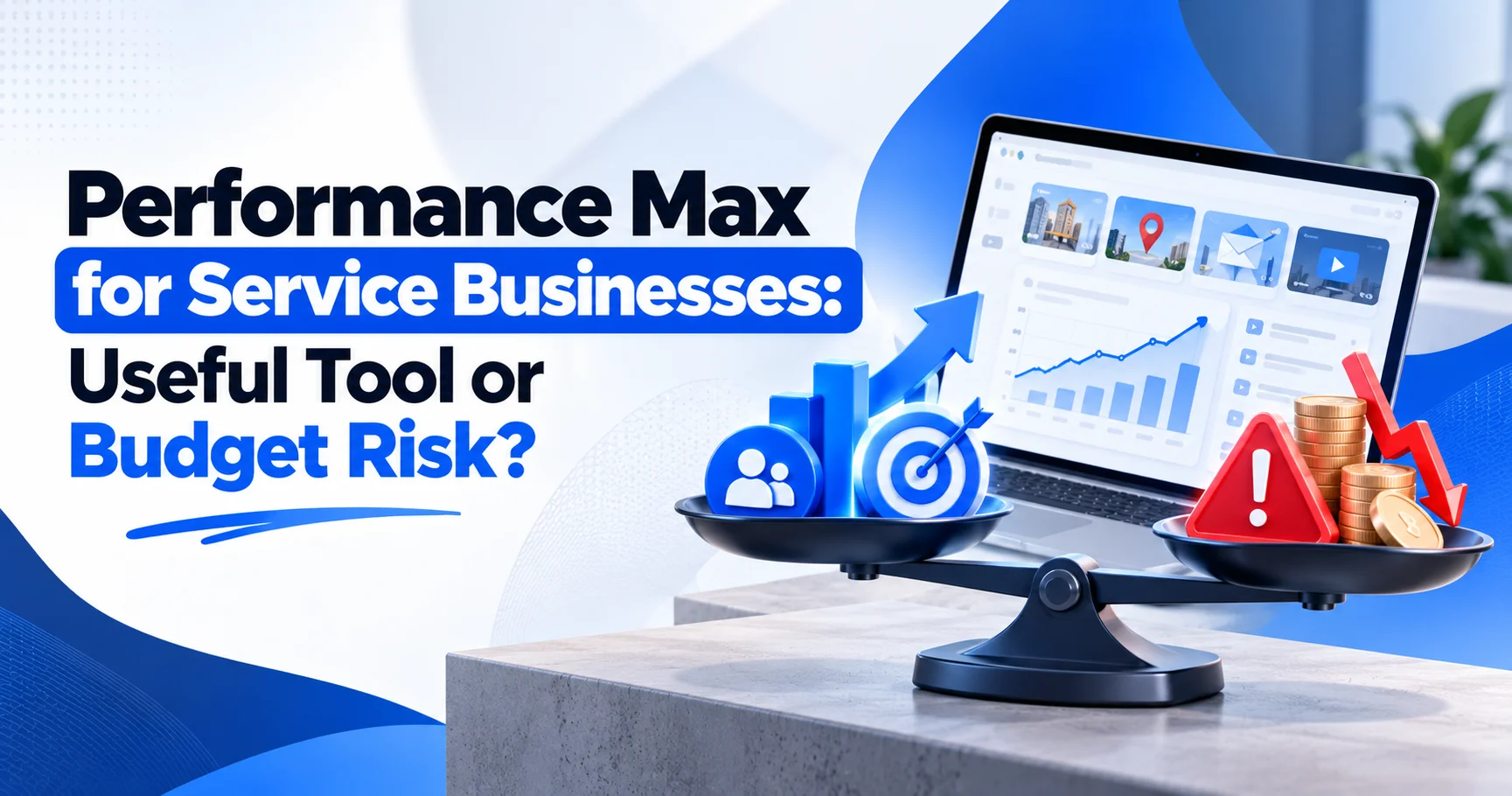
Performance Max for Service Businesses can be useful, but only when the account is ready for more automation.
One campaign can reach people across Search, YouTube, Display, Discover, Gmail and Maps while Google automates bidding, targeting and creative combinations.
That wider reach is the attraction.
It is also the risk.
For locksmiths, accountants, roofers, chauffeur companies and other lead-generation businesses, the real question is not whether Performance Max for Service Businesses is good or bad.
It is whether the account has:
- reliable conversion tracking;
- useful lead-quality data;
- enough budget;
- strong creative;
- relevant landing pages;
- clear commercial goals.
This guide explains when Performance Max for Service Businesses makes sense, when Search deserves priority and how to test PMax without wasting budget.
What Is Performance Max?
Performance Max, often called PMax, is a goal-based Google Ads campaign type.
It can serve across:
- Search;
- YouTube;
- Display;
- Discover;
- Gmail;
- Maps.
Google uses automation across bidding, targeting and creative delivery.
Its official Performance Max campaign overview explains how advertisers can provide conversion goals, images, video, text, audience signals, search themes and landing pages.
Google then uses those inputs to find conversion opportunities.
That wider reach is what makes Performance Max for Service Businesses attractive.
Performance Max Is Not a Replacement for Search
A common mistake is assuming:
“Performance Max for Service Businesses reaches more channels, so it must be better than Search.”
Search and PMax do different jobs.
Search gives stronger control over:
- keywords;
- search intent;
- ad groups;
- service themes;
- landing pages.
Performance Max gives Google more freedom to find opportunities across multiple channels.
For many service businesses, PMax works better as an expansion campaign than as an automatic replacement for profitable Search activity.
Search vs Performance Max for Service Businesses
| Area | Search Campaign | Performance Max |
| Main strength | Captures known search intent | Finds opportunities across channels |
| Keyword control | Strong | More automated |
| Channel reach | Mainly Search | Search, YouTube, Display, Maps, Gmail and more |
| Creative needs | Mainly text | Text, images and video |
| Automation | Moderate | High |
| Best fit | Proven high-intent demand | Expansion beyond proven demand |
| Main risk | Missing wider opportunities | Spending broadly with weak signals |
Neither campaign type automatically wins.
The better option depends on the account.
When Performance Max for Service Businesses Can Work Well
PMax becomes more attractive when the rest of the account is already healthy.
Imagine a London accountant with profitable Search campaigns around:
- small business accountant London;
- limited company accountant;
- tax accountant London.
The campaigns generate qualified enquiries.
Tracking works.
The business knows its normal cost per lead and which enquiries become customers.
That is a strong environment for testing Performance Max for Service Businesses.
You are asking automation to find additional customers.
You are not asking it to fix a weak PPC setup.
When Performance Max for Service Businesses Becomes a Budget Risk
PMax becomes much riskier when the account has:
- broken tracking;
- generic landing pages;
- little conversion history;
- weak creative;
- a very small budget;
- no lead-quality measurement.
Adding more automation does not fix those problems.
It simply gives Google more places to spend while providing weak information about what a valuable customer looks like.
Google’s Performance Max lead-generation guidance recommends stronger measurement and deeper lead outcomes where possible.
For service businesses, a qualified lead is more useful than a simple form submission.
A paying customer is better still.

Check Conversion Tracking First
Before launching Performance Max for Service Businesses, check what the account currently treats as a conversion.
Suppose all of these are primary conversions:
- contact-page visits;
- phone-button clicks;
- form starts;
- completed forms;
- qualified leads.
They do not have equal business value.
If Google is told they are equally important, the campaign may optimise towards the easiest action rather than the best customer.
Stronger signals include:
- completed forms;
- qualified calls;
- booked appointments;
- sales-qualified leads;
- converted customers.
The closer your tracking gets to real commercial value, the better information automation receives.
Performance Max for Service Businesses Readiness Checklist
Before launching PMax, ask:
Is Tracking Reliable?
Test forms, calls and bookings.
Do not assume tracking works because a conversion action exists.
Can You Measure Lead Quality?
If every enquiry is treated equally, automation has weaker information.
Do You Have Recent Conversion Data?
There is no universal magic number.
But regular verified conversions provide more useful signals than one lead every few months.
Is There Spare Budget?
Do not starve a profitable Search campaign just to fund a PMax test.
Do You Have Good Creative?
Performance Max for Service Businesses needs more than text.
Strong images and video matter.
Can the Business Handle More Leads?
More enquiries are pointless if calls go unanswered or follow-up is poor.
If several answers are no, fix those areas first.
Search Still Matters for High-Intent Services
Some searches show very clear intent.
For example:
emergency locksmith Mayfair
A Search campaign can match that journey closely.
The ad can focus on the exact service and location.
The landing page can explain:
- response process;
- coverage;
- contact details;
- pricing approach;
- service information.
That level of control can be valuable for urgent or high-value services.
Our guide on how to structure Google Ads Search campaigns explains how to organise service themes around intent.
Does Performance Max Take Traffic From Search?
The answer is more nuanced than a simple yes or no.
Search and PMax can both become eligible around similar demand.
Google uses campaign-prioritisation rules.
Its Search and Performance Max prioritisation guidance explains how eligibility can depend on exact-match keywords, relevance and Ad Rank.
So:
“PMax always steals traffic from Search”
is too simplistic.
Monitor Search after launching PMax.
The better question is whether the combined setup generates more qualified business.
Protect Budget-Limited Search Campaigns
If your strongest Search campaign is already limited by budget and consistently produces good leads, taking money away from it to fund PMax may be a poor trade.
Before testing wider automation, check whether proven Search demand deserves more funding.
Our guide on how to set a Google Ads budget without guessing explains how CPC, conversion rate and customer value should guide budget decisions.
Use Search Themes Carefully
Performance Max does not use positive keywords in the same way as Search campaigns.
Advertisers can provide search themes instead.
A chauffeur business might use:
- Heathrow chauffeur service;
- corporate chauffeur London;
- executive airport transfer;
- private chauffeur hire.
These help Google understand the type of demand the business values.
They are still signals, not traditional keyword targeting.
If you need tight control around a small number of valuable searches, Search may remain stronger.
Negative Keywords Give More Control
Older advice often says PMax gives advertisers almost no search exclusion control.
That is outdated.
Google supports campaign-level negative keywords for Performance Max, while account-level negatives can also apply across relevant inventory.
Google’s Performance Max negative keyword documentation explains the current setup.
Useful exclusions might include:
- chauffeur jobs;
- plumbing training;
- accountant salary;
- free courses;
- irrelevant products.
Do not overbuild negative lists.
The goal is to protect the budget without blocking valuable demand.
Reporting Has Improved
Performance Max reporting is more transparent than it used to be.
Google provides channel-level reporting across areas such as:
- Search;
- Display;
- YouTube;
- Discover;
- Gmail;
- Maps.
Its Performance Max reporting guidance covers channel performance, placements, search terms, landing pages and creative insights.
This gives advertisers more visibility.
It does not make PMax fully manual.
Lead Quality Matters More Than CPL
Consider this example:
| Campaign | Leads | CPL | Qualified Leads | Customers |
| Performance Max | 60 | £40 | 10 | 2 |
| Search | 30 | £70 | 22 | 10 |
PMax has the cheaper CPL.
Search produces far more customers.
That is why Performance Max for Service Businesses should not be judged by reported conversions alone.
Cheap leads are not automatically valuable leads.
Spam Leads Can Distort PMax
Spam and poor-quality enquiries can damage automated campaigns.
The loop can become:
Poor lead → recorded as conversion → automation learns from it → more similar leads
The conversion count may rise while sales quality falls.
Useful controls can include:
- form validation;
- qualifying questions;
- call-quality rules;
- deeper lead-status tracking.
Fix measurement before blaming the campaign type.
Example: London Accountant
Imagine an accountancy firm already has profitable Search campaigns.
It tracks:
- completed forms;
- booked consultations;
- qualified leads;
- converted clients.
The business also has budget available to test wider demand.
That is a reasonable environment for Performance Max for Service Businesses.
A PMax asset group could focus on small-business accountancy with:
- service-specific headlines;
- useful images;
- a relevant landing page;
- clear conversion goals.
Then ask:
Did PMax generate additional qualified clients?
That is the test that matters.
Example: Emergency Locksmith
Now imagine an emergency locksmith with a £40 daily budget.
Search already uses the full budget and generates useful calls.
The account also has:
- weak call-quality tracking;
- little historical data;
- limited creative.
Taking half the Search budget to fund PMax may weaken the campaign that already works.
A better sequence is:
- Improve tracking.
- Review lead quality.
- Optimise Search.
- Check whether Search deserves more budget.
- Test PMax when budget becomes available.
That is sensible sequencing, not anti-PMax.
Example: Chauffeur Company
A chauffeur company may be a stronger PMax candidate because the service works well with visual assets.
Search can capture direct demand such as:
- Heathrow chauffeur service;
- corporate chauffeur London;
- private chauffeur hire.
Performance Max can support broader discovery with:
- fleet photography;
- chauffeur pickup images;
- airport imagery;
- luggage handling;
- service videos.
Strong creative gives automation better material than a logo and generic stock imagery.
Asset Quality Matters
Performance Max needs stronger creative depth than Search.
Useful assets include:
- real service photography;
- project images;
- clear headlines;
- strong descriptions;
- short video;
- relevant landing pages.
Do not fill asset slots just because they exist.
Each asset should help a potential customer understand the service.
Build Asset Groups Around Clear Services
Imagine a construction company offers:
- extensions;
- loft conversions;
- roofing;
- commercial construction.
One asset group called:
Trusted Building Services
is too broad.
A roofing asset group could instead use:
- roofing photography;
- roofing landing pages;
- repair-focused headlines.
You are not removing automation.
You are giving it clearer inputs.
Search or Performance Max First?
For many small service businesses, Search is the simpler starting point.
Someone searching:
boiler repair Chelsea
already shows strong commercial intent.
Once Search generates reliable lead and sales data, Performance Max for Service Businesses becomes easier to test properly.
There is no fixed rule saying Search must run for a certain number of months.
Judge readiness by account quality.
How Long Should You Test Performance Max?
Do not make a final decision after only a few days.
PMax needs enough stable data to respond to your goals.
But obvious problems should still be fixed quickly.
Examples include:
- broken tracking;
- incorrect landing pages;
- spam conversions;
- wrong goals.
Avoid rebuilding the campaign every few days.
Use a meaningful test period and judge qualified commercial results.
Do Not Test With Money You Cannot Afford to Learn With
Testing costs real money.
Suppose your total budget is £2,000 per month and profitable Search campaigns already use £1,800.
Moving £1,000 away from Search just to test PMax creates a large opportunity cost.
A smaller controlled test may be more sensible.
The right amount depends on:
- CPC;
- CPA;
- conversion rate;
- customer value;
- available budget.
Our Google Ads bidding strategies guide explains how bidding choices affect this decision.

Give PMax the Right Bidding Goal
Performance Max uses automated bidding.
For lead generation, conversion-focused bidding may make sense.
For accounts with reliable value data, value-based bidding may be stronger.
Targets still need to reflect reality.
If qualified leads normally cost £80, setting a £25 target does not magically produce £25 leads.
Automation does not remove business economics.
Use Sales Feedback
Google knows someone submitted a form.
Your sales team knows whether that person:
- wanted the right service;
- lived in the right area;
- had the right budget;
- answered follow-up calls;
- became a customer.
Connect those two sets of information where possible.
Sales feedback gives Performance Max for Service Businesses a stronger definition of a valuable lead.
Audience Signals Are Not Hard Targeting
Audience signals can help Google understand likely customer characteristics.
But PMax can explore beyond them.
That can expand reach.
It also means advertisers have less rigid audience control than they may expect.
Use audience signals to guide automation, not as strict targeting rules.
When Search Deserves Priority
Search may deserve priority when:
- budget is tight;
- geographic coverage is strict;
- conversion data is weak;
- services have very different values;
- a small number of queries drive most sales.
Examples include:
- emergency locksmiths;
- specialist legal work;
- Heathrow chauffeur services;
- structural engineering;
- high-value private services.
These are reasons to build control first, not permanent reasons to avoid PMax.
When Performance Max for Service Businesses Is More Attractive
Performance Max for Service Businesses becomes stronger when:
- Search campaigns are healthy;
- tracking is reliable;
- lead quality is measured;
- conversion volume is steady;
- strong creative exists;
- testing budget is available;
- sales teams can handle more enquiries.
That is a much better reason to launch than simply following an automation trend.
Performance Max Readiness Scorecard
| Account Condition | Ready | Needs Work |
| Main conversions tested | Yes | No |
| Lead quality measured | Yes | No |
| Search performance understood | Yes | No |
| Extra budget available | Yes | No |
| Landing pages convert well | Yes | No |
| Strong images available | Yes | No |
| Useful video available | Yes | No |
| Service priorities clear | Yes | No |
| Sales feedback available | Yes | No |
If most answers fall under Needs Work, fix those areas first.
PMax should scale a working system.
It should not be expected to build one from scratch.
How to Test Performance Max Without Losing Control
Start with one clear goal.
Do not launch asset groups for every service immediately.
A chauffeur company could test airport transfers first.
Use:
- one main conversion goal;
- service-specific creative;
- a relevant landing page;
- a realistic budget;
- existing Search campaigns for comparison.
Then ask:
Did PMax produce additional qualified business at an acceptable cost?
Do not judge the test by impressions alone.
Use Experiments Where Useful
Google provides Performance Max experiments that can help measure additional conversion or conversion-value lift.
This gives a stronger comparison than simply looking at one month before and one month after launch.
Seasonality, demand and competitor activity can all affect performance.
Controlled testing reduces guesswork.
Metrics That Matter
Clicks, CTR, impressions and reported conversions can explain campaign behaviour.
For service businesses, stronger metrics include:
- qualified leads;
- cost per qualified lead;
- appointments;
- sales;
- customer acquisition cost;
- customer value;
- revenue.
A campaign can look good inside Google Ads while producing little useful business.
Should Search and Performance Max Run Together?
Often, yes.
Search can capture known high-intent demand.
PMax can test wider multi-channel opportunities.
The important thing is giving each campaign a clear purpose.
If nobody can explain why both campaigns exist, the setup needs reviewing.
Should PMax Replace Search Completely?
For many service businesses, that should not be the default starting point.
Search gives strong control around known commercial intent.
If those searches already produce profitable customers, removing them simply because PMax is newer makes little sense.
Replacement should follow evidence.
Should a New Service Business Start With PMax?
It can, but it is not automatically the best first campaign.
New accounts often have:
- little conversion history;
- limited sales feedback;
- weak lead-quality data.
Focused Search campaigns can make early learning easier.
Once the account understands what a good lead looks like, broader automation becomes easier to judge.
Should a Mature Service Business Test PMax?
A mature account is often a stronger candidate.
It may already know:
- average qualified-lead cost;
- strongest services;
- best locations;
- customer value;
- conversion rate;
- sales close rate.
Now Performance Max for Service Businesses can be tested against a known baseline instead of being judged in the dark.
When Should You Pause a Test?
Investigate quickly if:
- lead quality falls;
- spam increases;
- tracking becomes unreliable;
- profitable Search volume drops unexpectedly;
- weak actions start driving bidding;
- landing pages mismatch services;
- stronger campaigns lose budget.
Do not stop PMax automatically.
Find the cause first.
When Should You Scale PMax?
Increasing budget becomes easier to justify when:
- qualified leads are valuable;
- CPA is sustainable;
- tracking is reliable;
- PMax creates additional customers;
- Search remains healthy;
- the business has capacity.
More spend should follow evidence.
Performance Max for Service Businesses: Decision Framework
Use this order:
1. Check Search
Are you already capturing important high-intent demand?
2. Check Tracking
Can conversion data be trusted?
3. Check Lead Quality
Can you separate useful leads from weak ones?
4. Check Creative
Do you have strong images, video and landing pages?
5. Check Budget
Can you test without starving proven campaigns?
6. Run a Controlled Test
Judge qualified customers, not impressions.
This is safer than launching Performance Max simply because the platform recommends it.
How Wixdek Approaches Performance Max for Service Businesses
At Wixdek, we would not recommend Performance Max simply because it uses more automation.
We would also not reject it just because Google controls more of the campaign.
The decision should come from the account.
If Search works, protect it.
If tracking is weak, fix it.
If creative is poor, improve it.
If lead quality is unclear, measure it.
Then decide whether wider automation has a clear commercial purpose.
A healthy account can use both Search and Performance Max for Service Businesses.
Need Help Deciding Whether Performance Max Fits?
If you are considering Performance Max for Service Businesses but do not know whether it will create additional customers or spread the budget too thinly, start with the foundations.
Wixdek can review:
- Search performance;
- conversion tracking;
- lead quality;
- landing pages;
- bidding;
- budget allocation.
Our PPC agency in London service focuses on measurable business outcomes rather than automation for its own sake.
The goal is not to run more campaign types.
It is to build the campaign mix that produces better customers.
Frequently Asked Questions
Is Performance Max for Service Businesses a Good Idea?
Yes, when tracking, lead-quality measurement, creative assets and budget are strong.
Is Performance Max Better Than Search?
Not automatically.
Search gives stronger control over known intent.
Performance Max gives wider automated reach.
Many businesses can use both.
Should a Small Local Business Use Performance Max?
It depends on budget and account maturity.
A small business with limited spend may get more value from proven Search demand first.
Does Performance Max Use Keywords?
Not in the same way as Search.
Advertisers can provide search themes to help Google understand valuable customer intent.
Can I Add Negative Keywords to Performance Max?
Yes.
Google supports campaign-level negative keywords for PMax and account-level exclusions across relevant inventory.
Can Performance Max Appear on Google Search?
Yes.
Search is one of the channels available to Performance Max.
Does Performance Max Use YouTube and Display?
Yes.
Performance Max can serve across Search, YouTube, Display, Discover, Gmail and Maps.
Can I See Which Performance Max Channels Are Being Used?
Yes.
Google provides channel-performance reporting.
Can Performance Max Generate Spam Leads?
Yes.
Reliable tracking and lead-quality controls are important because automated bidding learns from recorded conversions.
Should I Stop Search When Launching Performance Max?
Usually not.
Profitable Search campaigns can continue while PMax tests additional demand.
How Long Should I Test Performance Max?
Do not make a final decision after only a few days.
Give the campaign enough stable data to judge qualified leads and commercial outcomes.
Should I Use PMax if Search Is Limited by Budget?
Think carefully.
If Search already produces good customers and is budget-limited, funding proven demand may deserve priority.
Is Performance Max Useful for Lead Generation?
Yes, when conversion goals and lead-quality data are strong.
What Is the Biggest Risk of Performance Max for Service Businesses?
The biggest risk is giving a highly automated campaign weak inputs.
Poor tracking, weak lead-quality data, generic assets and insufficient budget can create plenty of activity without enough valuable customers.
By Wixdek