Choosing between Google Ads Bidding Strategies can feel confusing.
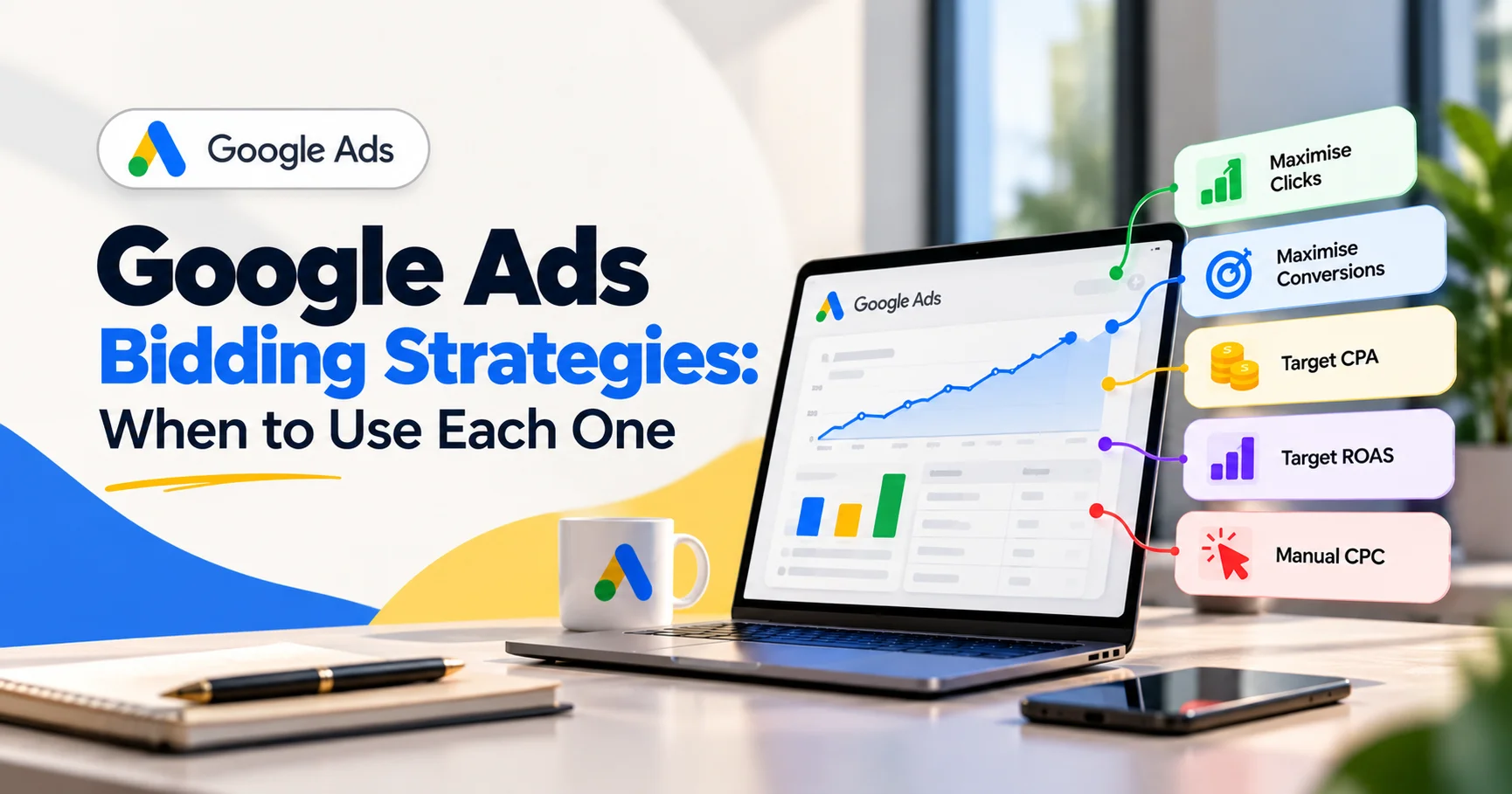
Manual CPC, Maximise Clicks, Maximise Conversions, Target CPA, Maximise Conversion Value, Target ROAS and Target Impression Share all serve different goals.
The right choice depends mainly on:
- campaign objective;
- conversion-data quality;
- conversion value;
- campaign maturity;
- budget.
A traffic strategy is not the same as a lead-generation strategy. Revenue-focused bidding also needs stronger value data than a campaign measuring simple enquiries.
This guide explains the main Google Ads Bidding Strategies, when each one can make sense and what to check before giving automation more control.
Google Ads Bidding Strategies at a Glance
| Strategy | Main Goal | Often Useful When |
| Manual CPC | Control individual bids | Testing or close manual control |
| Maximise Clicks | Generate traffic | Early research or traffic goals |
| Maximise Conversions | Generate more conversions | Tracking is reliable |
| Target CPA | Control average acquisition cost | CPA history is trustworthy |
| Maximise Conversion Value | Increase total conversion value | Values are reliable |
| Target ROAS | Aim for return on spend | Revenue or value data is strong |
| Target Impression Share | Increase visibility | Brand or visibility goals |
Google’s bid strategy guidance groups bidding around clicks, conversions, conversion value and visibility.
There is no single best strategy for every account.
Start With the Campaign Goal
Before choosing between Google Ads Bidding Strategies, ask:
What should this campaign achieve?
If you want traffic, click-focused bidding may fit.
If you want enquiries or sales, conversion-focused bidding usually makes more sense.
If conversions have different financial values, value-based bidding may be stronger.
If visibility itself matters, an impression-focused strategy may fit.
The bidding strategy should follow the goal, not the other way around.
Manual CPC
Manual CPC gives you direct control over bids.
You can set bids at keyword or ad-group level rather than letting Google choose every auction bid automatically.
Google explains the setup in its Manual CPC documentation.
Manual CPC can be useful when:
- a campaign is new;
- historical data is limited;
- CPCs vary widely;
- you are testing a market;
- close bid control matters.
For example, a roofing company entering Google Ads for the first time may want to understand actual click costs before relying heavily on automation.
However, manual bidding cannot respond to auction-time signals as quickly as automated bidding.
Control alone does not make it better.
When Manual CPC Makes Sense
Manual CPC can be useful during testing or diagnosis.
It may also help when conversion tracking is not yet reliable enough for conversion-focused automation.
But broken tracking should still be fixed.
Do not build long-term Google Ads Bidding Strategies around weak measurement.
Maximise Clicks
Maximise Clicks is automated bidding designed to generate as many clicks as possible within the available budget.
Google explains it in its Maximise Clicks guide.
It can help you learn:
- normal CPC ranges;
- which keywords attract traffic;
- which search terms appear;
- which locations generate clicks.
But Maximise Clicks does not mean:
Maximise qualified customers.
Its job is traffic.
Maximise Clicks Example
Suppose a campaign has a £50 daily budget.
Google may find clicks at £2, £4 and £6.
Traffic can increase while performance remains weak if cheaper clicks come from poor-intent searches.
That is why Maximise Clicks still needs strong search-term management.
Our Negative Keyword Strategy for Lead-Generation Campaigns explains how to reduce irrelevant traffic.
Should You Set a Maximum CPC?
A maximum CPC can prevent individual clicks becoming too expensive.
But an overly low cap can restrict useful demand.
If valuable searches normally cost £8, a £3 limit may prevent the campaign from entering worthwhile auctions.
Use market data rather than choosing a cap simply because it feels comfortable.
Maximise Conversions
Maximise Conversions is one of the most common conversion-focused Google Ads Bidding Strategies.
Its goal is to generate as many conversions as possible within the available budget.
Google’s Smart Bidding overview explains how auction-time signals support conversion-focused bidding.
The key requirement is reliable conversion tracking.
If Google treats a contact-page view as a primary conversion, it may find more people who visit that page.
That is not the same as generating more qualified enquiries.
Maximise Conversions Example
Imagine a solicitor spending £150 per day.
The main conversion is a completed enquiry form.
Tracking is tested and the campaign has reliable lead data.
Maximise Conversions may fit because the goal is clear:
Generate more enquiries from the available budget.
Now imagine the campaign counts:
- page views;
- phone clicks;
- form starts;
- completed forms
as equally important conversions.
That creates weak bidding signals.
Fix the conversion setup first.
Does Maximise Conversions Use the Whole Budget?
It is designed to use the available budget to maximise conversions.
That means you should be comfortable with the amount you set.
A campaign that previously underspent may behave differently after switching.
Do not set a budget you would be uncomfortable spending.
Target CPA
Target CPA aims to generate conversions around an average acquisition-cost target.
It can make sense when:
- tracking is reliable;
- recent CPA data exists;
- lead quality is acceptable;
- the target reflects real performance.
Do You Need Exactly 30 Conversions?
No universal rule says every campaign must have exactly 30 conversions before using Target CPA.
Instead, ask:
- Is tracking reliable?
- Are conversions meaningful?
- Is recent performance stable?
- Is the CPA target realistic?
- Is there enough demand?
A fixed threshold can be a useful internal guideline, but it should not replace judgement.
How to Choose Target CPA
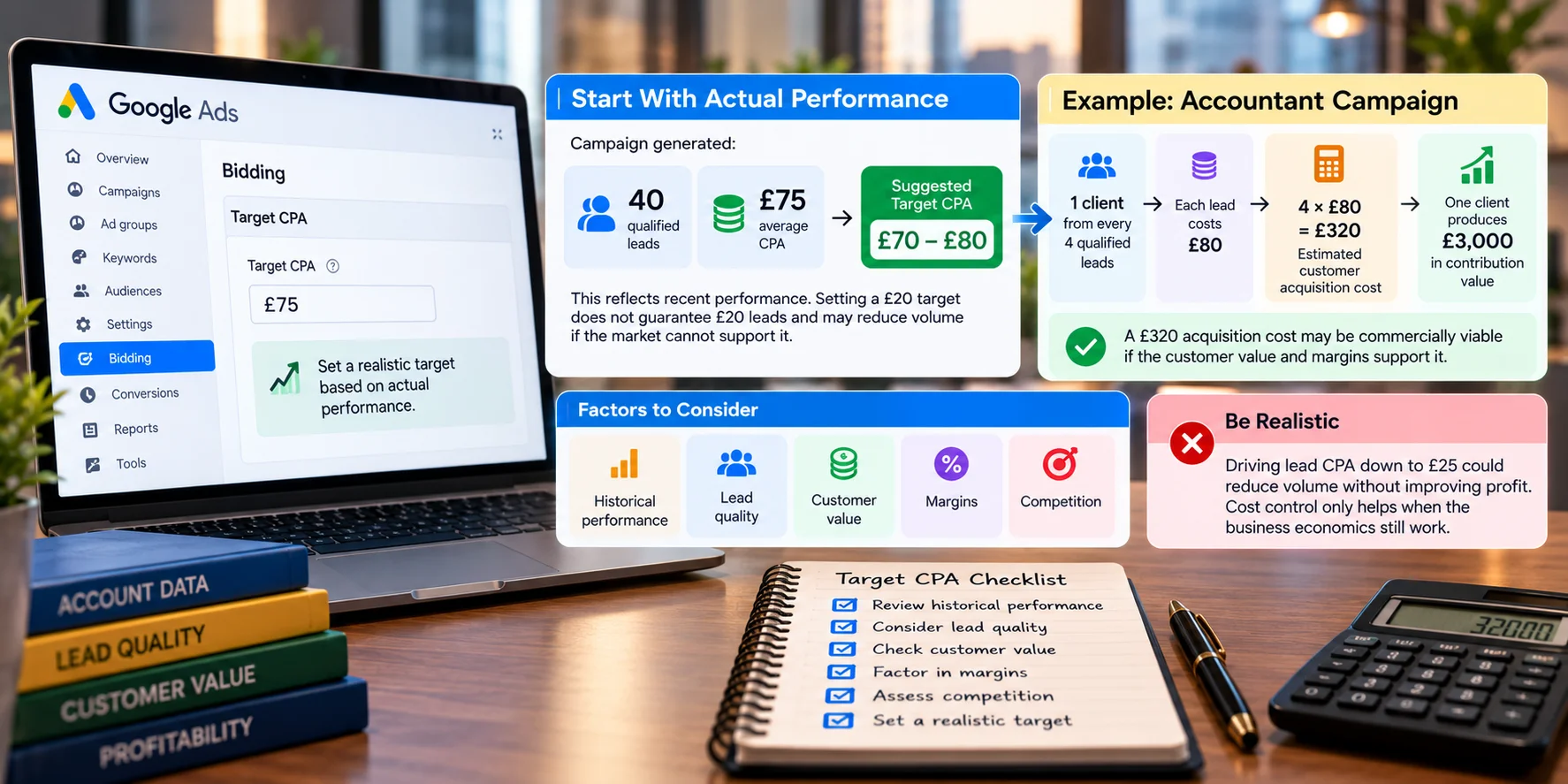
Start with actual account performance.
Suppose a campaign generated:
40 qualified leads at an average CPA of £75.
A target near £70–£80 may reflect recent reality.
Setting a £20 target does not magically create £20 leads.
If the market cannot support the target, conversion volume may fall sharply.
A realistic CPA should reflect:
- historical performance;
- lead quality;
- customer value;
- margins;
- competition.
Target CPA Example
Imagine an accountant closes one client from every four qualified leads.
Each lead costs £80.
Estimated customer acquisition cost:
4 × £80 = £320
If one client produces £3,000 in contribution value, that may be commercially viable.
Driving lead CPA down to £25 could reduce volume without improving profit.
Cost control only helps when the business economics still work.
Maximise Conversion Value
Not every conversion has the same value.
Imagine an ecommerce store receives orders worth:
- £40;
- £300;
- £1,500.
Maximise Conversions focuses mainly on conversion volume.
Maximise Conversion Value uses the values attached to those conversions.
Google explains this in its value-based bidding guidance.
This can matter for lead generation too.
A £20,000 commercial project is not equal to a £150 repair.
If reliable values can be passed back into Google Ads, automation receives a more useful signal.
Maximise Conversion Value Example
Suppose two campaigns each generate ten conversions.
Campaign A creates:
£5,000 total conversion value
Campaign B creates:
£20,000
A conversion-count strategy sees ten versus ten.
Value-based Google Ads Bidding Strategies see a major difference.
But inaccurate values can mislead the system.
Do not assign random lead values just to make value-based bidding possible.
Target ROAS
Target ROAS aims for a chosen average return on advertising spend.
For example:
500% ROAS
means aiming for roughly £5 in conversion value for every £1 spent.
It does not mean every individual sale must achieve exactly 500%.
The target applies across performance.
Target ROAS Needs Reliable Value Data
Target ROAS is only as useful as the values feeding it.
Ecommerce revenue can provide strong signals.
Lead generation is harder.
One enquiry may never become a customer.
Another may become a £20,000 contract.
If both carry the same value, Google cannot distinguish them properly.
CRM and offline sales data can become important for mature lead-generation campaigns.
Do You Need 30 or 50 Conversions for Target ROAS?
Do not treat one online threshold as universal.
More recent, high-quality data usually helps.
But quality still matters.
Thirty poor conversions are not automatically more useful than fifteen commercially valuable ones.
Target Impression Share
Target Impression Share focuses on visibility.
Google can aim to show ads:
- anywhere on the results page;
- among top ads;
- in the first top-ad position.
Google explains the strategy in its Target Impression Share guidance.
This can make sense for certain brand or visibility goals.
Do Not Use Target Impression Share Everywhere
Imagine a plumber wants more emergency jobs.
Target Impression Share may increase visibility.
But it optimises for visibility, not qualified enquiries.
Higher visibility does not guarantee more profitable customers.
Use it when visibility itself is genuinely the goal.
Smart Bidding Is Not Set and Forget
Automated Google Ads Bidding Strategies still need active management.
Continue reviewing:
- search terms;
- conversions;
- lead quality;
- budgets;
- landing pages;
- locations;
- campaign structure.
Google can choose auction bids.
You still need to decide whether the campaign is commercially successful.
What Smart Bidding Uses
Smart Bidding can use auction-time signals such as:
- device;
- location;
- time;
- browser;
- search context;
- predicted conversion likelihood.
That gives automation more flexibility than manual bid adjustments.
But better bid calculations cannot fix poor goals.
If Google is optimising towards weak conversions, it may simply find more weak conversions.
Google Ads Bidding Strategies Readiness Checklist
Before using conversion-focused automation, check:
1. Tracking Works
Test forms, calls, purchases and bookings.
2. Primary Conversions Matter
A real enquiry should carry more importance than a page view.
3. Data Is Recent
Old performance may no longer reflect current conditions.
4. Conversion Activity Is Useful
There is no magic threshold, but regular verified conversions provide stronger evidence.
5. Lead Quality Is Acceptable
Spam and poor enquiries create bad training data.
6. CPA or ROAS Targets Are Realistic
Base targets on actual performance.
7. Budget Fits the Market
A £10 daily budget in a £15 CPC market creates obvious limits.
8. Search Terms Are Controlled
Automation does not replace query management.
9. Landing Pages Convert
Better bidding cannot rescue weak landing pages.
10. The Business Can Handle More Leads
More demand only helps if the business can respond.
If several areas need work, fix them before relying more heavily on automation.
Data Quality Matters More Than a Magic Number
Businesses often ask:
How many conversions do I need before Smart Bidding?
A better question is:
What kind of conversions do I have?
Imagine Account A records 50 conversions:
- 30 spam leads;
- 10 weak button clicks;
- 10 genuine leads.
Account B records 25 conversions, all qualified enquiries.
The raw count favours Account A.
The useful data favours Account B.
This is why Google Ads Bidding Strategies should be chosen using data quality, not conversion count alone.
Maximise Clicks vs Maximise Conversions
Use Maximise Clicks when:
- traffic is the goal;
- early search data is needed;
- conversion tracking is not yet reliable.
Use Maximise Conversions when:
- tracking is trustworthy;
- the campaign goal is clear;
- you want conversions rather than traffic.
The transition should be deliberate.
Maximise Conversions vs Target CPA
Maximise Conversions can suit accounts with reliable tracking but no clear CPA target yet.
Target CPA becomes more useful once normal acquisition costs are understood.
If qualified leads usually cost £70–£90, a target near that range may be sensible.
Demanding £30 leads in an £80 market may simply reduce volume.
Maximise Conversions vs Maximise Conversion Value
Use Maximise Conversions when conversion volume is the main goal.
Use Maximise Conversion Value when conversions differ meaningfully in financial value.
For example, a contractor may receive:
- small repairs;
- renovations;
- commercial projects.
Treating all three as equal hides commercial differences.
Target CPA vs Target ROAS
Target CPA focuses on acquisition cost.
Target ROAS focuses on conversion value relative to ad spend.
Target CPA often suits lead-generation campaigns where realistic acquisition costs are known.
Target ROAS becomes more useful when reliable value data exists.
Google Ads Bidding Strategies and Match Types
Bidding and keyword matching work together.
Broad match can expose the campaign to more searches.
Smart Bidding can then decide which auctions appear more likely to convert.
That combination can work when:
- tracking is accurate;
- search terms are controlled;
- lead quality is strong.
Wider matching plus poor conversion data can create expensive mistakes.
Google Ads Bidding Strategies and Negative Keywords
Automated bidding does not remove the need for negative keywords.
Jobs, courses, DIY queries and other irrelevant intent can still waste budget.
Automation decides bids.
It does not mean every search should be allowed.
Google Ads Bidding Strategies and Campaign Structure
Campaign structure affects bidding control.
Imagine one campaign contains:
- emergency plumbing;
- bathroom installation;
- commercial heating;
- boiler servicing.
These services may have different CPCs, margins and lead values.
One bidding strategy may struggle when unrelated services are mixed together.
Our guide on how to structure Google Ads Search campaigns explains this in more detail.
Google Ads Bidding Strategies and Performance Max
Performance Max depends heavily on automation and conversion signals.
The same principle applies:
weak inputs create weak bidding decisions.
Poor conversion tracking creates weak signals.
Poor conversion values make value-based bidding less useful.
For service businesses, our Performance Max for Service Businesses guide explains when greater control may still be needed.
Do Not Change Bidding Strategies Constantly
Frequent changes make performance harder to understand.
For example:
Manual CPC → Maximise Clicks → Maximise Conversions → Target CPA
within a short period creates too many moving parts.
Make deliberate changes.
Record:
- what changed;
- when;
- why;
- what happened afterwards.
Then judge the commercial result.

Do Not Judge Google Ads Bidding Strategies by CPC Alone
A higher CPC can still produce better results.
Strategy A
- CPC: £4
- Conversion rate: 2%
- CPA: £200
Strategy B
- CPC: £8
- Conversion rate: 8%
- CPA: £100
Strategy B pays twice as much per click.
Its conversion cost is half as high.
CPC is only one part of the picture.
Do Not Judge by CPA Alone
CPA can also hide poor lead quality.
Campaign A produces leads at £50.
Only 5% become customers.
Campaign B produces leads at £90.
Thirty per cent become customers.
Campaign B may create cheaper customers despite the higher lead CPA.
Connect bidding decisions with sales data.
Example: London Locksmith
Imagine a locksmith launches a campaign with little conversion history.
Initially, the business may use tighter keywords and traffic-focused bidding while form and call tracking are tested.
After several weeks:
- conversion tracking works;
- search terms are controlled;
- qualified-lead costs are understood.
At that point, Maximise Conversions or a realistic Target CPA may make more sense.
The sequence matters.
Example: London Accountant
An accountancy firm has been advertising for nine months.
It receives regular enquiries, but every form submission is treated equally.
One type of enquiry may be worth £500.
Another may create a client worth several thousand pounds.
Before moving towards value-based Google Ads Bidding Strategies, the business should improve conversion-value data.
Better bidding starts with better information.
Example: Ecommerce
An ecommerce store tracks purchase revenue accurately.
Products range from £20 to £1,000.
Maximise Conversions may favour transaction volume.
Maximise Conversion Value considers the difference in order value.
Target ROAS can then introduce a return objective once the business understands what level of return it needs.
The bidding strategy should follow the economics.
Which Strategy Should a New Campaign Use?
There is no universal answer.
If reliable conversion tracking does not exist, conversion-focused automation has weak information.
Manual CPC or Maximise Clicks may help during early testing.
If a mature account already has strong conversion data, automation may be useful sooner.
Campaign age alone should not decide the strategy.
Best Google Ads Bidding Strategies for Lead Generation
For mature lead-generation campaigns, common options include:
- Maximise Conversions;
- Target CPA;
- Maximise Conversion Value;
- Target ROAS where reliable values exist.
Manual CPC or Maximise Clicks can still help during testing or diagnosis.
The correct choice depends on data quality and commercial goals.
Best Bidding Strategies for Ecommerce
Ecommerce campaigns often have stronger transaction-value data.
That can make:
- Maximise Conversion Value;
- Target ROAS
especially useful.
But accurate order values still matter.
Revenue is not always the same as profit, so wider business economics should still be considered.
Best Strategy for Brand Campaigns
Target Impression Share can make sense when visibility on branded searches matters.
But do not chase 100% absolute-top visibility at any cost.
Competitor activity, CPC and incremental value still matter.
Simple Google Ads Bidding Strategies Decision Tree
Use this as a starting point.
Main goal is traffic?
Consider Maximise Clicks or Manual CPC.
Main goal is conversions?
Check tracking, then consider Maximise Conversions.
Know a realistic acquisition target?
Target CPA may fit.
Conversions have different reliable values?
Consider Maximise Conversion Value.
Have reliable value data and a return target?
Target ROAS may fit.
Visibility itself is the goal?
Consider Target Impression Share.
Then check whether the account is actually ready.
What to Check After Changing Strategy
Do not judge a bidding change from the first day.
Monitor:
- spend;
- conversion volume;
- qualified leads;
- CPA;
- conversion value;
- ROAS;
- search-term quality;
- sales.
Also check whether the campaign starts using more or less of the available budget.
Judge commercial impact, not platform status alone.
How Wixdek Approaches Google Ads Bidding Strategies
At Wixdek, we choose Google Ads Bidding Strategies after reviewing the campaign goal, conversion setup and business economics.
Automation should not be enabled simply because it sounds more advanced.
Google needs a clear definition of valuable performance.
For lead generation, that means trustworthy enquiries.
For ecommerce, it may mean accurate conversion value.
For brand campaigns, it may mean controlled visibility.
The strategy should follow the business objective.
Need Help Choosing Google Ads Bidding Strategies?
If campaigns keep moving between Manual CPC, Maximise Clicks, Maximise Conversions and Target CPA without a clear reason, bidding may not be the real problem.
Tracking, search intent, campaign structure, budget or lead quality may need attention first.
Wixdek’s PPC agency in London service reviews Google Ads Bidding Strategies as part of the wider campaign.
The aim is not to use the most advanced option.
It is to choose the strategy most likely to produce useful business.
Frequently Asked Questions
What Are Google Ads Bidding Strategies?
Google Ads Bidding Strategies control how bids are set when ads enter auctions.
Different strategies optimise towards clicks, conversions, conversion value or visibility.
What Is Smart Bidding?
Smart Bidding is Google’s group of conversion-focused automated strategies, including Maximise Conversions, Target CPA, Maximise Conversion Value and Target ROAS.
Is Maximise Clicks a Smart Bidding Strategy?
No.
Maximise Clicks is automated bidding, but it is not part of Google’s conversion-focused Smart Bidding group.
When Should I Use Maximise Clicks?
Use it when traffic or early search data is the main goal.
It does not optimise directly for qualified leads.
When Should I Use Maximise Conversions?
Consider it when conversion tracking is reliable and the goal is to generate more useful conversions from the available budget.
When Should I Use Target CPA?
Target CPA can make sense when tracking is reliable and you understand a realistic acquisition-cost range.
Do I Need 30 Conversions Before Target CPA?
No universal rule requires exactly 30 conversions.
Quality, recency and reliability matter alongside volume.
What Is Maximise Conversion Value?
It aims to maximise the total value generated by conversions rather than simply increasing conversion count.
What Is Target ROAS?
Target ROAS aims for an average return on advertising spend using conversion-value data.
When Should I Use Target Impression Share?
Use it when visibility is the main campaign objective, such as certain brand campaigns.
Is Manual CPC Still Useful?
Yes, in some testing or diagnostic situations.
However, it cannot use auction-time signals as extensively as automated bidding.
Should I Change Google Ads Bidding Strategies After a Few Bad Days?
Not automatically.
Check tracking, search terms, budget, competition and recent account changes first.
Which Google Ads Bidding Strategy Is Best?
There is no universal winner.
Choose based on your campaign goal, data quality, conversion value, budget and account maturity.
By Wixdek